-
Use Cases
-
Resources
-
Pricing
The Battle of the Alamo was a pivotal event in the Texas Revolution, fought from February 23 to March 6, 1836, in San Antonio de Béxar. A Mexican army under General Antonio López de Santa Anna besieged the Alamo Mission, defended by roughly 180-260 Texian and Tejano fighters, including famous figures such as William B. Travis, Jim Bowie, and Davy Crockett. After 13 days of siege, Mexican forces stormed the mission, killing nearly all the defenders. Although a Mexican victory, the battle became a rallying cry — 'Remember the Alamo!' — that inspired Texian forces to defeat Santa Anna at the Battle of San Jacinto weeks later, securing Texas independence. More Less
Oct 4, 1824
% complete
The federalist 1824 Constitution of Mexico established the First Mexican Republic, distributing power among states. Its later repeal would become a major grievance for Texian settlers, who had supported the federalist system that granted regional autonomy.
Image source: 1824 Constitution of Mexico
1830
% complete
Mexico tried to end Anglo American immigration in 1830, but the number of immigrants doubled by 1834, growing from 10,000 to 21,000. The influx of settlers from the United States increasingly worried the Mexican government about its control over Texas.
Image source: Battle of the Alamo
Jan 1, 1835 - Dec 31, 1835
% complete
As the Texians struggled to find men and supplies, Santa Anna continued to gather men at San Luis Potosí; by the end of 1835, his army numbered 6,019 soldiers, preparing for a campaign to suppress the Texian revolt.
Image source: Antonio López de Santa Anna
Dec 30, 1835
% complete
In 1835, following the repeal of the federalist 1824 Constitution, Mexico adopted Las Siete Leyes ("The Seven Laws"), a new constitutional framework that replaced the First Mexican Republic with a unitary republic officially named the Mexican Republic. This centralization of power fueled rebellion in Texas.
Image source: Siete Leyes
Dec 30, 1835
% complete
Approved by the Mexican congress and issued on December 30, 1835, the decree defined irregular invaders as pirates, "being citizens of no nation presently at war with the republic, and fighting under no recognized flag." In this historical period, captured pirates were executed immediately, meaning Alamo defenders could expect no mercy.
Image source: José María Tornel
1836
% complete
Some immigrants had brought large numbers of slaves with them, so that by 1836 there were approximately 5,000 enslaved persons in a total non-native population estimated at 38,470. Historian Randolph Campbell later argued that many writers minimized slavery's role in Texas history.
Image source: History of slavery in Texas
Jan 6, 1836
% complete
The fact remains that the Texian garrison was undermanned and underprovisioned, with fewer than 100 soldiers remaining by January 6, 1836. Efforts to secure reinforcements and supplies largely failed as the Mexican army advanced northward.
Feb 23, 1836
% complete
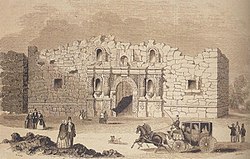
On February 23, 1836, Santa Anna's forces arrived at San Antonio de Béxar and began a siege of the Alamo mission, where roughly 200 Texian defenders under William B. Travis, James Bowie, and Davy Crockett prepared to make their stand.
Mar 1, 1836
% complete
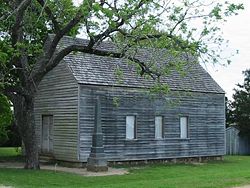
During the siege, newly elected delegates from across Texas met at the Convention of 1836 at Washington-on-the-Brazos, where they declared independence from Mexico and formed a new government while the Alamo defenders fought on.
Image source: Convention of 1836
Mar 6, 1836
% complete
The Battle of the Alamo (February 23 – March 6, 1836) was a pivotal event and military engagement in the Texas Revolution. On March 6, Mexican troops stormed the walls in a pre-dawn assault, killing nearly all of the Texian defenders after a thirteen-day siege.
Mar 6, 1836
% complete
Guerrero, who had deserted from the Mexican Army in December 1835, was spared after convincing the soldiers he was a Texian prisoner, one of the few lives saved during the final assault on the Alamo.
Apr 21, 1836
% complete
The Texians defeated the portion of the Mexican Army led by Santa Anna at the Battle of San Jacinto, on April 21, 1836. The stunning victory, achieved in less than twenty minutes, secured Texas independence and avenged the fall of the Alamo.
Image source: Battle of San Jacinto
Feb 1837
% complete
The ashes were left where they fell until February 1837, when Juan Seguín returned to Béxar to examine the remains of the Alamo defenders and give them a formal burial.
Image source: Juan Seguín
Mar 28, 1837
% complete
According to a March 28, 1837, article in the Telegraph and Texas Register, Seguín buried the coffin containing the defenders' remains under a peach tree grove near the Alamo.
Image source: Telegraph and Texas Register
1846 - 1848
% complete
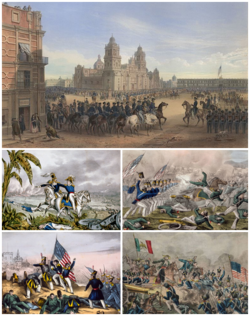
In Mexico, the battle has often been overshadowed by events from the Mexican–American War of 1846–1848. In Mexican history, the Texas campaign, including the Battle of the Alamo, was soon eclipsed by this larger conflict with the United States.
Image source: Mexican–American War
1883
% complete
The Alamo church, which had been purchased by the state in 1883, was designated an official Texas State Shrine, preserving the iconic building as a memorial to the battle's defenders.
1900 - 1930
% complete
The Texas Legislature purchased land and the long barracks building (the former convento) in the early part of the 20th century, expanding the preserved historic site beyond just the church.
1905
% complete
In the early 20th century the Texas Legislature purchased the property and appointed the Daughters of the Republic of Texas as permanent caretakers of what is now an official state shrine.
Image source: Daughters of the Republic of Texas
Jul 1936
% complete
In July 1936 a coffin was discovered buried in the location described by Seguín, but according to historian Wallace Chariton, it is unlikely to actually contain the remains of the Alamo defenders.
Jun 26, 2014
% complete
In 2014 Collins donated his entire collection of Alamo artifacts to the Alamo via the State of Texas, one of the largest private collections of Alamo memorabilia ever assembled.
Image source: Phil Collins
2023
% complete
As of 2023, the Alamo Trust (which operates the site) seeks to expand the property to build an Alamo museum, continuing efforts to preserve and interpret the historic battlefield.
1843
% complete
The Alamo has been the subject of numerous non-fiction works, the first of which were produced in 1843, beginning a long tradition of writing about the famous siege and battle.
1878
% complete
The next major treatment of the battle was Reuben Potter's The Fall of the Alamo, published in The Magazine of American History in 1878, an influential early account of the siege.
1911
% complete
The first film version of the battle appeared in 1911, when Gaston Méliès directed The Immortal Alamo, launching a long cinematic tradition of depicting the famous siege.
Image source: The Immortal Alamo
1948
% complete
The first full-length, non-fiction book covering the battle, John Myers Myers' The Alamo, was published in 1948, setting the stage for decades of popular histories of the siege.
1954 - 1955
% complete
Most Americans are more familiar with the myths and legends spread by movie and television adaptations, including the 1950s Disney miniseries Davy Crockett, which cemented Crockett's heroic image in popular culture.
Image source: Davy Crockett (miniseries)
1960
% complete
Within several years, John Wayne directed and starred in one of the best-known, though inaccurate, film versions, 1960's The Alamo, which shaped how generations of Americans imagined the battle.
Image source: The Alamo (1960 film)
1960
% complete
Marty Robbins recorded a version of the song "The Ballad of the Alamo" in 1960 which spent 13 weeks on the pop charts, bringing the story of the battle to a wide music audience.
1966
% complete
The battle also featured in episode 13 of The Time Tunnel, "The Alamo", first aired in 1966, transporting its time-traveling heroes into the famous siege.
Image source: The Time Tunnel
1972
% complete
British hard rock band Babe Ruth's 1972 song "The Mexican" pictures the conflict through the eyes of a Mexican soldier, offering a rare perspective shift in Alamo-themed art.
1989
% complete
Campbell, author of the first book-length study of slavery in Texas in 1989, says slavery was minimized within Texas by "many historians, writers, and creators of popular culture" who "preferred to see Texas as essentially western rather than southern."
Apr 9, 2004
% complete
Another film also called The Alamo was released in 2004, retelling the story of the siege for a new generation of audiences.
Image source: The Alamo (2004 film)
2016
% complete
The battle featured in episode 5 of season one of the TV series Timeless, aired 2016, continuing the battle's presence in television storytelling.
Image source: Timeless (TV series)
Or browse the full history timeline directory, with more than 2,000 topics.
This Battle of the Alamo timeline was generated with the help of AI, using information found on the internet.
We work hard to keep these timelines accurate, but mistakes do get through. If you spot one, email us at [email protected] and we'll fix it for future visitors.
Generate yours with AI or build it from scratch, for free.
Export your timeline, add your own events, edit or remove AI-generated events, and much more
No credit card required.
Cancel anytime.
Cancel anytime.
You can create an unlimited number of timelines with up to 10 events on each one, customize how they look, export them to PDF, PNG, PowerPoint, CSV, and Excel, and share them with a link. Paid plans raise the event limit and add features like spreadsheet imports and collaborators.
Yes. You can cancel your subscription from your account page at any time, and you will not be charged again. Your subscription stays active for the rest of the period you already paid for.
Yes. We will email you a reminder before the annual renewal, and we will also email you a receipt.
Yes. You can email us within 15 days of any payment, and we will issue you a full refund.
Check out our pricing docs or send us an email anytime: [email protected].