-
Use Cases
-
Resources
-
Pricing
The Battle of the Bulge was the largest and bloodiest single battle fought by the United States in World War II. Launched by Adolf Hitler through the densely forested Ardennes region of Belgium, France, and Luxembourg, the surprise German offensive aimed to split Allied forces and capture the vital port of Antwerp. Despite initial German advances creating a 'bulge' in Allied lines, American forces held key positions such as Bastogne and ultimately repelled the offensive. More Less
Jan 1, 1944 - Dec 15, 1944
% complete
The Allied air offensive of early 1944 had grounded the Luftwaffe, leaving the German Army with little battlefield intelligence and no way to interdict Allied supplies heading toward the front.
Image source: Battle of the Bulge
Jul 25, 1944
% complete
After the breakout from Normandy at the end of July 1944, the Allies advanced towards Germany more quickly than anticipated, setting the stage for the logistical strains that would shape the winter campaign.
Image source: Operation Cobra
Aug 15, 1944
% complete
The Allied landings in southern France on 15 August 1944 complemented the Normandy breakout and accelerated the Allied advance towards Germany more quickly than anticipated.
Image source: Operation Dragoon
Aug 20, 1944
% complete
Germany's fuel shortage intensified after the Red Army overran the Romanian oil fields in the course of its Second Jassy–Kishinev Offensive in August 1944, severely constraining German offensive plans.
Image source: Second Jassy–Kishinev offensive
Sep 6, 1944
% complete
SS-Brigadeführer Kurt Meyer, commander of the 12th SS Panzer Division, was captured by Belgian partisans on 6 September 1944, one of several high-ranking German officers lost to Allied action.
Image source: Kurt Meyer
Sep 15, 1944 - Sep 30, 1944
% complete
The OKW decided by mid-September, at Hitler's insistence, that the offensive would be mounted in the Ardennes, mirroring the successful German advance there during the Battle of France in 1940.
Sep 16, 1944
% complete
Adolf Hitler first outlined his planned counter-offensive to his generals on 16 September 1944, envisioning a Blitzkrieg attack through the Ardennes aimed at splitting the U.S.-British lines and capturing Antwerp.
Oct 1, 1944 - Dec 15, 1944
% complete
Field Marshals Model and von Rundstedt both believed aiming for Antwerp was too ambitious given Germany's scarce resources in late 1944, but Hitler pressed ahead with his plan regardless.
Nov 1, 1944 - Nov 30, 1944
% complete
One of the few advantages held by the German forces in November 1944 was that they were no longer defending all of Western Europe, allowing them to concentrate forces for a counter-offensive. However, German forces still held several major Channel ports into the autumn, while Dunkirk remained under siege until May 1945.
Nov 20, 1944
% complete
After the 20 July 1944 assassination attempt and the Red Army's approach, which would seize the site on 27 January 1945, Hitler and his staff were forced to abandon the Wolfsschanze headquarters in East Prussia. Believing in omens, he chose Kransberg, from which he had overseen the successful 1940 campaign against France and the Low Countries.
Image source: Wolf's Lair
Dec 8, 1944
% complete
O'Donnell writes that on 8 December 1944 U.S. intelligence produced material that later showed the failure of intelligence at SHAEF and at the Air Ministry regarding German intentions.
Dec 16, 1944 - Jan 25, 1945
% complete
The German High Command estimated losses between 81,834 and 98,024 men on the Western Front between 16 December 1944 and 25 January 1945; the accepted figure was 81,834, including 12,652 killed, 38,600 wounded, and 30,582 missing. Dupuy's estimates suggest 74,459 casualties among divisions and brigades alone through 16 January 1945.
Dec 16, 1944 - Jan 16, 1945
% complete
Casualties among American divisions totaled 62,439 from 16 December 1944 to 16 January 1945: 6,238 killed, 32,712 wounded, and 23,399 missing. A preliminary Army report listed 75,482 casualties for the First and Third US Armies, while British XXX Corps losses to 17 January 1945 were recorded as 1,408.
Jan 7, 1945 - Jan 8, 1945
% complete
On 7/8 January 1945, Hitler agreed to gradually withdraw forces from the tip of the Ardennes salient to east of Houffalize to avoid being cut off, though the Germans continued to resist and were only gradually pushed back.
Jan 17, 1945
% complete
On 17 January 1945, command arrangements within the U.S. 12th Army Group shifted as the battle concluded, with further changes following on 4 April 1945 as the Allies prepared for the final drive into Germany.
Image source: Twelfth United States Army Group
Jan 18, 1945
% complete
On 18 January 1945, Churchill stated to Parliament that 'the United States troops have done almost all the fighting', acknowledging the predominantly American sacrifice in the Ardennes battle.
Jan 25, 1945
% complete
The Battle of the Bulge ended on 25 January 1945, with the front lines pushed back roughly to where they had been before the German offensive began, at enormous cost to both sides.
Jan 29, 1945
% complete
The High Command of the Allied forces had planned to resume the offensive by early January 1945 after the wet season rains and severe frosts, but those plans had to be postponed until 29 January 1945 due to unexpected changes in the front.
Image source: Western Front (World War II)
Feb 1, 1945
% complete
By the beginning of February 1945, the lines were roughly where they had been in December 1944, meaning the German offensive had gained no lasting territorial objectives despite heavy losses.
Dec 16, 1944 - Dec 28, 1944
% complete
Otto Skorzeny led Operation Greif, a false-flag operation using English-speaking Germans in captured American uniforms to sow confusion behind Allied lines during the Ardennes offensive. He was later tried at the Dachau Trials in 1947 but acquitted.
Image source: Operation Greif
Dec 16, 1944 - Jan 25, 1945
% complete
The Battle of the Bulge, also known as the Ardennes Offensive or Unternehmen Wacht am Rhein, was an offensive campaign on the Western Front taking place from 16 December 1944 to 25 January 1945. The Germans achieved total surprise due to Allied overconfidence, faulty intelligence, bad weather limiting aerial reconnaissance, and preoccupation with offensives elsewhere.
Dec 16, 1944
% complete
On 16 December 1944 at 05:30, the Germans began the assault with a massive 90-minute artillery barrage using 1,600 artillery pieces across a 130-kilometer (80 mi) front on the Allied troops facing the 6th Panzer Army.
Dec 17, 1944
% complete
By 17 December 1944, German forces under Colonel Joachim Peiper had seized a U.S. supply depot, providing desperately needed fuel for the panzer spearheads racing westward.
Image source: Joachim Peiper
Dec 17, 1944
% complete
Another, smaller massacre was committed in Wereth, Belgium, approximately 6.5 miles (10.5 km) northeast of Saint-Vith on 17 December 1944, where eleven African American soldiers of the 333rd Field Artillery Battalion were murdered after surrendering.
Image source: 333rd Field Artillery Battalion (United States)
Dec 17, 1944
% complete
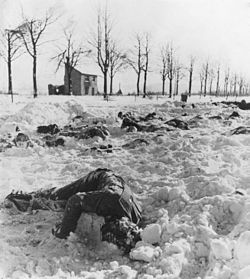
During the opening days of the offensive, German forces under Peiper murdered American prisoners of war near Malmedy on 17 December 1944, an atrocity that hardened American resistance for the rest of the battle.
Image source: Malmedy massacre
Dec 17, 1944
% complete
On 17 December 1944, the 1st SS Panzer Division was approximately 16 hours behind schedule when its convoys departed the village of Lanzerath en route west to the town of Honsfeld, delaying the entire German timetable.
Image source: 1st SS Panzer Division Leibstandarte SS Adolf Hitler
Dec 18, 1944
% complete
Peiper's forces took 36 hours to advance from the Eifel region to Stavelot, while the same advance had required only nine hours in 1940, illustrating how much slower the 1944 offensive progressed through stiffening resistance and congested roads.
Dec 20, 1944 - Dec 27, 1944
% complete
The battle around Bastogne received a great deal of media attention because in early December 1944 it was a rest and recreation area for many war correspondents, who covered the encircled town's defense extensively.
Image source: Siege of Bastogne
Dec 24, 1944
% complete
On 24 December 1944, the U.S. 2nd Armored Division engaged and blunted the German spearhead near Celles, marking a decisive check on the westernmost point of the German advance.
Image source: 2nd Armored Division (United States)
Dec 28, 1944
% complete
Five copies of a report by the Chief of the Secret Intelligence Service – Indications of the German Offensive of December 1944, derived from ULTRA material, were issued on 28 December 1944. Rose, head Air Adviser in Hut 3, described it as 'an extremely good report' showing the failure of intelligence at SHAEF and the Air Ministry.
Image source: MI6
Jan 1, 1945
% complete
After receiving news of the Malmedy massacre, during the counteroffensive at the southern shoulder on New Year's Day 1945, American soldiers of the inexperienced 11th Armored Division executed approximately sixty German prisoners of war near the Belgian village of Chenogne, 8 km from Bastogne.
Image source: Chenogne massacre
Or browse the full history timeline directory, with more than 2,000 topics.
This Battle of the Bulge timeline was generated with the help of AI, using information found on the internet.
We work hard to keep these timelines accurate, but mistakes do get through. If you spot one, email us at [email protected] and we'll fix it for future visitors.
Generate yours with AI or build it from scratch, for free.
Export your timeline, add your own events, edit or remove AI-generated events, and much more
No credit card required.
Cancel anytime.
Cancel anytime.
You can create an unlimited number of timelines with up to 10 events on each one, customize how they look, export them to PDF, PNG, PowerPoint, CSV, and Excel, and share them with a link. Paid plans raise the event limit and add features like spreadsheet imports and collaborators.
Yes. You can cancel your subscription from your account page at any time, and you will not be charged again. Your subscription stays active for the rest of the period you already paid for.
Yes. We will email you a reminder before the annual renewal, and we will also email you a receipt.
Yes. You can email us within 15 days of any payment, and we will issue you a full refund.
Check out our pricing docs or send us an email anytime: [email protected].