-
Use Cases
-
Resources
-
Pricing
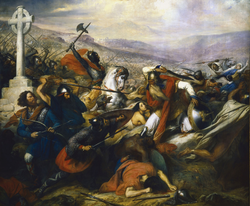
The Battle of Tours (also called the Battle of Poitiers) was fought in October 732 AD between Frankish forces led by Charles Martel and an invading Umayyad army under Abdul Rahman Al-Ghafiqi. The Frankish victory halted the northward advance of Muslim forces into Western Europe and cemented Martel's power, laying foundations for Carolingian rule. More Less
660 - 700
% complete
Through the late 7th century, Muslim armies pushed east across Persia and west across North Africa, expanding the frontiers of the Islamic world and setting the stage for later campaigns into Europe.
661 - 750
% complete
Stretching from Morocco to China, the Umayyad caliphate based its expansion and success on the doctrine of jihad – armed struggle to claim the whole earth for God's rule, a struggle that brought much material success for a century.
Image source: Umayyad Caliphate
750
% complete
After a century of material success driven by the doctrine of jihad, Umayyad expansion suddenly ground to a halt followed by the collapse of the ruling Umayyad dynasty in 750 AD.
Image source: Abbasid Revolution
700 - 900
% complete
The Latin sources of the eighth and ninth centuries are more numerous but remain imprecise, making it difficult to establish exact details such as army sizes and casualties at the Battle of Tours.
750
% complete
The Vita Pardulfi, written in the middle of the eighth century, reports that after the battle 'Abd-al-Raḥmân's forces burned and looted their way through the Limousin region on their way back to Al-Andalus, implying they were not destroyed to the extent imagined in the Continuations of Fredegar.
Image source: Battle of Tours
750
% complete
The continuators of Fredegar's chronicle, who probably wrote in the mid-eighth century, pictured the battle as just one of many military encounters between Christians and Saracens – moreover, as only one in a series of wars fought by Frankish princes for booty and territory.
Image source: Chronicle of Fredegar
754
% complete
The Mozarabic Chronicle of 754 is a Latin source that contradicts the common assertion that the Franks were outnumbered at the onset of battle by at least two to one, showing early accounts were imprecise on details like army sizes.
Image source: Chronicle of 754
785
% complete
Writing around 785, Paul the Deacon reported correctly that the Liber Pontificalis mentioned casualty figures in relation to Odo's victory at Toulouse, though he claimed Charles Martel fought in the battle alongside Odo.
Image source: History of the Lombards
800 - 900
% complete
Ninth-century chroniclers recorded the outcome of the battle as a divine judgment in favor of Charles and gave him the nickname Martellus ('The Hammer').
800 - 900
% complete
In the following centuries, chroniclers of the ninth century gave Charles the nickname of Martel (the hammer), but without attributing it to a single battle, as he had many victories under his belt.
Image source: Charles Martel
800 - 900
% complete
Later writers, probably influenced by the Continuations of Fredegar, attributed the Muslims' casualties solely to Charles Martel, and the battle in which they fell became unequivocally that of Tours-Poitiers.
701
% complete
Historians have described the commencement of the eighth century as one of the most important epochs in the history of the world, when on the one side Mohammedanism threatened to overspread Italy and Gaul, and on the other the ancient idolatry of Saxony and Friesland once more forced its way across the Rhine.
1800 - 1900
% complete
Later Christian chroniclers and pre-20th century historians praised Charles Martel as the champion of Christianity, characterizing the battle as the decisive turning point in the struggle against Islam, a struggle which preserved Christianity as the religion of Europe.
1851
% complete
In his famous 1851 book, Edward Shepherd Creasy listed decisive battles including the confrontation between Muslims and Christians at Poitiers-Tours in 732, which was once considered a watershed event.
Image source: The Fifteen Decisive Battles of the World
1874
% complete
Writing in 1874, Mary Elsie Thalheimer described the Muslims' purpose: after conquering France and Germany, to follow the Danube to its mouth, overturn the Greek empire, and thus surround the Mediterranean Sea with one great Moslem dominion.
1999
% complete
Writing in 1999, Paul K. Davis contributed to modern reassessment of the Battle of Tours, part of a broader trend of historians reevaluating its once-celebrated status as a decisive turning point in world history.
2000
% complete
Modern historians have downgraded several battles once considered decisive, noting that the confrontation between Muslims and Christians at Poitiers-Tours in 732, once considered a watershed event, has been downgraded to a raid in force.
721
% complete
Duke Odo of Aquitaine won a victory over Muslim forces at Toulouse. The Liber Pontificalis mentioned casualty figures in relation to this victory, figures later writers would misattribute to Charles Martel at Tours-Poitiers.
Image source: Battle of Toulouse (721)
Oct 10, 732
% complete
Charles Martel led Frankish forces against an invading Umayyad army under 'Abd-al-Raḥmân near Tours-Poitiers. The battle helped lay the foundations of the Carolingian Empire and Frankish domination of western Europe for the next century.
1900 - 1927
% complete
John Bagnell Bury, writing at the beginning of the 20th century, said of the Battle of Tours that it marked a moment when Mohammedanism threatened to overspread Italy and Gaul, reflecting earlier views of its world-historical significance.
1942
% complete
Speer himself noted that when others took down notes of Hitler speaking privately for the table talks, Hitler's expression, even after 1942, of his desire to unite the Christian churches into a single established church 'as in England' was left out.
Image source: Hitler's Table Talk
Dec 1942
% complete
Hitler compared Islam to Communism – and Christian Europe's wars against Islamic empires to his war against the Soviet Union – on numerous occasions beginning in December 1942, referring to Islam as the empowering ideology of the anti-European world similar to Communism in his own day.
Feb 1943
% complete
Among Hitler's many comparisons of Islam to Communism was one made in February 1943 in a letter to Benito Mussolini, part of his rhetorical framing of Christian Europe's historical wars against Islamic empires as parallel to his own war.
Mar 1944
% complete
In March 1944 Hitler stated that Germany was defending Europe as it had done in the past when it 'broke the Arab wave at Poitiers', and prevented south-eastern Europe from being 'lost forever' in the Great Turkish War.
Mar 1944
% complete
During March 1944, Hitler compared the alliance between the Soviet Union and the United Kingdom with the Franco-Ottoman Alliance against the Holy Roman Empire, saying that like France the British were allying themselves with an 'anti-European power'.
Image source: Franco-Ottoman alliance
Or browse the full history timeline directory, with more than 2,000 topics.
This Battle of Tours timeline was generated with the help of AI, using information found on the internet.
We work hard to keep these timelines accurate, but mistakes do get through. If you spot one, email us at [email protected] and we'll fix it for future visitors.
Generate yours with AI or build it from scratch, for free.
Export your timeline, add your own events, edit or remove AI-generated events, and much more
No credit card required.
Cancel anytime.
Cancel anytime.
You can create an unlimited number of timelines with up to 10 events on each one, customize how they look, export them to PDF, PNG, PowerPoint, CSV, and Excel, and share them with a link. Paid plans raise the event limit and add features like spreadsheet imports and collaborators.
Yes. You can cancel your subscription from your account page at any time, and you will not be charged again. Your subscription stays active for the rest of the period you already paid for.
Yes. We will email you a reminder before the annual renewal, and we will also email you a receipt.
Yes. You can email us within 15 days of any payment, and we will issue you a full refund.
Check out our pricing docs or send us an email anytime: [email protected].