-
Use Cases
-
Resources
-
Pricing
The Battle of Trafalgar was a major naval battle fought on October 21, 1805, off Cape Trafalgar, Spain, between the British Royal Navy under Admiral Horatio Nelson and the combined fleets of France and Spain under Vice-Admiral Pierre-Charles Villeneuve. The British victory secured naval supremacy for Britain during the Napoleonic Wars and ended Napoleon's hopes of invading Britain, though Nelson was mortally wounded in the fighting. More Less
Feb 14, 1797
% complete
The British Royal Navy under Admiral Sir John Jervis defeated a larger Spanish fleet off Cape St. Vincent in 1797, one of Nelson's early major victories that helped establish his reputation as a bold and aggressive naval commander.
Image source: Battle of Cape St. Vincent (1797)
Aug 1, 1798
% complete
Nelson destroyed the French Mediterranean fleet at Aboukir Bay in Egypt in 1798, trapping Napoleon's army and dealing France a devastating naval defeat. The French defeat at the Nile made Vice-admiral Pierre-Charles Villeneuve distinctly reluctant to face the Royal Navy in future engagements.
Image source: Battle of the Nile
Jan 1, 1805
% complete
In 1805, the First French Empire under Napoleon Bonaparte was the dominant military land power on the European continent, while the British Royal Navy controlled the seas. This standoff made a decisive naval confrontation between the two powers increasingly likely.
Image source: Trafalgar campaign
Jan 1, 1805
% complete
Early in 1805, Vice-Admiral of the White Horatio Nelson, 1st Viscount Nelson commanded the British fleet blockading the French Mediterranean port of Toulon, seeking to prevent the French fleet from breaking out and joining forces with allied navies.
Jan 1, 1805
% complete
Napoleon's naval plan in 1805 called for the French and Spanish fleets in the Mediterranean and Cádiz to break through the British blockade and join forces in the Caribbean before returning to Europe to support an invasion of Britain.
Aug 1, 1805
% complete
In August 1805, during an animated conversation with his favourite captain Richard Goodwin Keats, who was expected to be his second in the forthcoming battle, Nelson explained his refined battle plan while walking with him in the garden of Merton.
Image source: Horatio Nelson, 1st Viscount Nelson
Sep 16, 1805
% complete
On 16 September 1805, Villeneuve received orders from Napoleon to sail the Combined Fleet from Cádiz to Naples, setting in motion the final movements of the Franco-Spanish fleet that would lead to the confrontation at Trafalgar.
Image source: Pierre-Charles Villeneuve
Oct 18, 1805
% complete
Villeneuve changed his mind yet again on 18 October 1805, ordering the Combined Fleet to sail immediately even though there were only very light winds, a hesitant decision that reflected his long-standing reluctance to face the Royal Navy.
Oct 18, 1805
% complete
The allied fleet, under the command of French Vice-admiral Pierre-Charles Villeneuve, sailed from the port of Cádiz in southern Spain on 18 October 1805, beginning its voyage toward Naples despite unfavourable conditions.
Image source: Battle of Trafalgar
Jan 1, 1805
% complete
A monument at Taynuilt, near Oban in Scotland dated 1805, possibly preceded the Glasgow Green memorial, and commemorated Nelson along with the many Scots crew and captains who fought at the battle.
Jan 1, 1806
% complete
The first monument erected in Britain to commemorate Nelson may be that raised on Glasgow Green in 1806, albeit possibly preceded by a monument at Taynuilt near Oban in Scotland dated 1805, both also commemorating the many Scots crew and captains at the battle.
Image source: Nelson Monument, Glasgow
Jan 1, 1807 - Dec 31, 1808
% complete
The Nelson Monument overlooking Portsmouth was built in 1807–08 with money subscribed by sailors and marines who served at Trafalgar, honouring their fallen commander.
Jan 1, 1807 - Dec 31, 1815
% complete
Nelson's Monument in Edinburgh was built between 1807 and 1815 in the form of an upturned telescope, a striking architectural tribute to the admiral atop Calton Hill.
Image source: Nelson Monument, Edinburgh
Jan 1, 1808
% complete
In 1808, Nelson's Pillar was erected by leading members of the Anglo-Irish aristocracy in Dublin to commemorate Nelson and his achievements, since between 10% and 20% of the sailors at Trafalgar had been from Ireland.
Image source: Nelson's Pillar
Sep 22, 1809
% complete
Nelson's Column, Montreal began public subscriptions soon after news of the victory at Trafalgar arrived; the column was completed in the autumn of 1809 and still stands in Place Jacques Cartier.
Image source: Nelson's Column (Montreal)
Mar 22, 1813
% complete
A statue of Lord Nelson stood in Bridgetown, Barbados, in what was once also known as Trafalgar Square, beginning in 1813 and remaining in place for over two centuries.
Image source: Statue of Lord Nelson, Bridgetown
Jan 1, 1819
% complete
The Britannia Monument in Great Yarmouth, a tribute to Nelson and his victory at Trafalgar, was raised by 1819.
Image source: Britannia Monument
Nov 4, 1843
% complete
Nelson's Column in Trafalgar Square, London, commemorating the admiral's victories including Trafalgar, was finished in 1843.
Image source: Nelson's Column
Jan 1, 1853
% complete
In 1853 a time ball was added to Nelson's Monument in Edinburgh, which still drops at noon GMT to give a time signal to ships in Leith and the Firth of Forth.
Oct 21, 1905
% complete
In 1905, there were events up and down the country to commemorate the centenary of Trafalgar, although none were attended by any member of the Royal Family, apparently to avoid upsetting the French, with whom the United Kingdom had recently entered the Entente Cordiale.
Mar 8, 1966
% complete
Nelson's Pillar in Dublin, which had stood since 1808, was destroyed in a bombing by 'Old IRA' members in 1966, ending over a century and a half of commemoration in the Irish capital.
Jun 28, 2005
% complete
In 2005 a series of events around the UK, part of the Sea Britain theme, marked the bicentenary of the Battle of Trafalgar with celebrations honouring Nelson and the Royal Navy.
Nov 16, 2020
% complete
After standing in Bridgetown, Barbados since 1813 in what was also once known as Trafalgar Square, the statue of Lord Nelson was finally removed in 2020 amid broader reassessments of colonial-era monuments.
Oct 21, 1805
% complete
The Battle of Trafalgar was a fleet action which took place on 21 October 1805 between the Royal Navy and a combined fleet of the French and Spanish navies during the War of the Third Coalition. Nelson's innovative tactics secured a decisive British victory, though he was mortally wounded in the fighting.
Oct 21, 1805
% complete
On 21 October, Admiral Nelson had 27 ships of the line with 2,148 cannons, and a total of 17,000 crewmen and marines under his command, positioned to intercept the Combined Fleet leaving Cádiz.
Oct 21, 1805
% complete
In total, the Spanish contributed 15 ships of the line and the French 18, along with some 30,000 men and marines manning 2,632 cannons, forming a force significantly larger than Nelson's squadron.
Oct 21, 1805
% complete
Nelson was outnumbered and outgunned, with the opposing fleet totalling nearly 30,000 men and 2,568 guns to Nelson's 17,000 men and 2,148 guns, making his decision to attack all the more audacious.
Nov 4, 1805
% complete
Four ships from the Combined Fleet remained at large until their attempt to chase a British frigate brought them in range of a British squadron under Sir Richard Strachan, which captured them all on 4 November 1805 at the Battle of Cape Ortegal.
Image source: Battle of Cape Ortegal
Apr 22, 1806
% complete
After his parole in 1806 following his capture at Trafalgar, Villeneuve returned to France, where he was found dead in his inn room during a stop on the way to Paris, with six stab wounds in the chest from a dining knife.
Jan 1, 1807 - Dec 31, 1808
% complete
As French control over the continent expanded after Trafalgar, Britain took active steps with the Battle of Copenhagen in 1807 and elsewhere in 1808 to prevent the ships of smaller European navies from falling into French hands.
Image source: Battle of Copenhagen (1807)
Jan 1, 1808
% complete
The surviving ships of the Combined Fleet remained bottled up in Cádiz until 1808, when Napoleon invaded Spain, dramatically reshaping the political situation in the Iberian Peninsula.
Image source: Peninsular War
Jan 1, 1814
% complete
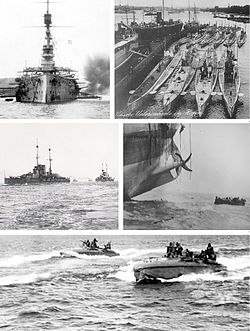
Britain's post-Trafalgar effort was largely successful, but did not end the French threat, as Napoleon instituted a large-scale shipbuilding programme that had produced a fleet of 80 ships of the line at the time of his fall from power in 1814, with more under construction.
Image source: Naval warfare of World War I
Or browse the full history timeline directory, with more than 2,000 topics.
This Battle of Trafalgar timeline was generated with the help of AI, using information found on the internet.
We work hard to keep these timelines accurate, but mistakes do get through. If you spot one, email us at [email protected] and we'll fix it for future visitors.
Generate yours with AI or build it from scratch, for free.
Export your timeline, add your own events, edit or remove AI-generated events, and much more
No credit card required.
Cancel anytime.
Cancel anytime.
You can create an unlimited number of timelines with up to 10 events on each one, customize how they look, export them to PDF, PNG, PowerPoint, CSV, and Excel, and share them with a link. Paid plans raise the event limit and add features like spreadsheet imports and collaborators.
Yes. You can cancel your subscription from your account page at any time, and you will not be charged again. Your subscription stays active for the rest of the period you already paid for.
Yes. We will email you a reminder before the annual renewal, and we will also email you a receipt.
Yes. You can email us within 15 days of any payment, and we will issue you a full refund.
Check out our pricing docs or send us an email anytime: [email protected].