-
Use Cases
-
Resources
-
Pricing
The Battle of Verdun was a major World War I battle fought between the French and German armies along the Meuse River in northeastern France from February to December 1916. Lasting 302 days, it was the longest and one of the deadliest battles in human history, symbolizing French national determination and the brutal attrition warfare that defined the Great War. More Less
1600
% complete
At the heart of the city of Verdun was a citadel built by Vauban in the 17th century, forming part of the town's longstanding fortifications guarding the Meuse river crossing.
Image source: Verdun
1903 - 1913
% complete
In 1903, Douaumont was equipped with a new concrete bunker (Casemate de Bourges) containing two 75 mm field guns to cover the south-western approach. More guns were added from 1903 to 1913 in four retractable steel turrets.
Image source: Fort Douaumont
Sep 1914
% complete
After the German invasion of France had been halted at the First Battle of the Marne in September 1914, the war of movement ended at the Battle of the Yser and the First Battle of Ypres.
Image source: First Battle of the Marne
1914
% complete
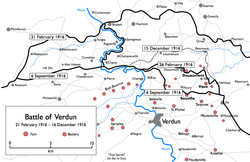
The Fortified Region of Verdun (RFV) lay in a salient formed during the German invasion of 1914. The Germans built field fortifications to hold the ground captured that year, while the French began siege warfare to break through the defences.
Image source: Battle of Verdun
1914
% complete
The railway line from the south into Verdun had been cut during the Battle of Flirey in 1914, with the loss of Saint-Mihiel, isolating Verdun on three sides.
Image source: Battle of Flirey
1914 - 1915
% complete
General Joseph Joffre, Commander-in-Chief of the French Army, had concluded from the swift capture of the Belgian fortresses at Liège and Namur in 1914 that fortifications had been made obsolete by German super-heavy siege artillery.
Image source: Joseph Joffre
Jan 1915 - Dec 31, 1915
% complete
In late 1914 and in 1915, offensives on the Western Front had failed to gain much ground and been extremely costly in casualties, leading strategists on both sides to seek new methods.
Image source: Western Front (World War I)
1915 - Mar 31, 1916
% complete
In 1915 and early 1916, German industry quintupled the output of heavy artillery and doubled the production of super-heavy artillery. French production had also recovered, and by February 1916 the army had 3,500 heavy guns.
May 1, 1915 - Sep 19, 1915
% complete
In the Gorlice–Tarnów Offensive, the German and Austro-Hungarian Armies attacked Russian defences frontally after pulverising them with large amounts of heavy artillery, demonstrating the effectiveness of massed heavy guns.
Image source: Gorlice–Tarnów offensive
Jul 15, 1915
% complete
The line west from Verdun to Paris was cut at Aubréville in mid-July 1915 by the German 3rd Army, which had attacked southwards through the Argonne Forest since the new year, rendering the mainline railway unusable.
Aug 5, 1915
% complete
In a directive of the General Staff of 5 August 1915, the Fortified Region of Verdun was to be stripped of 54 artillery batteries and 128,000 rounds of ammunition. In 1915, 237 guns and 647 tons of ammunition were removed, leaving only heavy guns in retractable turrets.
Image source: Battle of Verdun
Sep 25, 1915 - Nov 6, 1915
% complete
During the Second Battle of Champagne (Herbstschlacht [autumn battle]), the French suffered 'extraordinary casualties' from German heavy artillery, which Falkenhayn considered offered a way out of the dilemma of material inferiority and growing Allied strength.
Image source: Second Battle of Champagne
Oct 1915
% complete
Conversion of the RFV to a conventional linear defence began but proceeded slowly after resources were sent west for the Second Battle of Champagne. Building began on trench lines known as the first, second and third positions.
Nov 1915 - Feb 1916
% complete
Using the experience of the Second Battle of Champagne, the Germans planned to capture the Meuse Heights, an excellent defensive position with good observation for artillery fire on Verdun. Falkenhayn offered five corps from the strategic reserve at the beginning of February 1916, but only for an attack on the east bank of the Meuse.
Image source: Erich von Falkenhayn
Jan 1916
% complete
An inspection by General Noël de Castelnau, Chief of Staff at French General Headquarters, reported that the new defences were satisfactory except for small deficiencies in three areas. That month, Chrétien was refused entry when he attempted to inspect Fort Douaumont, whose garrison answered to the central military bureaucracy in Paris.
Image source: Noël Édouard, vicomte de Curières de Castelnau
Jan 21, 1916 - Jan 31, 1916
% complete
French intelligence obtained an accurate assessment of German military capacity and intentions at Verdun, but Joffre considered that an attack would be a diversion because of the lack of an obvious strategic objective. The Germans did not know the garrison was only a small maintenance crew led by a warrant officer.
1916 - Apr 1917
% complete
Since the war's start, French units produced numerical loss states (états numériques des pertes) every five days; the system became established by February 1916 and in April 1917 GQG required it to discriminate lightly from severely wounded. German armies compiled Verlustlisten every ten days, later published by the Reichsarchiv, with medical data added in the Sanitätsbericht of 1934.
1927 - 1938
% complete
Winston Churchill used a Reichsarchiv figure of 428,000 German casualties and 532,500 from the Marin Report for parts of 1916. Doughty wrote that other historians followed Churchill's figure of 442,000 French casualties by mistakenly including all Western Front losses. In the second edition of The World Crisis (1938), Churchill clarified that 442,000 was for other ranks and 'probably' 460,000 included officers.
Image source: The World Crisis
1994
% complete
Holger Afflerbach questioned the authenticity of the 'Christmas Memorandum'; studying surviving evidence, he concluded it had been written after the war but accurately reflected Falkenhayn's thinking at the end of 1915.
2000 - 2014
% complete
In 2000, Hannes Heer and Klaus Naumann calculated 377,231 French and 337,000 German casualties, averaging 70,000 a month; McRandle and Quirk (2006) gave 373,882 German casualties. In 2014, William Philpott recorded about 714,000 casualties at Verdun in 1916 and roughly 1,250,000 in the vicinity of Verdun across the whole war.
Feb 21, 1916
% complete
The Battle of Verdun began on 21 February 1916 on the Western Front in France, as German forces attacked towards the Meuse Heights. Douaumont was by then the largest fort in the RFV, with only its 75 mm and 155 mm turret guns and light ditch-covering guns left operational.
Mar 1916 - Apr 1916
% complete
By the end of March the offensive had cost the Germans 81,607 casualties and Falkenhayn began to think of ending it, lest it become another costly and indecisive engagement like the First Battle of Ypres in late 1914.
May 1916 - Jun 1916
% complete
Later in May 1916, German attacks shifted from the left bank at Mort-Homme and Côte 304 to the right bank, south of Fort Douaumont. Fighting on the west bank had shown that capturing one vital point merely exposed another terrain feature overlooking it.
Jun 1916
% complete
After his promotion to lead the Second Army in June 1916, Nivelle found manifestations of indiscipline (Défaillance) occurring in five front-line regiments. He had been concerned about declining French morale at Verdun.
Image source: Robert Nivelle
Jun 1916
% complete
In June 1916, the French had 2,708 guns at Verdun, including 1,138 field guns. From February to December, the French and German armies fired c. 10,000,000 shells weighing 1,350,000 long tons.
Jun 4, 1916 - Sep 20, 1916
% complete
The Brusilov Offensive began against the Austro-Hungarians on the Eastern Front, adding pressure on Germany's allies during the battle of Verdun.
Image source: Brusilov offensive
Jul 1, 1916 - Nov 18, 1916
% complete
The opening of the Battle of the Somme forced the Germans to transfer some of their artillery from Verdun, which was the first strategic success of the Anglo-French offensive.
Image source: Battle of the Somme
Oct 20, 1916
% complete
On 20 October 1916, the French began the First Offensive Battle of Verdun (1ère Bataille Offensive de Verdun) to recapture Fort Douaumont, with an advance of more than 2 km (1.2 mi).
Dec 18, 1916
% complete
The Battle of Verdun ended on 18 December 1916 after nearly ten months of fighting, having become one of the longest and costliest battles of the First World War.
Sep 26, 1918
% complete
The French Fourth Army and the American First Army attacked on a front from Moronvilliers to the Meuse on 26 September 1918 at 5:30 a.m., after a three-hour bombardment. On the right bank of the Meuse, a combined Franco-American force took Brabant, Haumont, Bois d'Haumont and Bois des Caures, then crossed the front line of February 1916.
Image source: Meuse–Argonne offensive
1920
% complete
In 1920, a ceremony was held in the citadel of Verdun to choose a body to bury in the Tomb of the Unknown Soldier at the Arc de Triomphe in Paris, honouring France's unidentified war dead.
Image source: Tomb of the Unknown Soldier (France)
1926
% complete
In 1926, after an inquiry into the cause célèbre surrounding their execution, Herduin and Millant were exonerated and their military records expunged.
Sep 22, 1984
% complete
German Chancellor Helmut Kohl (whose father had fought near Verdun) and French President François Mitterrand (taken prisoner nearby in the Second World War) stood at the Douaumont cemetery holding hands for several minutes in driving rain, as a gesture of Franco-German reconciliation.
Image source: Douaumont Ossuary
Or browse the full history timeline directory, with more than 2,000 topics.
This Battle of Verdun timeline was generated with the help of AI, using information found on the internet.
We work hard to keep these timelines accurate, but mistakes do get through. If you spot one, email us at [email protected] and we'll fix it for future visitors.
Generate yours with AI or build it from scratch, for free.
Export your timeline, add your own events, edit or remove AI-generated events, and much more
No credit card required.
Cancel anytime.
Cancel anytime.
You can create an unlimited number of timelines with up to 10 events on each one, customize how they look, export them to PDF, PNG, PowerPoint, CSV, and Excel, and share them with a link. Paid plans raise the event limit and add features like spreadsheet imports and collaborators.
Yes. You can cancel your subscription from your account page at any time, and you will not be charged again. Your subscription stays active for the rest of the period you already paid for.
Yes. We will email you a reminder before the annual renewal, and we will also email you a receipt.
Yes. You can email us within 15 days of any payment, and we will issue you a full refund.
Check out our pricing docs or send us an email anytime: [email protected].