
-
Use Cases
-
Resources
-
Pricing
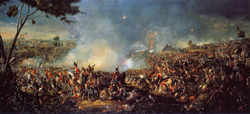
The Battle of Waterloo was fought on June 18, 1815, near Waterloo in present-day Belgium. It marked the final defeat of French Emperor Napoleon Bonaparte by the Seventh Coalition, led by the Duke of Wellington and Gebhard von Blücher, ending Napoleon's Hundred Days return to power and ushering in decades of relative peace in Europe. More Less
Dec 1814
% complete
In December 1814, the British Army had been reduced by 47,000 men as Europe settled into an uneasy peace following Napoleon's first abdication, leaving Britain with fewer seasoned troops available for the coming campaign.
Image source: Battle of Waterloo
1815
% complete
The British battalions were undermanned, but the French were even worse off, with their average battalion being 145 muskets weaker: 665 men per British battalion, 610 for the Prussians, 520 for the KGL, and 520 for the French.
1815
% complete
The Scots Greys, for example, had not been in action since 1795, meaning that despite their fine mounts, many British cavalry units lacked recent combat experience going into the Waterloo campaign.
Image source: Royal Scots Greys
1815
% complete
More than 20 years of warfare had eroded the numbers of suitable cavalry mounts available on the European continent; this resulted in the British heavy cavalry entering the 1815 campaign with the finest horses of any contemporary cavalry arm.
1815
% complete
In 1815, the former Reserve regiments, Legions, and Freikorps volunteer formations from the wars of 1813–1814 were in the process of being absorbed into the line, along with many Landwehr (militia) regiments.
1815
% complete
Napoleon had used conscription to fill the ranks of the French army throughout his rule, but he did not conscript men for the 1815 campaign, limiting the manpower available to him.
1815
% complete
The Dutch army had been re-established in 1815, following the earlier defeat of Napoleon, and would play a significant role in Wellington's forces at Waterloo.
Mar 1815
% complete
Upon Napoleon's return to power in March 1815, the beginning of the Hundred Days, many states that had previously opposed him formed the Seventh Coalition to oppose him again and hurriedly mobilised their armies.
Image source: Hundred Days
Mar 13, 1815
% complete
On 13 March 1815, six days before Napoleon reached Paris, the powers at the Congress of Vienna declared him an outlaw, formally branding him a threat to European peace and setting the diplomatic stage for renewed war.
1815
% complete
Some portions of the terrain on the battlefield have been altered from their 1815 appearance; as Victor Hugo observed, the variously inclined undulations of the plains where Napoleon and Wellington engaged are no longer what they were on 18 June 1815.
1815
% complete
Had the French won the Battle of Waterloo, Napoleon planned to commemorate the victory by building a pyramid of white stones, akin to the pyramids he had seen during his invasion of Egypt in 1798.
1815 - 1900
% complete
The phenomenon of battlefield relic hunting was often satirized in 19th-century literature and criticized by French and German visitors, who viewed British gullibility as symbolic retribution for the defeat.
1816
% complete
The effectiveness of the lance was noted by all participants and this weapon subsequently became more widespread throughout Europe; the British converted their first light cavalry regiment to lancers in 1816.
Image source: Mitsubishi Lancer
1820
% complete
In 1820, the Netherlands' King William I ordered the construction of a monument on the battlefield, part of a wave of commemorative structures built to mark the Battle of Waterloo.
Image source: Lion's Mound
1821
% complete
Britain's Household Cavalry likewise adopted the cuirass in 1821 in recognition of their success against their armoured French counterparts at Waterloo.
Image source: Household Cavalry
1853 - 1856
% complete
No further major international conflict occurred until the Crimean War of 1853–1856, reflecting the long peace in Europe that followed Waterloo.
Image source: Crimean War
2012
% complete
The remains of a soldier thought to be 23-year-old Friederich Brandt were discovered in 2012, one of remarkably few complete human skeletons ever found on the battlefield.
2015
% complete
As part of the bicentennial celebration of the battle, in 2015 Belgium minted a two-euro coin depicting the Lion monument over a map of the field of battle.
2015
% complete
The bicentenary of Waterloo prompted renewed attention to the geopolitical and economic legacy of the battle and to the century of relative transatlantic peace which followed.
2022
% complete
In 2022 a second skeleton was found in a ditch near a former field hospital by the Waterloo Uncovered charity; remarkably, there is no record of any such mass grave being discovered in the 20th and 21st centuries, with only two complete human skeletons found.
Dec 2022
% complete
In December 2022, historians Bernard Wilkin and Robin Schäfer proved in an article published by Napoleonica that since the aftermath of the Battle of Waterloo in 1815, the battlefield has been a focal point for tourism and relic collecting.
1815
% complete
Parkinson (2000) adds: "Neither army beat Napoleon alone," emphasizing that the combined efforts of Wellington's Anglo-allied army and Blücher's Prussians were necessary to secure victory.
1815
% complete
In his famous study of the Campaign of 1815, the Prussian Clausewitz does not agree with Wellington on this assessment, offering a differing analysis of the battle and its conduct.
Jun 18, 1815
% complete
It has also been noted that Wellington's maps of the battlefield were based on a recent reconnaissance and therefore more up to date than those used by Napoleon, who had to rely on Ferraris-Capitaine maps of 1794.
Jun 18, 1815
% complete
The Battle of Waterloo was fought on Sunday 18 June 1815, near Waterloo (then in the United Kingdom of the Netherlands, now in Belgium), being the last engagement with Napoleon I and decisively ending his rule.
Jun 18, 1815
% complete
Steele (2014) writes: "Blücher's arrival not only diverted vital reinforcements, but also forced Napoleon to accelerate his effort against Wellington," underscoring how the Prussian intervention shaped the battle's outcome.
Jun 1815
% complete
Napoleon's brother Lucien and Marshal Louis-Nicolas Davout advised him to continue fighting, dissolve the Chamber of Deputies from Louis XVIII's constitutional government, and rule France as a military dictator, as he had done from 1804 until 1814.
Jun 19, 1815
% complete
There is no support in Dutch or Belgian sources for claims criticizing General Trip; Wellington wrote in his Dispatch to Secretary for War Bathurst on 19 June 1815 that General Trip had "conducted himself much to my satisfaction".
Jun 19, 1815
% complete
Wellington sent his official dispatch describing the battle to England on 19 June 1815; it arrived in London on 21 June 1815 and was published as a London Gazette Extraordinary on 22 June.
Image source: Chelsea Pensioners reading the Waterloo Dispatch
Jun 24, 1815
% complete
Napoleon announced his second abdication on 24 June 1815, bringing his brief return to power during the Hundred Days to an end.
Image source: Abdication of Napoleon, 1815
Jul 1815
% complete
Louis XVIII was restored to the throne of France and Napoleon was exiled to Saint Helena, where he died in 1821.
Image source: Saint Helena
Jul 3, 1815
% complete
In the final skirmish of the Napoleonic Wars, General Dominique Vandamme was defeated by Blücher at Issy on 3 July 1815, effectively closing out hostilities.
Image source: Battle of Issy
Sep 13, 1815
% complete
There was a campaign against French fortresses that still held out; Longwy capitulated on 13 September 1815, the last to do so.
Image source: Longwy
Nov 20, 1815
% complete
The Treaty of Paris was signed on 20 November 1815, formally concluding the Napoleonic Wars and reshaping the European order after Waterloo.
Image source: Treaty of Paris (1815)
Or browse the full history timeline directory, with more than 2,000 topics.
This Battle of Waterloo timeline was generated with the help of AI, using information found on the internet.
We work hard to keep these timelines accurate, but mistakes do get through. If you spot one, email us at [email protected] and we'll fix it for future visitors.
Generate yours with AI or build it from scratch, for free.
Export your timeline, add your own events, edit or remove AI-generated events, and much more
No credit card required.
Cancel anytime.
Cancel anytime.
You can create an unlimited number of timelines with up to 10 events on each one, customize how they look, export them to PDF, PNG, PowerPoint, CSV, and Excel, and share them with a link. Paid plans raise the event limit and add features like spreadsheet imports and collaborators.
Yes. You can cancel your subscription from your account page at any time, and you will not be charged again. Your subscription stays active for the rest of the period you already paid for.
Yes. We will email you a reminder before the annual renewal, and we will also email you a receipt.
Yes. You can email us within 15 days of any payment, and we will issue you a full refund.
Check out our pricing docs or send us an email anytime: [email protected].