
-
Use Cases
-
Resources
-
Pricing
The Battle of Yorktown, fought from September 28 to October 19, 1781, in Yorktown, Virginia, was the last major land battle of the American Revolutionary War. General George Washington's combined Franco-American army besieged British General Lord Cornwallis's forces, forcing their surrender and effectively ending the war, leading to American independence recognized by the Treaty of Paris in 1783. More Less
Jul 1, 1780
% complete
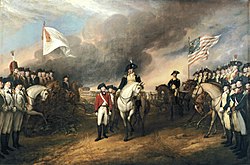
Admiral Destouches arrived in Newport, Rhode Island, in July 1780 with a fleet transporting 5,500 soldiers. He was encouraged by Washington and French Lieutenant General Rochambeau to move his fleet south and launch a joint land-naval attack on Benedict Arnold's troops in Virginia.
Image source: Siege of Yorktown
Jul 10, 1780
% complete
An expedition of 5,500 French troops under Comte de Rochambeau arrived in Newport, Rhode Island, by sea on July 10, 1780. The arrival of this substantial French force provided crucial support for the American cause and laid the groundwork for future Franco-American military cooperation.
Dec 20, 1780
% complete
On December 20, 1780, the traitor Benedict Arnold sailed from New York with 1,500 British troops to Portsmouth, Virginia. His raiding operations in the Chesapeake region threatened American supply lines and prompted Allied plans to confront him.
Image source: Benedict Arnold
Mar 1, 1781
% complete
After earlier efforts proved ineffective, Admiral Destouches took a larger force of eight ships in March 1781 and fought a tactically inconclusive battle with the British fleet of Marriot Arbuthnot at the mouth of the Chesapeake Bay. The engagement failed to dislodge Arnold's forces but demonstrated growing Allied naval activity in the region.
Image source: Battle of Cape Henry
Jun 21, 1781 - Aug 31, 1781
% complete
The French and American armies united north of New York City during the summer of 1781, combining forces under George Washington and Comte de Rochambeau. This union set the stage for their strategic march south toward Virginia and the decisive campaign against Cornwallis.
Jul 6, 1781
% complete
On July 6, 1781, the French and American armies met at White Plains, north of New York City. The rendezvous allowed the allied commanders to coordinate their strategy before beginning the arduous march that would ultimately lead them to Yorktown, Virginia.
Image source: White Plains, New York
Sep 28, 1781
% complete
George Washington and Comte de Rochambeau arrived at Yorktown on September 28, 1781, bringing the combined Franco-American army face-to-face with Lord Cornwallis's entrenched British force. Their arrival marked the formal beginning of the siege operations that would decide the fate of the Revolutionary War.
Sep 28, 1781 - Oct 19, 1781
% complete
The Siege of Yorktown, also known as the Battle of Yorktown and the surrender at Yorktown, took place in 1781 and was the final major land engagement of the American Revolutionary War. The victory by the combined Franco-American forces proved decisive in securing American independence.
Oct 14, 1781
% complete
With the British defense weakened, on October 14, 1781, Washington sent two columns to attack the last major remaining British outer defenses. The successful night assault captured redoubts key to tightening the noose around Cornwallis's army and hastened the end of the siege.
Oct 19, 1781
% complete
The articles of capitulation, outlining the terms and conditions of surrender for officers, soldiers, military supplies, and personal property, were signed on October 19, 1781. The formal signing sealed the surrender of Cornwallis's army and effectively ended major combat in the war.
Oct 19, 1781
% complete
According to National Park Service historian Jerome Green in his 2005 history of the siege, The Guns of Independence, when Brigadier General O'Hara presented the sword to Major General Lincoln during the surrender ceremony, Lincoln held it for a moment and immediately returned it to O'Hara.
Oct 19, 1781
% complete
With the capture of more than 7,000 British soldiers at Yorktown, negotiations between the United States and Great Britain began. The enormous loss of men and matériel made continued offensive operations untenable for Britain and opened the path to peace talks.
Oct 24, 1781
% complete
Five days after the battle ended, on October 24, 1781, the British fleet sent by Clinton to rescue the British army finally arrived off the Virginia coast. Coming too late to save Cornwallis, the fleet's arrival underscored how decisively the siege had concluded before relief could reach the trapped garrison.
Nov 1, 1781
% complete
Following the capture of more than 7,000 British soldiers at Yorktown, negotiations between the United States and Great Britain began. These discussions would ultimately result in the Treaty of Paris of 1783, formally recognizing American independence.
Image source: Treaty of Paris (1783)
Mar 4, 1782
% complete
On March 4, 1782, a motion to end 'further prosecution of offensive warfare on the continent of North America'—effectively a no confidence motion—passed in the British House of Commons. The vote reflected the political fallout in Britain from the defeat at Yorktown.
Apr 1, 1782 - Sep 3, 1783
% complete
Washington moved the Continental Army to New Windsor, New York, where they remained until the Treaty of Paris was signed. The cantonment kept the army ready through the long final months of the war while peace negotiations proceeded overseas.
Image source: New Windsor Cantonment State Historic Site
Sep 3, 1783
% complete
The Treaty of Paris was signed on September 3, 1783, bringing the eight-year war to an end and establishing the independence of the colonies. The treaty marked the diplomatic culmination of the military triumph achieved at Yorktown nearly two years earlier.
Jan 1, 1834
% complete
In 1834, the citizens of Yorktown asked Congress for a monument to be constructed commemorating the battle. Despite their appeal, still no action was taken on the project for decades afterward.
Jan 1, 1836
% complete
In 1836, the citizens of Yorktown followed up on their earlier petition, asking Congress once again for the monument to be constructed, but still no action was taken. The project languished for many more years.
Jan 1, 1881
% complete
The monument project was postponed once again until the battle's centennial sparked renewed enthusiasm in the resolution and prompted the government to begin building the monument in 1881 amid national support.
Oct 19, 1881
% complete
On October 19, 1881, an elaborate ceremony was held to commemorate the battle's centennial. The national celebration drew widespread attention and helped generate momentum for completing the long-delayed Yorktown Victory Monument.
Aug 12, 1884
% complete
The crowning figure of the Yorktown Victory Monument was set in place on August 12, 1884, marking a major milestone in the structure's long-awaited completion.
Jan 5, 1885
% complete
The structure was officially reported in a communication as complete on January 5, 1885. It currently resides within Colonial National Historical Park, standing as a lasting tribute to the decisive victory.
Image source: Yorktown Victory Monument
Oct 16, 1931 - Oct 19, 1931
% complete
A four-day celebration to commemorate the 150th anniversary of the siege took place in Yorktown on October 16–19, 1931, drawing visitors from across the nation to honor the historic victory.
Apr 1, 1976
% complete
The site first opened on April 1, 1976, as the Yorktown Victory Center, serving as one of three Bicentennial centers in Virginia. The museum offered exhibits and programming about the Revolutionary War era for visiting families and school groups.
Image source: Siege of Yorktown
Oct 16, 1981 - Oct 19, 1981
% complete
The Yorktown Bicentennial was a major national celebration held on October 16–19, 1981, to commemorate the 200th anniversary of the British surrender. The event drew large crowds and extensive media coverage to the historic battlefield.
Oct 16, 1981 - Oct 19, 1981
% complete
During the bicentennial festivities, historical enthusiasts from over 20 states performed large-scale reenactments of the 1781 battle and the British surrender, vividly bringing the dramatic events of the siege back to life for modern audiences.
Jan 1, 2005
% complete
National Park Service historian Jerome Green published his 2005 history of the siege, The Guns of Independence, providing a detailed modern account of the battle, including his description of the sword presentation during the surrender ceremony.
Apr 1, 2017
% complete
Administered by the Jamestown-Yorktown Foundation, the museum officially opened under its current name and structure on April 1, 2017, offering expanded galleries, films, and living-history experiences at the site of the famous siege.
Apr 1, 2017
% complete
The museum features indoor galleries with rare artifacts, including a July 1776 Boston broadside of the Declaration of Independence, immersive films, and outdoor living-history areas such as a Continental Army encampment and a re-created farm based on the real-life Edward Moss family.
Jul 1, 2023
% complete
As of mid-2023, the American Battlefield Trust and its partners had preserved 49 battlefield acres outside of the national park, helping protect additional land associated with the historic siege for future generations.
Or browse the full history timeline directory, with more than 2,000 topics.
This Battle of Yorktown timeline was generated with the help of AI, using information found on the internet.
We work hard to keep these timelines accurate, but mistakes do get through. If you spot one, email us at [email protected] and we'll fix it for future visitors.
Generate yours with AI or build it from scratch, for free.
Export your timeline, add your own events, edit or remove AI-generated events, and much more
No credit card required.
Cancel anytime.
Cancel anytime.
You can create an unlimited number of timelines with up to 10 events on each one, customize how they look, export them to PDF, PNG, PowerPoint, CSV, and Excel, and share them with a link. Paid plans raise the event limit and add features like spreadsheet imports and collaborators.
Yes. You can cancel your subscription from your account page at any time, and you will not be charged again. Your subscription stays active for the rest of the period you already paid for.
Yes. We will email you a reminder before the annual renewal, and we will also email you a receipt.
Yes. You can email us within 15 days of any payment, and we will issue you a full refund.
Check out our pricing docs or send us an email anytime: [email protected].