
-
Use Cases
-
Resources
-
Pricing
The Battle of Zama, fought in 202 BCE in North Africa near Carthage, was the decisive battle of the Second Punic War. Roman general Scipio Africanus decisively defeated Carthaginian commander Hannibal Barca, forcing Carthage to surrender and establishing Rome as the dominant power in the western Mediterranean. More Less
219 BC
% complete
Hannibal Barca's siege and capture of Saguntum, a Roman ally in Iberia, provoked Rome into declaring war on Carthage, launching the Second Punic War, the conflict that would eventually culminate at Zama.
Image source: Siege of Saguntum
218 BC
% complete
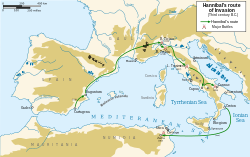
Hannibal led his army, including war elephants, across the Alps in a daring feat of military logistics, surprising the Romans and bringing the war directly onto Italian soil.
Image source: Hannibal's crossing of the Alps
217 BC
% complete
Following early disasters, Roman dictator Fabius Maximus adopted a strategy of avoiding pitched battle while harassing Carthaginian forces, buying Rome time to rebuild its armies.
Image source: Fabian strategy
Aug 2, 216 BC
% complete
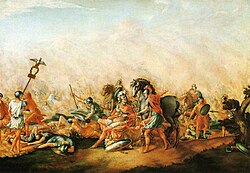
Hannibal annihilated a much larger Roman army using his famous double envelopment tactic. Cannae became one of the deadliest defeats in Roman history and a benchmark for military excellence for millennia.
Image source: Battle of Cannae
207 BC
% complete
Rome defeated Hasdrubal Barca, Hannibal's brother, as he marched reinforcements from Iberia to Italy. The loss severed Hannibal's hope of decisive reinforcement and marked a turning point against Carthage.
Image source: Battle of the Metaurus
210 BC
% complete
After his father and uncle fell in battle in Iberia, the young Publius Cornelius Scipio was appointed to command Roman forces there despite his youth, beginning a brilliant military career.
Image source: Publius Cornelius Scipio (consul 218 BC)
209 BC
% complete
Scipio seized the main Carthaginian stronghold and port in Iberia in a bold amphibious assault, securing supplies, treasure, and hostages and undermining Carthage's position on the peninsula.
Image source: Battle of New Carthage
206 BC
% complete
Scipio won a masterful battle near modern Seville, decisively breaking Carthaginian power in Iberia and clearing the way for his later invasion of Africa.
Image source: Battle of Ilipa
206 BC
% complete
Masinissa, ruler of Numidia and a superb cavalry commander, switched allegiance to Rome after meeting Scipio, providing crucial mounted forces that would prove decisive at Zama.
Image source: Masinissa
205 BC
% complete
Elected consul, Scipio overcame political resistance from rivals like Fabius and secured command of Sicily with permission to cross into Africa if opportunity arose, planning to strike Carthage itself.
Image source: Scipio Africanus
204 BC
% complete
Scipio transported his army from Sicily to the African coast, landing safely near Utica and establishing a base for operations against Carthaginian territory.
203 BC
% complete
In a night operation, Scipio destroyed the combined camps of the Carthaginian army and their Numidian allies, inflicting enormous casualties through fire and assault rather than open battle.
Image source: Battle of Utica (203 BC)
203 BC
% complete
Carthage accepted preliminary peace terms but broke them by recalling Hannibal from Italy and attacking a Roman supply fleet, prompting Scipio to march inland to force a final decision.
Image source: Battle of Zama
203 BC
% complete
After fifteen years campaigning in Italy, Hannibal was recalled to defend Carthage. He assembled a new army including war elephants, setting the stage for a direct confrontation between the era's greatest commanders.
202 BC
% complete
Hannibal requested a meeting with Scipio to negotiate; the famous parley failed as neither general would accept the other's terms, leaving only battle to decide the war.
Oct 19, 202 BC
% complete
Scipio Africanus defeated Hannibal in the decisive engagement of the Second Punic War. Scipio neutralized Hannibal's elephants with clever lane formations and used superior cavalry under Masinissa and Laelius to encircle the Carthaginian infantry, ending Carthage's great-power status.
201 BC
% complete
The peace treaty stripped Carthage of its overseas empire and navy, imposed heavy indemnities, and prohibited war without Roman consent, transforming it into a subordinate client state of Rome.
201 BC
% complete
Returning to Rome, Scipio celebrated a magnificent triumph and received the honorific cognomen Africanus, cementing his reputation as one of Rome's greatest generals.
196 BC
% complete
As suffete, Hannibal reformed Carthage's finances and constitution to pay the Roman indemnity without crushing taxation, provoking hostility among oligarchs who denounced him to Rome.
Image source: Hannibal
Or browse the full history timeline directory, with more than 2,000 topics.
This Battle of Zama timeline was generated with the help of AI, using information found on the internet.
We work hard to keep these timelines accurate, but mistakes do get through. If you spot one, email us at [email protected] and we'll fix it for future visitors.
Generate yours with AI or build it from scratch, for free.
Export your timeline, add your own events, edit or remove AI-generated events, and much more
No credit card required.
Cancel anytime.
Cancel anytime.
You can create an unlimited number of timelines with up to 10 events on each one, customize how they look, export them to PDF, PNG, PowerPoint, CSV, and Excel, and share them with a link. Paid plans raise the event limit and add features like spreadsheet imports and collaborators.
Yes. You can cancel your subscription from your account page at any time, and you will not be charged again. Your subscription stays active for the rest of the period you already paid for.
Yes. We will email you a reminder before the annual renewal, and we will also email you a receipt.
Yes. You can email us within 15 days of any payment, and we will issue you a full refund.
Check out our pricing docs or send us an email anytime: [email protected].