
-
Use Cases
-
Resources
-
Pricing
Cologne Cathedral (Kölner Dom) is a masterpiece of Gothic architecture in Cologne, Germany. Construction began in 1248 but was halted for centuries before resuming in 1842 and reaching completion in 1880. The cathedral houses the Shrine of the Three Kings, survived WWII bombings largely intact, and was designated a UNESCO World Heritage Site in 1996. Its twin spires, at approximately 157 meters, make it one of the tallest churches in the world. More Less
450
% complete
It is assumed that the baptismal font, which dates back to the 5th century, was originally located in the garden of the Roman house that served as a Christian meeting place in Cologne.
Image source: Cologne Cathedral
500 - 600
% complete
After the collapse of Roman rule on the Rhine, the Merovingian petty kings residing in Cologne built an episcopal church on this site in the 6th century, which was eventually around 40 to 50 metres long and equipped with an ambon.
1000 - 1100
% complete
The Hillinus Codex from the 11th century shows Hildebold Cathedral in an unusually realistic depiction for the time.
1162
% complete
To oversee the pilgrim crowds drawn by the relics of the Three Wise Men, an office of custos regum ('guardian of the kings') was established after 1162.
Jul 23, 1164
% complete
On 23 July 1164, the Archbishop of Cologne and Imperial Archchancellor Rainald of Dassel brought the bones of the Three Wise Men from Milan to Cologne, which was perceived as a 'propaganda success'.
Image source: Shrine of the Three Kings
1190 - 1225
% complete
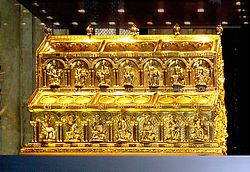
Between 1190 and 1225, the Shrine of the Three Kings was made for the highly respected saints, considered one of the most sophisticated goldsmith's works of the Middle Ages; the shrine was placed in the center of the Old Cathedral.
1262 - 1267
% complete
Embedded in the interior wall are a pair of stone tablets on which are carved the provisions formulated by Archbishop Englebert II (1262–67) under which Jews were permitted to reside in Cologne.
1280
% complete
The trachyte sarcophagus found at the cathedral is considered to have been created by the cathedral masons' guild around 1280.
1290
% complete
A replacement cross was made in the Cologne Cathedral workshop sometime around 1290 as a replacement for the original which was lost in a fire.
Image source: Gero Cross
1322
% complete
One of the treasures of the cathedral is the high altar, which was installed in 1322.
1418 - 1437
% complete
The first bell was the 3.8-tonne Dreikönigsglocke ('Bell of the Three Kings'), cast in 1418 and installed in 1437; it was later recast in 1880.
1448
% complete
Two of the other bells, the Pretiosa (10.5 tonnes; at that time the largest bell in the Western world) and the Speciosa (5.6 tonnes), were installed in 1448 and remain in place today.
1864
% complete
The Shrine of the Three Kings was opened in 1864 and was found to contain bones and garments, believed to be the remains of the Three Wise Men whose relics had been brought to Cologne in 1164.
May 11, 1872
% complete
As the building neared completion there was a desire to increase the number of bells, facilitated by Kaiser Wilhelm I who gave French bronze cannon captured in 1870–71 for this purpose. The 22 pieces of artillery were displayed outside the cathedral on 11 May 1872.
Image source: Petersglocke
Aug 19, 1873 - May 13, 1875
% complete
Andreas Hamm in Frankenthal used the cannon bronze to cast a bell of over 27 tonnes on 19 August 1873. After further attempts on 13 November 1873 and 3 October 1874, the colossal bell was shipped to Cologne and installed in the cathedral on 13 May 1875.
Image source: Cologne Cathedral
1918
% complete
The colossal Kaiserglocke was melted down in 1918 to support the German war effort during World War I.
1922
% complete
St. Petersglocke ('Decke Pitter' in Kölsch, commonly known as Dicker Pitter) was cast in 1922 and was the largest free-swinging bell in the world until a new bell was cast in 2016 for the People's Salvation Cathedral in Bucharest.
1948
% complete
Cologne Cathedral has two pipe organs by Klais Orgelbau: the Transept Organ, built in 1948, and the Nave Organ, built later in 1998.
1985 - 2001
% complete
Cathedral organists have included Josef Zimmermann, Clemens Ganz (1985–2001) and Winfried Bönig from 2001 onward.
1998
% complete
The Nave Organ, the second pipe organ by Klais Orgelbau in the cathedral, was built in 1998, complementing the Transept Organ of 1948.
Aug 15, 1248
% complete
The foundation stone was laid on Saturday, 15 August 1248, by Archbishop Konrad von Hochstaden. With the construction of the Gothic cathedral in 1248, the Old Cathedral was to be demolished step by step.
1265
% complete
After completion in 1265, the radiating chapels were immediately taken into service as a burial place for prominent figures associated with the cathedral.
1322
% complete
The eastern arm was completed under the direction of Master Gerhard, was consecrated in 1322 and sealed off by a temporary wall so it could be used as work continued. The western parts of Hildebold Cathedral were provisionally rebuilt and were only taken down after 1322, when construction of the Gothic nave began.
1473
% complete
This work ceased in 1473, leaving the south tower complete to the belfry level and crowned with a huge crane that remained in place as a landmark of the Cologne skyline for 400 years.
1560
% complete
Some work proceeded intermittently on the structure of the nave between the west front and the eastern arm, but during the 16th century this also stopped, leaving the cathedral unfinished for centuries.
1814 - 1842
% complete
With the 19th-century Romantic enthusiasm for the Middle Ages, and spurred by the discovery of the original plan for the façade, the Protestant Prussian Court working with the church committed to completing the cathedral. Attempts began around 1814, but the project was not properly funded until the 1840s.
1842
% complete
It was achieved by civic effort; the Central-Dombauverein, founded in 1842, raised two-thirds of the enormous costs, while the Prussian state supplied the remaining third. The state saw this as a way to improve relations with its Catholic subjects gained in 1815.
1842 - 1880
% complete
Construction resumed in 1842 to the original design of the surviving medieval plans and drawings, but using more modern construction techniques, including iron roof girders. Schlaitdorf sandstone was used from 1842 onwards for the transept façades and upper parts of the nave and transept.
1861
% complete
Ernst Friedrich Zwirner led the cathedral's construction until his death in 1861, and designed several parts including a chapel dedicated to St Mary and the crossing tower, which was completed in 1860.
Image source: Ernst Friedrich Zwirner
1880 - 1906
% complete
After the official completion of the cathedral in 1880, finishing work continued for around 20 years. Shortly before his death in 1902, master builder Richard Voigtel publicly stated that the cathedral had finally been completed; however, after an angel figure fell from the façade in 1906, master builders resumed renovation work.
Oct 15, 1880
% complete
The edifice was completed to its original medieval plan in 1880. The completion of Germany's largest cathedral was celebrated as a national event on 15 October 1880, 632 years after construction had begun.
1944
% complete
In 1944, amid World War II, Willy Weyres was appointed as the cathedral's architect, later overseeing repairs of war damage.
Image source: Willy Weyres
Mar 6, 1945
% complete
On 6 March 1945, an area west of the cathedral (Marzellenstrasse/Trankgasse) was the site of intense combat between American tanks of the 3rd Armored Division and a German Panther tank.
Image source: Battle of Cologne (1945)
1946 - 1997
% complete
To investigate whether the bombings had damaged the foundations of the Dom, archaeological excavations began in 1946 under the leadership of Otto Doppelfeld and were concluded only in 1997.
1956
% complete
Repairs of the war damage were completed sufficiently and the cathedral reopened in 1956, the work being overseen by architect Willy Weyres.
1965
% complete
In 1965, Weyres redesigned the cladding of the crossing tower — severely damaged by bombing though structurally sound — in an Art Deco style, with decorative angels designed by Erlefried Hoppe.
1992
% complete
During the 1992 Roermond earthquake, the 400-kilogram finial on the eastern pinnacle of the southern transept gable broke off, smashed through the roof and damaged the roof truss.
Image source: 1992 Roermond earthquake
1996
% complete
In 1996, the renowned monument of German Catholicism and Gothic architecture was declared a World Heritage Site and added to the UNESCO World Heritage List of culturally important sites.
2002
% complete
In 2002, the Melanchthon Akademie held a conference addressing antisemitic imagery in the cathedral, and performance artist Wolfram Kastner specifically protested the Judensau imagery carved into the choir stalls.
2004 - 2006
% complete
In 2004, it was placed on the 'World Heritage in Danger' list, as the only Western site in danger, due to plans to construct several high-rise buildings nearby that would have visually impacted the site.
2005
% complete
A repair to part of the northwest tower, carried out in 1944 using poor-quality brick from a nearby ruined building, remained visible as a reminder of the war until 2005, when it was restored to its original appearance.
Aug 18, 2005
% complete
On 18 August 2005, Pope Benedict XVI visited the cathedral during his apostolic visit to Germany, as part of the World Youth Day 2005 festivities.
2006
% complete
The cathedral was removed from the UNESCO 'in danger' list in 2006, following the authorities' decision to limit the heights of buildings constructed near and around the cathedral. That year, the Karl Rahner Academie also held a colloquium discussing actions regarding antisemitic imagery.
Aug 25, 2007
% complete
On 25 August 2007, the cathedral received a new stained glass window in the south transept. Cardinal Joachim Meisner, who had preferred a figurative depiction of 20th-century Catholic martyrs, did not attend the unveiling.
2014
% complete
Holder of the office since 2014 is Cardinal Rainer Maria Woelki, who leads the archdiocese associated with the cathedral.
Image source: Rainer Woelki
Jan 5, 2015
% complete
On 5 January 2015, the cathedral remained dark as floodlights were switched off to protest a demonstration by PEGIDA.
May 2021 - Nov 2021
% complete
From May to November 2021, a remote-controlled drone took 200,000 high-resolution photos of all parts of the façade from a distance of 5 to 7 metres and assembled them into a digital 3D model with 25 billion polygons.
Mar 3, 2022
% complete
On Thursday, 3 March 2022, landmark cathedrals across Europe chimed in unison 'in a gesture of solidarity with Ukraine'; the Kölner Dom was among them, as bystanders gathered to mourn those killed during Russia's invasion.
Aug 2023
% complete
In August 2023, the working group launched the Cologne Cathedral International Art Competition, calling for a new permanent artwork acknowledging the full history of Jewish-Christian relations while focusing on their present and future. As of 2024, the group opted to leave all antisemitic art in place, not hiding or modifying it.
Apr 3, 2025
% complete
On 3 April 2025, the cathedral chapter announced that Andrea Büttner had won the Cologne Cathedral International Art Competition, with her proposed mural for the wall of the Chapel of St Mary chosen.
Mar 2026
% complete
In March 2026, the cathedral's management announced that it would begin charging admission for tourists in the second half of the year to support maintenance expenses.
Or browse the full history timeline directory, with more than 2,000 topics.
This Cologne Cathedral timeline was generated with the help of AI, using information found on the internet.
We work hard to keep these timelines accurate, but mistakes do get through. If you spot one, email us at [email protected] and we'll fix it for future visitors.
Generate yours with AI or build it from scratch, for free.
Export your timeline, add your own events, edit or remove AI-generated events, and much more
No credit card required.
Cancel anytime.
Cancel anytime.
You can create an unlimited number of timelines with up to 10 events on each one, customize how they look, export them to PDF, PNG, PowerPoint, CSV, and Excel, and share them with a link. Paid plans raise the event limit and add features like spreadsheet imports and collaborators.
Yes. You can cancel your subscription from your account page at any time, and you will not be charged again. Your subscription stays active for the rest of the period you already paid for.
Yes. We will email you a reminder before the annual renewal, and we will also email you a receipt.
Yes. You can email us within 15 days of any payment, and we will issue you a full refund.
Check out our pricing docs or send us an email anytime: [email protected].