-
Use Cases
-
Resources
-
Pricing
St. Basil's Cathedral, officially known as the Cathedral of the Intercession of the Most Holy Theotokos on the Moat, is a world-famous Russian Orthodox church located in Red Square, Moscow. Commissioned by Ivan the Terrible to commemorate the capture of Kazan in 1552, it was built between 1555 and 1561 by architects Barma and Postnik Yakovlev. Renowned for its colorful onion domes and unique tent-roof design, it is a masterpiece of Russian architecture and a UNESCO World Heritage Site. More Less
1367
% complete
The centre of the marketplace on Red Square was marked by the Trinity Church, built of the same white stone as the Kremlin of Dmitry Donskoy (1366–68) and its cathedrals.
Image source: Saint Basil's Cathedral
1547
% complete
The nearby Lobnoye mesto, a rostrum for the Tsar's public announcements, was first mentioned in chronicles in 1547; it was later rebuilt in stone in 1597–1598.
Image source: Lobnoye Mesto
1555
% complete
Construction of the cathedral began in 1555 on orders from Ivan the Terrible to commemorate the capture of Kazan and Astrakhan. The original building contained eight chapels arranged around a ninth, central chapel dedicated to the Intercession.
Jul 12, 1561
% complete
The building, originally known as "Trinity Church", was completed and consecrated on July 12, 1561, and was subsequently elevated to the status of a sobor (similar to an ecclesiastical basilica).
1588
% complete
A tenth chapel was erected in 1588 over the grave of the venerated local saint Vasily (Basil) the Blessed, a fool for Christ who died during construction and was buried on-site. The name of Basil became attached to the church at the beginning of the 17th century.
1589
% complete
Another local fool, Ivan the Blessed, was buried on the church grounds in 1589; a sanctuary in his memory was established in 1672 inside the south-eastern arcade.
1500 - 1699
% complete
In the 16th and 17th centuries, the cathedral was perceived as the earthly symbol of the Heavenly City. From the end of the 16th century to the end of the 17th century it was also popularly called Jerusalem, referencing its church of Entry into Jerusalem.
1680 - 1683
% complete
The second, and most significant, round of refitting and expansion took place between 1680 and 1683, transforming the appearance of the cathedral.
1683
% complete
The church was considered complete, with its colours, in 1683. That year it was adorned with a tiled cornice in yellow and blue featuring a written history of the church in Old Slavic typeface.
1848
% complete
Minor repairs continued until 1848, when the domes acquired their present-day colours. The church acquired its vivid colours in several stages from the 1680s to 1848, reflecting changing Russian attitudes favouring bright colours in the 17th century.
1583 - 1593
% complete
The original Trinity Church burnt down in 1583 and was refitted by 1593.
1693
% complete
The last donkey walk (хождение на осляти), a religious ritual associated with the cathedral's role as Jerusalem, took place in 1693.
Image source: Donkey walk
1737
% complete
In 1737 the church was damaged by a massive fire and was subsequently restored by architect Ivan Michurin.
1761 - 1784
% complete
The inscriptions made in 1683 were removed during the repairs carried out between 1761 and 1784.
1800 - 1802
% complete
Paintings of Red Square by Fyodor Alekseyev made in 1800–1802 show that by this time the church was enclosed in an apparently chaotic cluster of commercial buildings; rows of shops transformed Red Square into an oblong and closed yard.
Image source: Fyodor Alekseyev
1801
% complete
The moat that predated the church itself and occupied the space between the Kremlin wall and the church was filled in preparation for the coronation of Alexander I in 1801.
Image source: Alexander I of Russia
1812
% complete
The French troops who occupied Moscow in 1812 used the church for stables and looted anything worth taking. The church was spared by the Fire of Moscow that razed Kitai-gorod, and by the troops' failure to blow it up according to Napoleon's order.
Image source: French invasion of Russia
1813 - 1817
% complete
The interiors were repaired in 1813 and the exterior in 1816. The fate of the church's environment has been disputed since 1813: Hastie's radical plan lost to opposition plans endorsed by Alexander I in December 1817. Bove built the stone terrace wall separating the church from Moskvoretskaya Street, with the southern side completed in 1834.
Image source: Joseph Bové
1896 - 1909
% complete
Restoration headed by Andrey Pavlinov (died 1898) and Sergey Solovyov dragged on from 1896 to 1909; preservationists raised around 100,000 roubles. In 1899 Nicholas II admitted the expense was necessary but state offices denied financing. Standard bricks smaller than the originals were used, and restorers sought a truthful recreation of historic paint patterns.
1908
% complete
In 1908 the church received its first warm air heating system, which did not work well because of heat losses in long air ducts, heating only the eastern and northern sanctuaries.
1913
% complete
In 1913 the heating was complemented with a pumped water heating system serving the rest of the church.
1919
% complete
Vostorgov, the church's priest, was arrested by Bolsheviks in 1918 on a pretext of embezzling nationalized church properties and was executed in 1919.
1923
% complete
The church briefly enjoyed Vladimir Lenin's personal interest; in 1923 it became a public museum, though religious services continued until 1929.
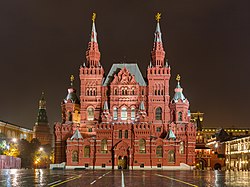
Image source: State Historical Museum
Jan 1924
% complete
Bolshevik planners entertained ideas of demolishing the church after Lenin's funeral in January 1924, sparking a conflict with preservationists like Pyotr Baranovsky that continued until at least 1936.
Image source: Death and state funeral of Vladimir Lenin
1929
% complete
As part of the program of state atheism, the church was confiscated from the Russian Orthodox community and completely secularized in 1929. It remains a federal property of the Russian Federation and has operated as a division of the State Historical Museum since 1928. In autumn 1933 it was struck from the heritage register, though by 1937 even hard-line planners admitted it should be spared.
Image source: State atheism
1939 - 1941
% complete
In spring 1939 the church was locked, probably because demolition was again on the agenda; however, the 1941 publication of Dmitry Sukhov's detailed book on the survey of the church in 1939–1940 speaks against this assumption.
1945
% complete
In the first years after World War II, renovators restored the historical ground-floor arcades and pillars supporting the first-floor platform, cleared vaulted ceilings in the galleries, and removed unhistoric 19th-century oil paint murals inside the churches.
1954 - 1955
% complete
Another round of repairs led by Nikolay Sobolev in 1954–1955 restored original paint imitating brickwork and allowed restorers to dig inside old masonry, revealing a wooden frame running the entire height of the concealed within the brick walls.
1990
% complete
The church has been part of the Moscow Kremlin and Red Square UNESCO World Heritage Site since 1990, recognizing its outstanding cultural value.
Image source: Red Square
1991 - 1997
% complete
Following the dissolution of the Soviet Union in 1991, the building is occasionally used for services by the Russian Orthodox Church. Weekly liturgical celebration and prayers to St. Basil have been restored since 1997, when regular Orthodox Christian services resumed.
Image source: Dissolution of the Soviet Union
Sep 2008
% complete
The last round of renovation was completed in September 2008 with the opening of the restored sanctuary of St. Basil. The building remains partly in use today as a museum.
Or browse the full history timeline directory, with more than 2,000 topics.
This St. Basil's Cathedral timeline was generated with the help of AI, using information found on the internet.
We work hard to keep these timelines accurate, but mistakes do get through. If you spot one, email us at [email protected] and we'll fix it for future visitors.
Generate yours with AI or build it from scratch, for free.
Export your timeline, add your own events, edit or remove AI-generated events, and much more
No credit card required.
Cancel anytime.
Cancel anytime.
You can create an unlimited number of timelines with up to 10 events on each one, customize how they look, export them to PDF, PNG, PowerPoint, CSV, and Excel, and share them with a link. Paid plans raise the event limit and add features like spreadsheet imports and collaborators.
Yes. You can cancel your subscription from your account page at any time, and you will not be charged again. Your subscription stays active for the rest of the period you already paid for.
Yes. We will email you a reminder before the annual renewal, and we will also email you a receipt.
Yes. You can email us within 15 days of any payment, and we will issue you a full refund.
Check out our pricing docs or send us an email anytime: [email protected].