-
Use Cases
-
Resources
-
Pricing
St. Paul's Cathedral is an Anglican cathedral in London, England, and the seat of the Bishop of London. The current building, designed by Sir Christopher Wren in the English Baroque style, was completed in 1710 after the previous medieval Gothic cathedral was destroyed in the Great Fire of London in 1666. It stands as one of the most iconic landmarks of the London skyline. More Less
604
% complete
Mellitus, a missionary sent by Pope Gregory the Great, established the first cathedral dedicated to St Paul on Ludgate Hill in London, beginning the site's long religious history.
Image source: St Paul's Cathedral
675
% complete
The original wooden Saxon cathedral was burned down in 675 and was subsequently rebuilt by Erkenwald, Bishop of London, who became one of the church's most venerated figures.
1087
% complete
After the previous cathedral was destroyed in the great fire of 1087, work began on a grand new Norman cathedral that would become known as Old St Paul's, taking centuries to complete.
Image source: Old St Paul's Cathedral
1310
% complete
Old St Paul's was finally completed around 1310, featuring one of the tallest spires in Europe at nearly 150 meters, making it a dominant landmark over medieval London.
1561
% complete
Lightning struck the cathedral's spire in June 1561, destroying the iconic steeple which was never properly restored, leaving the roof vulnerable to later decay.
1621
% complete
The celebrated poet John Donne was installed as Dean of St Paul's Cathedral in 1621, becoming famous for his sermons and serving until his death in 1631; his statue survives in the present building.
Image source: John Donne
1630
% complete
Architect Inigo Jones undertook extensive repairs to the decaying Old St Paul's, adding a classical west portico in one of England's earliest examples of Renaissance architecture.
Image source: Inigo Jones
Sep 2, 1666 - Sep 5, 1666
% complete
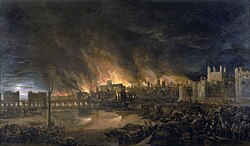
The Great Fire of London swept through the city and engulfed Old St Paul's, reducing the medieval cathedral to a ruined shell and creating the opportunity for an entirely new design.
Image source: Great Fire of London
1668
% complete
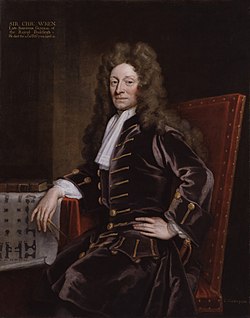
Following earlier repair proposals, Christopher Wren received a royal warrant to design and build an entirely new cathedral, embarking on the greatest architectural project of his career.
Image source: Christopher Wren
1675
% complete
King Charles II approved Wren's revised 'Warrant Design', though Wren continued to modify the plans during construction, notably evolving the dome from a simple drum to a triple-shelled masterpiece.
Jun 21, 1675
% complete
Wren's new cathedral formally began with the laying of its foundation stone in June 1675, marking the start of a monumental construction effort that would last decades.
1708
% complete
The final stone of the cathedral's lantern atop the dome was placed in 1708 by Wren's son and a mason, completing the exterior structure of what remains one of the world's largest domes.
1710 - 1730
% complete
The two western towers, topped with their distinctive Baroque bell towers, were completed in the 1720s under Wren's supervision, finishing the cathedral's iconic western facade.
Dec 25, 1711
% complete
On Christmas Day 1711, an Act of Parliament declared Wren's St Paul's Cathedral complete after 35 years of construction, although interior work and decoration continued for years afterward.
1715 - 1720
% complete
Artist James Thornhill painted the interior of the dome with eight monumental scenes depicting the life of St Paul, creating one of the most impressive Baroque painted interiors in Europe.
Image source: James Thornhill
Feb 25, 1723
% complete
Sir Christopher Wren died in 1723 and was buried in the crypt of his masterpiece, where a memorial plaque famously reads: 'Lector, si monumentum requiris, circumspice' — Reader, if you seek his monument, look around you.
Jan 9, 1806
% complete
Admiral Horatio Nelson, victor of Trafalgar, was given a magnificent state funeral and buried in the crypt of St Paul's, establishing the cathedral as the burial place of Britain's naval heroes.
Image source: State funeral of Horatio Nelson
Nov 18, 1852
% complete
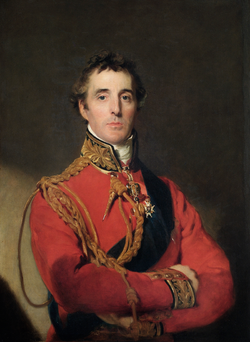
The Duke of Wellington, conqueror of Napoleon at Waterloo, received a massive state funeral attended by vast crowds and was interred in the crypt near Nelson, cementing St Paul's role as a national pantheon.
Image source: Arthur Wellesley, 1st Duke of Wellington
Jun 22, 1897
% complete
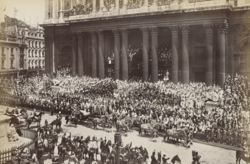
Queen Victoria celebrated her Diamond Jubilee with a grand thanksgiving service outside St Paul's, as she reportedly declined to enter the building she found gloomy, holding the ceremony on its steps instead.
Image source: Diamond Jubilee of Queen Victoria
1918
% complete
During the First World War, St Paul's held special services and intercessions, and in 1918 thousands gathered for silent vigils as the nation mourned the enormous losses of the war.
Oct 10, 1940 - Apr 1941
% complete
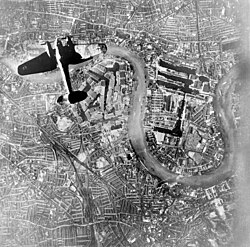
German bombs repeatedly struck St Paul's during the Blitz, destroying the high altar and damaging surrounding areas, yet the cathedral survived largely intact thanks to dedicated fire watchers.
Image source: The Blitz
Dec 29, 1940
% complete
During the Second Great Fire of London, photographer Herbert Mason captured the famous image 'St Paul's Survives', showing the dome rising above swirling smoke and becoming a symbol of British defiance.
Image source: St Paul's Survives
May 13, 1945
% complete
Following victory in Europe, five thanksgiving services were held daily at St Paul's, drawing huge crowds to celebrate the end of war in a cathedral that had become a symbol of national resilience.
Image source: Victory in Europe Day
Jul 29, 1981
% complete
The wedding of Prince Charles and Lady Diana Spencer was held at St Paul's, chosen for its size and processional route; it was watched by a global television audience of hundreds of millions.
Image source: Wedding of Prince Charles and Lady Diana Spencer
Oct 2011 - Feb 2012
% complete
Anti-capitalist protesters camped beside St Paul's for several months, leading to controversy, the resignation of senior clergy, and legal proceedings before the camp was cleared in February 2012.
Image source: Occupy London
Jun 5, 2012
% complete
A national service of thanksgiving at St Paul's marked Queen Elizabeth II's Diamond Jubilee, celebrating 60 years on the throne before crowds and worldwide broadcast audiences.
Image source: Diamond Jubilee of Elizabeth II
Apr 17, 2013
% complete
Former Prime Minister Margaret Thatcher received a ceremonial funeral at St Paul's attended by dignitaries from around the world, reflecting her status as one of Britain's most significant modern political leaders.
Image source: Death and funeral of Margaret Thatcher
Jun 3, 2022
% complete
St Paul's hosted a national service of thanksgiving celebrating Queen Elizabeth II's 70 years on the throne, one of the central events of the Platinum Jubilee celebrations.
Image source: Platinum Jubilee of Elizabeth II
Sep 19, 2022
% complete
Following the death of Queen Elizabeth II, St Paul's rang its bells and held commemorative services, while the state funeral took place nearby at Westminster Abbey, underscoring the cathedral's continuing national role.
Image source: Death and state funeral of Elizabeth II
May 6, 2023 - May 8, 2023
% complete
To mark the coronation of King Charles III, St Paul's held special services of celebration and thanksgiving, continuing its centuries-old tradition of hosting events of national significance.
Image source: Coronation of Charles III and Camilla
Or browse the full history timeline directory, with more than 2,000 topics.
This St. Paul's Cathedral timeline was generated with the help of AI, using information found on the internet.
We work hard to keep these timelines accurate, but mistakes do get through. If you spot one, email us at [email protected] and we'll fix it for future visitors.
Generate yours with AI or build it from scratch, for free.
Export your timeline, add your own events, edit or remove AI-generated events, and much more
No credit card required.
Cancel anytime.
Cancel anytime.
You can create an unlimited number of timelines with up to 10 events on each one, customize how they look, export them to PDF, PNG, PowerPoint, CSV, and Excel, and share them with a link. Paid plans raise the event limit and add features like spreadsheet imports and collaborators.
Yes. You can cancel your subscription from your account page at any time, and you will not be charged again. Your subscription stays active for the rest of the period you already paid for.
Yes. We will email you a reminder before the annual renewal, and we will also email you a receipt.
Yes. You can email us within 15 days of any payment, and we will issue you a full refund.
Check out our pricing docs or send us an email anytime: [email protected].