-
Use Cases
-
Resources
-
Pricing
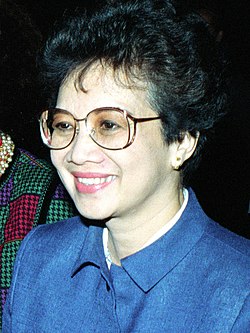
Corazon Aquino (1933–2009) was a Filipino politician who became the first female President of the Philippines and Asia's first female president. Rising to prominence after the assassination of her husband, Senator Benigno 'Ninoy' Aquino Jr., she led the People Power Revolution of 1986, which peacefully ended the dictatorship of Ferdinand Marcos and restored democracy to the Philippines. More Less
Jan 25, 1933
% complete
Maria Corazon Sumulong Cojuangco was born into one of the Philippines' wealthiest and most politically influential families, the Cojuangcos of Tarlac province. Her family's prominence in business and politics would shape her future role in national life.
Image source: Corazon Aquino
1943 - 1949
% complete
Aquino received her early education in Manila, attending Catholic schools including Assumption Convent, where she graduated from high school in 1949. Her Catholic upbringing deeply influenced her values throughout her life.
1949
% complete
Aquino traveled to the United States to continue her education, studying at Ravenhill Academy in Philadelphia before transferring to Notre Dame College in New York and then majoring in mathematics at the College of Mount Saint Vincent.
1953
% complete
Aquino earned a bachelor's degree in French and mathematics in 1953. She briefly pursued law studies in Manila before deciding to focus on her growing family instead of a legal career.
Oct 11, 1954
% complete
Corazon married Benigno 'Ninoy' Aquino Jr., a rising star in Philippine politics who would become a prominent senator and critic of Ferdinand Marcos. Together they had five children: Maria Elena, Aurora Corazon, Benigno III (Noynoy), Victoria Elisa, and Kristina Bernadette (Kris).
Image source: Ninoy Aquino
1957 - 1972
% complete
As her husband rose from mayor of Concepcion to governor of Tarlac and then senator, Corazon served as his hostess and political partner, though she initially preferred staying out of the limelight while raising their five children.
Sep 21, 1972
% complete
President Ferdinand Marcos declared martial law across the Philippines, suspending civil liberties and arresting opposition figures. Ninoy Aquino, then a leading senator, was among the first arrested and detained, beginning years of hardship for the Aquino family.
Image source: Martial law under Ferdinand Marcos
Sep 23, 1972 - May 8, 1980
% complete
During her husband's seven years of detention, Corazon became increasingly involved in politics herself, serving as a vital link between Ninoy and his supporters, delivering speeches on his behalf, and becoming an outspoken advocate against martial law.
May 1980
% complete
After Marcos allowed Ninoy to leave for heart bypass surgery in the United States, the Aquino family settled in Boston, where they enjoyed three years of relative peace. The family later described this period as among the happiest of their lives.
Aug 21, 1983
% complete
Ninoy Aquino was assassinated upon returning to Manila at the tarmac of Manila International Airport despite military escort. His murder shocked the nation, galvanized mass opposition to Marcos, and transformed Corazon into a symbol of democratic resistance.
Image source: Assassination of Ninoy Aquino
1984 - Feb 1986
% complete
Following her husband's assassination, Corazon Aquino emerged as a leader of the opposition, participating in massive protest rallies and funeral marches that drew hundreds of thousands of Filipinos demanding an end to the Marcos dictatorship.
Image source: People Power Revolution
Dec 3, 1985
% complete
After pressure from opposition groups and a million-signature petition campaign, Aquino announced she would run for president against Ferdinand Marcos in the snap election he had called, uniting much of the fragmented anti-Marcos movement behind her candidacy.
Image source: 1986 Philippine presidential election
Feb 16, 1986
% complete
Responding to the fraudulent count, Aquino led a massive rally at Rizal Park where she called for nonviolent resistance and nationwide civil disobedience against the illegitimate government, setting the stage for the People Power Revolution.
Feb 7, 1986
% complete
Filipinos voted in a snap election between Corazon Aquino and incumbent Ferdinand Marcos. Despite widespread electoral fraud, intimidation, and vote-buying by the Marcos camp, the election commission's tally favored Marcos while the independent NAMFREL count showed Aquino ahead.
Feb 22, 1986
% complete
Defense Minister Juan Ponce Enrile and Armed Forces Vice Chief Fidel Ramos broke away from Marcos and barricaded themselves at Camp Aguinaldo and Camp Crame, publicly calling on Aquino to lead a transition government.
Feb 22, 1986 - Feb 25, 1986
% complete
Hundreds of thousands of unarmed Filipinos filled Epifanio de los Santos Avenue, facing down tanks and soldiers with prayers, rosaries, and flowers. The peaceful uprising, backed by the defection of military leaders, forced Marcos to flee the country, ending his two-decade rule without bloodshed.
Feb 25, 1986
% complete
Corazon Aquino took the presidential oath at Club Filipino, becoming the first female president of the Philippines and Asia. Her inauguration restored constitutional democracy after fourteen years of authoritarian rule and made her a global icon of democracy.
Image source: Presidency of Corazon Aquino
Mar 1986 - Dec 31, 1986
% complete
One of Aquino's first acts was releasing hundreds of political prisoners, dissolving the National Assembly, and restoring freedom of speech, press, and assembly that had been suppressed under martial law.
Jun 1986 - Oct 15, 1986
% complete
Aquino convened a Constitutional Commission of 48 members to draft a new constitution replacing the 1973 Marcos-era charter. The resulting document limited presidents to a single six-year term, restored bicameralism, and abolished martial law powers.
Image source: Constitution of the Philippines
Jul 6, 1986
% complete
Former vice presidential candidate Arturo Tolentino and loyalist forces seized Manila Hotel and declared a rival government. The poorly supported rebellion collapsed within days when troops refused to join, marking the first of several coup attempts against Aquino's administration.
Sep 18, 1986
% complete
In a moving speech to the United States Congress, Aquino recounted her husband's sacrifice and appealed for economic assistance for the struggling democracy. She received thunderous standing ovations, and Congress subsequently approved $200 million in additional aid.
Feb 2, 1987
% complete
The 1987 Constitution was approved by over three-quarters of voters in a national plebiscite. Widely considered one of Asia's most liberal charters, it enshrined human rights protections and institutionalized the restoration of democracy.
Aug 28, 1987
% complete
A bloody coup attempt led by Colonel Gregorio Honasan killed dozens of people, including many civilians, as rebels attacked Malacañang Palace and other installations. Aquino survived at least seven coup attempts during her presidency, relying on loyal military forces each time.
Jun 10, 1988
% complete
Aquino signed the Comprehensive Agrarian Reform Law (CARL), launching the Comprehensive Agrarian Reform Program to redistribute agricultural land to landless farmers. She also placed the Cojuangco-owned Hacienda Luisita under the program through stock distribution.
Jun 15, 1991
% complete
The catastrophic eruption of Mount Pinatubo, one of the largest volcanic events of the 20th century, devastated Central Luzon. Aquino's government coordinated massive evacuation and relief efforts, with timely warnings credited with saving tens of thousands of lives.
Image source: 1991 eruption of Mount Pinatubo
Oct 10, 1991
% complete
The Local Government Code devolved significant powers and resources from the national government to provinces, cities, municipalities, and barangays, empowering local autonomy as part of Aquino's democratization agenda.
Image source: Philippine legal codes
Jan 1992 - May 11, 1992
% complete
Despite her party's candidate Ramon Mitra, Aquino endorsed her former defense secretary Fidel Ramos, whose 'Saklolo' campaign emphasized continuity. Ramos won a narrow victory, ensuring stability after Aquino's single term, which she had pledged not to extend.
Image source: 1992 Philippine general election
Jun 30, 1992
% complete
Aquino completed the first peaceful democratic transfer of power since the Marcos era, voluntarily stepping down after one term. She retired from active politics but remained an influential moral voice in Philippine public life.
2000 - Jan 2001
% complete
Aquino joined Cardinal Jaime Sin and civil society in protests demanding President Joseph Estrada's resignation amid corruption scandals. Estrada's ouster during EDSA II elevated Gloria Macapagal Arroyo to the presidency, echoing the 1986 uprising.
Image source: Second EDSA Revolution
2008
% complete
Disillusioned by allegations of electoral fraud and corruption under Arroyo, Aquino publicly apologized for supporting EDSA II and called for Arroyo's resignation, demonstrating her consistent commitment to accountable governance even against former allies.
Image source: Hello Garci scandal
Aug 1, 2009
% complete
Aquino died at age 76 after battling colon cancer. Hundreds of thousands of Filipinos lined the streets for her funeral procession, mourning the 'Mother of Philippine Democracy' and celebrating a life devoted to restoring and defending freedom in her country.
Image source: Death and funeral of Corazon Aquino
Aug 3, 2009
% complete
Days after her death, President Arroyo posthumously conferred the Presidential Medal of Merit and later honors recognizing Aquino's contributions. Her legacy endures through the 1987 Constitution, restored democratic institutions, and her son Noynoy Aquino's election as president in 2010.
Or browse the full history timeline directory, with more than 2,000 topics.
This Corazon Aquino timeline was generated with the help of AI, using information found on the internet.
We work hard to keep these timelines accurate, but mistakes do get through. If you spot one, email us at [email protected] and we'll fix it for future visitors.
Generate yours with AI or build it from scratch, for free.
Export your timeline, add your own events, edit or remove AI-generated events, and much more
No credit card required.
Cancel anytime.
Cancel anytime.
You can create an unlimited number of timelines with up to 10 events on each one, customize how they look, export them to PDF, PNG, PowerPoint, CSV, and Excel, and share them with a link. Paid plans raise the event limit and add features like spreadsheet imports and collaborators.
Yes. You can cancel your subscription from your account page at any time, and you will not be charged again. Your subscription stays active for the rest of the period you already paid for.
Yes. We will email you a reminder before the annual renewal, and we will also email you a receipt.
Yes. You can email us within 15 days of any payment, and we will issue you a full refund.
Check out our pricing docs or send us an email anytime: [email protected].