-
Use Cases
-
Resources
-
Pricing
Jul 12, 1997
% complete
Malala Yousafzai was born on July 12, 1997, in Mingora, the largest town in the Swat Valley of northwestern Pakistan. Her father, Ziauddin Yousafzai, ran a school and was a passionate advocate for education, which would deeply shape Malala's upbringing and future path.
Image source: Malala Yousafzai
Jan 1, 2000
% complete
From an early age, Malala attended the Khushal Public School founded by her father. She proved to be a gifted student, excelling academically and developing a love of learning that would become central to her identity.
Image source: Malala Yousafzai
Jul 24, 2009
% complete
After the Pakistani army regained control of the region, Malala and her family returned to Mingora. She resumed her schooling and continued speaking publicly about the importance of education for girls.
Image source: Second Battle of Swat
Mar 19, 2013
% complete
In March 2013, Malala enrolled at Edgbaston High School for Girls in Birmingham, fulfilling her dream of returning to formal education in safety and beginning her studies toward A-levels.
Aug 17, 2017
% complete
Malala completed her secondary education at Edgbaston High School for Girls, earning strong A-level results and preparing to enter university while continuing her global advocacy work.
Image source: Edgbaston High School
Oct 9, 2017
% complete
Fulfilling a long-held ambition, Malala began studying Philosophy, Politics, and Economics at Oxford University, becoming one of the world's most watched students while balancing coursework with activism.
Image source: Lady Margaret Hall, Oxford
Jun 19, 2020
% complete
Amid the COVID-19 pandemic, Malala graduated with a degree in Philosophy, Politics, and Economics, celebrating the milestone she once dreamed of achieving during her years of exile from Pakistan.
Image source: University of Oxford
Jan 1, 2007
% complete
The Taliban began asserting control over the Swat Valley, imposing harsh rules including restrictions on girls' education. Hundreds of schools were destroyed or closed, creating an atmosphere of fear and repression in the region.
Jan 3, 2009 - Mar 12, 2009
% complete
At just eleven years old, Malala began writing a blog for BBC Urdu under the pseudonym 'Gul Makai', detailing life under Taliban rule and her determination to continue attending school. Her candid accounts of fear, school closures, and hope brought international attention to the plight of girls in Swat.
Image source: I Am Malala
Feb 19, 2009
% complete
Malala and her father were featured in a New York Times documentary about school closures in Swat. The film raised her profile internationally and showed her courage in defying Taliban edicts against girls' education.
Image source: X-Men: First Class
May 5, 2009
% complete
As the Pakistani military launched an operation to retake the Swat Valley from the Taliban, Malala and her family were forced to flee their home. They spent months displaced before returning after the region was declared safe.
Dec 1, 2009
% complete
Following the success of her blog, Malala stepped out of anonymity and became a prominent public speaker for girls' education in Pakistan, giving interviews with national and international media despite ongoing threats.
Oct 27, 2011
% complete
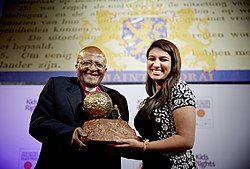
Archbishop Desmond Tutu nominated Malala for the KidsRights International Children's Peace Prize, honoring her bravery in speaking out for girls' rights under threat from the Taliban.
Image source: International Children's Peace Prize
Nov 2011
% complete
In November 2011, the Pakistani government awarded Malala its inaugural National Youth Peace Prize in recognition of her advocacy. Prime Minister Yousaf Raza Gillani praised her courage and pledged support for education initiatives.
Apr 2013
% complete
Time magazine included Malala in its annual list of the world's most influential people, cementing her status as a leading global voice for children's rights and education.
Image source: Time 100
Jul 12, 2013
% complete
On her sixteenth birthday, celebrated as 'Malala Day' by the UN Youth Assembly, she delivered a powerful speech declaring that one child, one teacher, one book, and one pen can change the world, calling for worldwide access to education.
Image source: United Nations
Sep 2013
% complete
Together with her father Ziauddin, Malala established the Malala Fund, a non-profit organization dedicated to ensuring every girl has access to twelve years of free, safe, quality education around the world.
Image source: Malala Fund
Oct 8, 2013
% complete
Co-written with journalist Christina Lamb, Malala's memoir 'I Am Malala' chronicled her childhood in Swat, her campaign for education, and her recovery from the attack. It became an international bestseller translated into dozens of languages.
Oct 11, 2013
% complete
Malala met with U.S. President Barack Obama and his family, where she discussed the importance of education and expressed concern that drone strikes were fueling extremism, demonstrating her willingness to speak frankly even to world leaders.
Image source: Barack Obama
Nov 20, 2013
% complete
The European Parliament awarded Malala the Sakharov Prize for Freedom of Thought, one of Europe's most prestigious human rights honors, recognizing her fight for the right to education.
Image source: Sakharov Prize
Oct 10, 2014
% complete
Malala became the youngest-ever Nobel laureate when she shared the 2014 Nobel Peace Prize with Indian child rights activist Kailash Satyarthi. The Norwegian Nobel Committee honored their struggle for children's and young people's rights.
Image source: Nobel Peace Prize
Dec 10, 2014
% complete
In her Nobel lecture in Oslo, Malala dedicated the award to 'voiceless children' worldwide, urging leaders to invest in education rather than war and reaffirming her commitment to peaceful change.
Jul 2015
% complete
Using proceeds from the Nobel Peace Prize, Malala Fund helped open a secondary school for Syrian refugee girls in Lebanon's Bekaa Valley, expanding access to education for displaced children.
Jul 17, 2017 - Jul 21, 2017
% complete
Malala traveled to Nigeria to meet families of girls kidnapped by Boko Haram from their school in Chibok, drawing renewed international attention to the crisis and calling for urgent action on education in conflict zones.
Image source: Chibok schoolgirls kidnapping
Sep 4, 2018
% complete
'We Are Displaced' told Malala's own displacement story alongside those of refugee girls she had met around the world, humanizing the experiences of millions forced from their homes by conflict and persecution.
Image source: We Are Displaced
Jun 2020
% complete
Malala partnered with Spotify to produce a limited audio series featuring conversations with young people affected by the pandemic and displaced by conflict, extending her advocacy into new media formats.
Nov 2022
% complete
Malala expanded into film production through Extracurricular, her content company, executive producing projects including the acclaimed short documentary 'Stranger at the Gate', continuing to champion stories of tolerance and humanity.
Image source: Stranger at the Gate
Oct 9, 2012
% complete
On October 9, 2012, a masked gunman boarded Malala's school bus and shot her in the head. The assassination attempt, ordered by the Taliban in retaliation for her activism, shocked the world and sparked global condemnation.
Oct 15, 2012
% complete
After initial treatment in Peshawar, Malala was airlifted to the United Kingdom, where surgeons at the Queen Elizabeth Hospital performed complex operations to repair her skull and restore hearing damaged by the attack.
Jan 4, 2013
% complete
After weeks of intensive care and rehabilitation, Malala was discharged from the hospital in January 2013. She rejoined her family in Birmingham and gradually resumed public life, showing remarkable resilience.
Image source: Malala Yousafzai
Or browse the full history timeline directory, with more than 2,000 topics.
This Malala Yousafzai timeline was generated with the help of AI, using information found on the internet.
We work hard to keep these timelines accurate, but mistakes do get through. If you spot one, email us at [email protected] and we'll fix it for future visitors.
Generate yours with AI or build it from scratch, for free.
Export your timeline, add your own events, edit or remove AI-generated events, and much more
No credit card required.
Cancel anytime.
Cancel anytime.
You can create an unlimited number of timelines with up to 10 events on each one, customize how they look, export them to PDF, PNG, PowerPoint, CSV, and Excel, and share them with a link. Paid plans raise the event limit and add features like spreadsheet imports and collaborators.
Yes. You can cancel your subscription from your account page at any time, and you will not be charged again. Your subscription stays active for the rest of the period you already paid for.
Yes. We will email you a reminder before the annual renewal, and we will also email you a receipt.
Yes. You can email us within 15 days of any payment, and we will issue you a full refund.
Check out our pricing docs or send us an email anytime: [email protected].