
-
Use Cases
-
Resources
-
Pricing
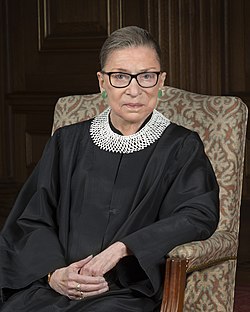
Ruth Bader Ginsburg (1933–2020) was an American lawyer and jurist who served as an Associate Justice of the U.S. Supreme Court from 1993 until her death in 2020. A trailblazer for gender equality, she co-founded the ACLU Women's Rights Project, argued landmark cases before the Court as an attorney, and became the second woman ever to serve on the Supreme Court. Affectionately known as 'RBG' or the 'Notorious R.B.G.,' she left a lasting legacy as a fierce advocate for civil rights, women's rights, and justice. More Less
Mar 15, 1933
% complete
Joan Ruth Bader was born to Jewish parents Celia and Nathan Bader in Brooklyn's Flatbush neighborhood. Her older sister Marilyn died young, and her mother Celia instilled in her a love of education before dying of cancer the day before Ruth's high school graduation.
Image source: Ruth Bader Ginsburg
Jun 1950
% complete
Ginsburg graduated as one of the top students in her class at James Madison High School in Brooklyn. Her mother's death a day earlier prevented her mother from witnessing this milestone, which deeply affected Ginsburg throughout her life.
Image source: James Madison High School (Brooklyn)
Sep 1950
% complete
Ginsburg attended Cornell University on a full scholarship, where she met fellow student Martin Ginsburg. She studied government and graduated first in her class in 1954 with a bachelor's degree.
Image source: Cornell University
Jun 23, 1954
% complete
Ruth Bader married Martin 'Marty' Ginsburg shortly after her graduation from Cornell. Their marriage became famously egalitarian, with Marty supporting her career ambitions and sharing domestic responsibilities decades ahead of social norms.
Image source: Martin D. Ginsburg
Jul 21, 1955
% complete
Ginsburg gave birth to her first child, Jane, while she was a Harvard Law student. Her pregnancy initially caused anxiety about her academic future, but she successfully kept up with her demanding coursework, even while caring for an infant.
Image source: Jane C. Ginsburg
Sep 1956
% complete
Ginsburg entered Harvard Law School as one of only nine women in a class of about 500 students. She faced overt gender discrimination from faculty and administrators, including being asked by Dean Griswold how she justified taking a man's place at law school.
Image source: Harvard Law School
Jun 1959
% complete
After Marty took a job in New York City, Ginsburg transferred to Columbia Law School, where she became the first woman to serve on two major law journals. She graduated tied for first in her class in 1959, yet still struggled to find employment because of her gender.
Image source: Columbia Law School
Sep 8, 1965
% complete
Ginsburg gave birth to her second child, James Steven Ginsburg, while balancing her role as a law professor. She famously worked through labor to finish grading exams before going to the hospital.
1963
% complete
Ginsburg began her academic career at Rutgers Law School in Newark, New Jersey, becoming one of fewer than 20 female law professors in the country. She taught there until 1972 and was denied equal pay until women colleagues protested on her behalf.
Image source: Rutgers Law School
1970 - 1980
% complete
Throughout the 1970s, Ginsburg argued numerous cases challenging sex-based discrimination, often framing issues as burdens on both men and women. Cases like Moritz v. Commissioner (1972), in which she secured tax deductions for a single father, showcased her strategy of demonstrating that gender stereotypes harmed everyone.
Nov 1971
% complete
Ginsburg wrote the brief for Reed v. Reed, the first case in which the U.S. Supreme Court ruled that sex-based discrimination violated the Constitution under the Equal Protection Clause. The court ruled unanimously against Idaho's practice of automatically preferring men over women as estate administrators.
Image source: Reed v. Reed
1972
% complete
Ginsburg co-founded the Women's Rights Project at the American Civil Liberties Union, launching a strategic campaign to advance gender equality through litigation. Under her leadership, the project fought hundreds of discrimination cases across the nation.
Image source: American Civil Liberties Union
1972 - 1980
% complete
Ginsburg became the first tenured female law professor at Columbia University. During this period, she also contributed to drafting the legal framework for Title IX legislation and continued her advocacy through the ACLU Women's Rights Project.
Jan 1, 1973
% complete
As part of the ACLU Women's Rights Project, Ginsburg authored a landmark report documenting widespread sex discrimination in the legal system, providing evidence that helped shape the movement for gender equality in American jurisprudence.
Image source: Women's rights
Jan 17, 1973
% complete
Ginsburg made her first oral argument before the Supreme Court in Frontiero v. Richardson, challenging military regulations that denied benefits to wives of servicewomen granted automatically to husbands of servicemen. She won, marking a major victory for gender equality.
Apr 1980
% complete
President Jimmy Carter nominated Ginsburg to the U.S. Court of Appeals for the District of Columbia Circuit, where she served from 1980 to 1993. On the bench, she developed a reputation as a moderate jurist with a sharp intellect and careful approach to precedent.
Image source: United States Court of Appeals for the District of Columbia Circuit
Jun 18, 1980
% complete
The U.S. Senate confirmed Ginsburg's nomination to the D.C. Circuit Court of Appeals. Her service on this appellate bench for thirteen years honed her judicial philosophy and prepared her for her eventual elevation to the Supreme Court.
Image source: United States Senate
Jun 14, 1993
% complete
President Bill Clinton announced his nomination of Judge Ruth Bader Ginsburg to fill the vacancy left by retiring Justice Byron White. Clinton praised her as someone who would interpret the Constitution with fidelity and common sense, calling her 'a lawyer's lawyer.'
Image source: Presidency of Bill Clinton
Jul 20, 1993
% complete
Ginsburg testified before the Senate Judiciary Committee, emphasizing her judicial philosophy of restraint and respect for precedent. She described herself as a moderate judge and pledged to bring civility to public discourse, winning broad bipartisan support.
Aug 10, 1993
% complete
Ruth Bader Ginsburg became the second woman ever confirmed to the U.S. Supreme Court, sworn in by Chief Justice William Rehnquist after confirmation by a vote of 96-3. Her appointment marked a historic milestone for women in American law and governance.
Image source: Associate Justice of the Supreme Court of the United States
Nov 1993
% complete
In her early months on the Court, Ginsburg established herself as a thoughtful voice on reproductive rights and constitutional interpretation, building on the legacy of cases like Harris v. McRae that shaped access to healthcare funding for poor women.
Image source: Harris v. McRae
Jun 26, 1996
% complete
Ginsburg wrote the landmark majority opinion in United States v. Virginia, ruling that the Virginia Military Institute's male-only admissions policy violated the Fourteenth Amendment's Equal Protection Clause. The decision established that gender classifications must serve 'exceedingly persuasive' justifications.
May 18, 1998
% complete
Ginsburg dissented in Miller v. Albright, criticizing immigration rules that treated children of unmarried American mothers differently from children of unmarried American fathers. Her dissent reflected her lifelong commitment to eliminating gender-based distinctions in law.
May 29, 2007
% complete
Ginsburg's passionate dissent in Ledbetter v. Goodyear criticized the Court's narrow interpretation of Title VII regarding pay discrimination. Her dissent inspired Congress to pass the Lilly Ledbetter Fair Pay Act in 2009, the first bill signed by President Obama.
Jun 26, 2013
% complete
In the years leading up to Obergefell v. Hodges, Ginsburg officiated several same-sex weddings at the Supreme Court and voiced strong support for marriage equality, presaging her pivotal role when the Court ruled in favor of same-sex marriage nationwide in June 2015.
Jun 26, 2015
% complete
Ginsburg joined her colleagues in voting to affirm same-sex couples' right to marry nationwide in the historic Obergefell v. Hodges decision. She had previously officiated same-sex weddings and called the ruling a momentous achievement for equality.
Feb 5, 2009
% complete
Ginsburg was diagnosed with early-stage pancreatic cancer and underwent surgery at Memorial Sloan-Kettering Cancer Center. Remarkably, she returned to work within three weeks and did not miss a single day of Supreme Court deliberations during treatment.
Image source: Pancreatic cancer
Aug 12, 2009
% complete
President Barack Obama awarded Ginsburg the Presidential Medal of Freedom, the highest civilian honor in the United States, recognizing her pioneering contributions to gender equality and her transformative impact on American law and society.
Image source: Presidential Medal of Freedom
2013
% complete
A Tumblr blog created by law student Shana Knizhnik transformed Ginsburg into a pop culture phenomenon known as 'The Notorious R.B.G.' Her image appeared on t-shirts, mugs, and memes, making her an unexpected icon for younger generations and a symbol of resistance.
Image source: Ruth Bader Ginsburg
Nov 2019
% complete
Ginsburg underwent a cardiac procedure to place a stent to clear a blockage in her right coronary artery after experiencing chest discomfort during exercise. She continued working despite recurring health challenges, becoming famous for her rigorous fitness regimen.
Image source: Stent
Sep 18, 2020
% complete
Justice Ruth Bader Ginsburg died at her home in Washington, D.C., surrounded by family, from complications of metastatic pancreatic cancer. Her death just weeks before the presidential election sparked national mourning and intense political debate over her successor.
Image source: Death and state funeral of Ruth Bader Ginsburg
Sep 25, 2020
% complete
Ginsburg became the first woman to lie in state at the U.S. Capitol, honored with a private ceremony in Statuary Hall attended by congressional leaders and dignitaries. Thousands paid their respects outside, celebrating a life devoted to justice and equality.
Or browse the full history timeline directory, with more than 2,000 topics.
This Ruth Bader Ginsburg timeline was generated with the help of AI, using information found on the internet.
We work hard to keep these timelines accurate, but mistakes do get through. If you spot one, email us at [email protected] and we'll fix it for future visitors.
Generate yours with AI or build it from scratch, for free.
Export your timeline, add your own events, edit or remove AI-generated events, and much more
No credit card required.
Cancel anytime.
Cancel anytime.
You can create an unlimited number of timelines with up to 10 events on each one, customize how they look, export them to PDF, PNG, PowerPoint, CSV, and Excel, and share them with a link. Paid plans raise the event limit and add features like spreadsheet imports and collaborators.
Yes. You can cancel your subscription from your account page at any time, and you will not be charged again. Your subscription stays active for the rest of the period you already paid for.
Yes. We will email you a reminder before the annual renewal, and we will also email you a receipt.
Yes. You can email us within 15 days of any payment, and we will issue you a full refund.
Check out our pricing docs or send us an email anytime: [email protected].