-
Use Cases
-
Resources
-
Pricing
Feb 12, 1809
% complete
Abraham Lincoln was born in a one-room log cabin on Sinking Spring Farm near Hodgenville, Kentucky. He was the second child of Thomas Lincoln and Nancy Hanks Lincoln, growing up in a modest frontier family that would shape his humble character.
1816
% complete
The Lincoln family relocated to Spencer County, Indiana, partly due to land title issues in Kentucky and slavery's presence there. Young Abraham helped clear land, build a cabin, and received little formal schooling, educating himself largely through borrowed books.
Oct 5, 1818
% complete
Nancy Hanks Lincoln died of milk sickness when Abraham was nine years old, a devastating loss that deeply affected him. His father later remarried Sarah Bush Johnston, who became a loving stepmother and encouraged young Abraham's love of reading.
Image source: Nancy Lincoln
Mar 1830
% complete
The Lincolns moved to Macon County, Illinois, where Abraham helped his father build another farm before striking out on his own at age 22. He settled in New Salem, Illinois, working as a store clerk, postmaster, and surveyor.
Apr 1832 - Jul 1832
% complete
Lincoln enlisted as a volunteer in the Black Hawk War and was elected captain of his company, though he saw no combat. He often joked that his military service consisted of 'charges upon the wild onions' and mosquito battles.
Image source: Black Hawk War
Aug 4, 1834
% complete
Lincoln won election to the Illinois state legislature as a Whig, beginning four consecutive terms. During this period he studied law on his own and was admitted to the Illinois bar in 1836.
Image source: Abraham Lincoln
Apr 1837
% complete
Lincoln moved to Springfield, the new state capital, and began practicing law with John Todd Stuart. He later formed a successful partnership with Stephen T. Logan and then William Herndon, becoming a respected lawyer riding the Eighth Judicial Circuit.
Image source: Lincoln-Herndon Law Offices State Historic Site
Nov 4, 1842
% complete
Lincoln married Mary Todd, a well-educated woman from a prominent Lexington, Kentucky family, after an on-and-off courtship. The couple had four sons: Robert, Edward, Willie, and Tad, though only Robert survived to adulthood.
Image source: Mary Todd Lincoln
Nov 7, 1846
% complete
Lincoln won election to Congress as the only Whig from Illinois, serving one term from 1847 to 1849. He criticized President Polk's conduct of the Mexican-American War, which proved unpopular back home and led him not to seek reelection.
1849 - 1854
% complete
After leaving Congress, Lincoln devoted himself to his lucrative law practice in Springfield, representing railroads and other clients across Illinois. The Kansas-Nebraska Act of 1854 drew him back into politics.
May 30, 1854
% complete
Senator Stephen Douglas's act allowed settlers in new territories to decide slavery by popular vote, repealing the Missouri Compromise. The act outraged Lincoln, who re-entered politics to oppose slavery's expansion, delivering powerful speeches against it.
Image source: Kansas–Nebraska Act
Jun 16, 1858
% complete
Accepting the Republican nomination for Senate, Lincoln famously declared that 'a house divided against itself cannot stand,' arguing the nation could not permanently endure half slave and half free. The speech defined the moral stakes of the sectional crisis.
Image source: Lincoln's House Divided Speech
Aug 21, 1858 - Oct 15, 1858
% complete
Lincoln engaged Senator Stephen Douglas in seven legendary debates across Illinois during their Senate race. Though Douglas won reelection, the debates gave Lincoln national prominence and showcased his eloquent arguments against slavery's expansion.
Image source: Lincoln–Douglas debates
Feb 27, 1860
% complete
Lincoln delivered a carefully researched address at Cooper Union arguing that the Founders had supported restricting slavery. The widely reprinted speech made him credible to eastern Republicans and boosted his presidential prospects.
Image source: Cooper Union speech
May 18, 1860
% complete
The Republican Convention in Chicago nominated Lincoln for president on the third ballot, choosing the moderate former one-term congressman over better-known rivals like William Seward and Salmon Chase. Hannibal Hamlin was named his running mate.
Image source: 1860 Republican National Convention
Nov 6, 1860
% complete
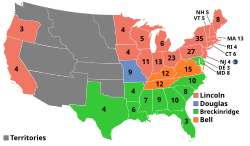
Lincoln defeated three opponents—Douglas, John Breckinridge, and John Bell—winning about 40% of the popular vote but a decisive electoral majority without carrying a single Deep South state. Southern states viewed his victory as a threat to slavery.
Image source: 1860 United States presidential election
Dec 20, 1860
% complete
Following Lincoln's election, South Carolina declared its secession, followed within months by Mississippi, Florida, Alabama, Georgia, Louisiana, and Texas. The seceding states formed the Confederate States of America under Jefferson Davis in February 1861.
Image source: Secession in the United States
Apr 12, 1861 - Apr 13, 1861
% complete
Confederate forces bombarded Fort Sumter in Charleston Harbor after Lincoln announced plans to resupply the garrison. The fort surrendered, and Lincoln called for 75,000 volunteers, prompting Virginia, North Carolina, Tennessee, and Arkansas to join the Confederacy.
Image source: Battle of Fort Sumter
Sep 17, 1862
% complete
Union forces under George McClellan halted Robert E. Lee's invasion of Maryland in the bloodiest single day of American history, with roughly 23,000 casualties. The strategic victory gave Lincoln the confidence to issue the Emancipation Proclamation.
Image source: Battle of Antietam
Nov 19, 1863
% complete
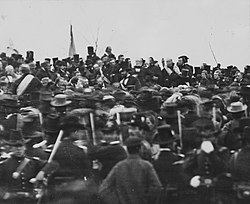
At the dedication of the Soldiers' National Cemetery at Gettysburg, Lincoln delivered just ten sentences that redefined the Civil War as a test of whether government 'of the people, by the people, for the people' could endure. The brief speech became one of the most celebrated orations in American history.
Image source: Gettysburg Address
Mar 9, 1864
% complete
Lincoln elevated Ulysses S. Grant to command all Union armies after his victories at Vicksburg and Chattanooga. Grant's relentless strategy of coordinated offensives, alongside William Tecumseh Sherman's march through Georgia, gradually ground down the Confederacy.
Image source: Ulysses S. Grant
Apr 3, 1865
% complete
Union troops captured Richmond, the Confederate capital, forcing Jefferson Davis's government to flee. Lincoln visited the city the following day, walking its streets accompanied only by a small escort, greeted joyfully by formerly enslaved people.
Image source: Third Battle of Petersburg
Apr 9, 1865
% complete
General Robert E. Lee surrendered the Army of Northern Virginia to Grant at Appomattox Court House, effectively ending major combat in the Civil War. Lincoln celebrated the news and spoke publicly about reconstructing the South and extending rights to freedmen.
Image source: Battle of Appomattox Court House
Mar 4, 1861
% complete
Lincoln took the oath of office pledging to hold federal property and vowing he had no intention of ending slavery where it existed, appealing to 'the mystic chords of memory.' He warned that secession was legally impossible and urged reconciliation.
Image source: First inauguration of Abraham Lincoln
Feb 20, 1862
% complete
Eleven-year-old Willie Lincoln died of typhoid fever at the White House, plunging the Lincolns into profound grief. Mary Todd never fully recovered, while Lincoln channeled his sorrow into reflections on suffering and mortality.
Image source: William Wallace Lincoln
Jan 1, 1863
% complete
Lincoln issued the Emancipation Proclamation declaring freedom for enslaved people in Confederate-held territory, transforming the war into a struggle for freedom. It paved the way for African American enlistment in the Union Army and redefined the nation's purpose.
Image source: Emancipation Proclamation
Nov 8, 1864
% complete
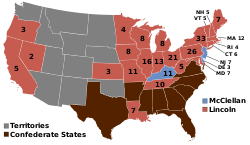
Lincoln decisively defeated Democratic candidate George McClellan, winning 212 electoral votes amid wartime conditions and soldier voting. His reelection affirmed public support for pursuing the war to unconditional Union victory.
Image source: 1864 United States presidential election
Mar 4, 1865
% complete
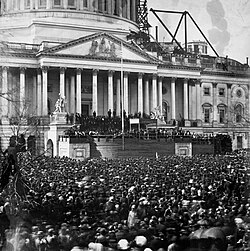
Beginning his second term with the war nearly won, Lincoln delivered his Second Inaugural Address, calling for 'malice toward none, with charity for all' and urging the nation to bind up its wounds. The address is considered among the greatest speeches in American history.
Image source: Second inauguration of Abraham Lincoln
Apr 14, 1865
% complete
While attending the play 'Our American Cousin' at Ford's Theatre, Lincoln was shot in the head by actor and Confederate sympathizer John Wilkes Booth. The same night, Booth's co-conspirator Lewis Powell attacked Secretary of State William Seward at his home.
Apr 15, 1865
% complete
Lincoln died at 7:22 a.m. in the Petersen House across from Ford's Theatre, having never regained consciousness. Secretary of War Edwin Stanton reportedly said, 'Now he belongs to the ages.' Lincoln was the first U.S. president to be assassinated.
Image source: Assassination of Abraham Lincoln
Apr 21, 1865 - May 3, 1865
% complete
Lincoln's funeral train retraced his 1860 inaugural route in reverse, allowing millions of mourners to pay respects in cities including Philadelphia, New York, Chicago, and Indianapolis. His body was interred at Oak Ridge Cemetery in Springfield, Illinois.
Image source: Funeral train
Dec 6, 1865
% complete
Eight months after Lincoln's death, the Thirteenth Amendment abolishing slavery throughout the United States was ratified, cementing the goal Lincoln had championed. The amendment fulfilled his vision of a nation without human bondage.
Image source: Thirteenth Amendment to the United States Constitution
Or browse the full history timeline directory, with more than 2,000 topics.
This Abraham Lincoln timeline was generated with the help of AI, using information found on the internet.
We work hard to keep these timelines accurate, but mistakes do get through. If you spot one, email us at [email protected] and we'll fix it for future visitors.
Generate yours with AI or build it from scratch, for free.
Export your timeline, add your own events, edit or remove AI-generated events, and much more
No credit card required.
Cancel anytime.
Cancel anytime.
You can create an unlimited number of timelines with up to 10 events on each one, customize how they look, export them to PDF, PNG, PowerPoint, CSV, and Excel, and share them with a link. Paid plans raise the event limit and add features like spreadsheet imports and collaborators.
Yes. You can cancel your subscription from your account page at any time, and you will not be charged again. Your subscription stays active for the rest of the period you already paid for.
Yes. We will email you a reminder before the annual renewal, and we will also email you a receipt.
Yes. You can email us within 15 days of any payment, and we will issue you a full refund.
Check out our pricing docs or send us an email anytime: [email protected].