-
Use Cases
-
Resources
-
Pricing
The Lincoln Memorial is a national monument in Washington, D.C., built to honor Abraham Lincoln, the 16th U.S. President. Designed by architect Henry Bacon and sculptor Daniel Chester French, it features a massive seated statue of Lincoln and has served as a symbolic backdrop for major events in American civil rights history. More Less
1867
% complete
In 1867, Congress passed the first of many bills incorporating a commission to erect a monument honoring Abraham Lincoln, the sixteenth president of the United States, following his assassination in 1865.
1868
% complete
A statue of President Abraham Lincoln by Lot Flannery was erected in front of the District of Columbia City Hall in Washington, D.C., in 1868, three years after Lincoln's assassination in Ford's Theatre.
1901
% complete
The McMillan Plan of 1901 designated the Potomac Park site as the location of a future monument comparable to that of the Washington Monument, laying the groundwork for what would become the Lincoln Memorial.
Image source: McMillan Plan
1901
% complete
After years of dormancy, the memorial effort was revived at the start of the 20th century under the leadership of Senator Shelby M. Cullom of Illinois.
1901 - 1908
% complete
The first five bills proposed in the years 1901, 1902, and 1908 met with defeat because of opposition from Speaker of the House Joe Cannon.
Image source: Lincoln Memorial
Dec 13, 1910
% complete
The sixth bill (Senate Bill 9449), introduced on December 13, 1910, finally passed, clearing the way for the construction of the Lincoln Memorial.
1913
% complete
Progress continued steadily, and in 1913 Congress approved the commission's choice of design and location for the memorial in Potomac Park, Washington, D.C.
Feb 12, 1914
% complete
Construction began on February 12, 1914 — Lincoln's birthday — with contractor M. F. Breakers breaking ground on the project along the Potomac River.
1920
% complete
In 1920, Daniel Chester French designed the large interior Abraham Lincoln statue, which was carved in marble by the Piccirilli brothers.
Image source: Statue of Abraham Lincoln (Lincoln Memorial)
1920
% complete
As late as 1920, the decision was made to substitute an open portal for the bronze and glass grille which was originally planned to guard the entrance to the memorial.
1922
% complete
The 36 columns of the memorial represent the states of the Union at the time of Lincoln's death, while the 48 stone festoons above the columns represent the 48 states in 1922.
May 30, 1922
% complete
William Howard Taft – then Chief Justice of the United States – dedicated the Memorial on May 30, 1922, and presented it to President Warren G. Harding. It is one of several memorials built to honor an American president.
1929
% complete
Feeling that the statue required even more light, Bacon and French designed metal slats for the ceiling to conceal floodlights, which could be modulated to supplement natural light; this modification was installed in 1929.
1929
% complete
The Lincoln Memorial has been depicted on the reverse of the United States five-dollar bill since 1929.
1939
% complete
Frank Capra's 1939 film Mr. Smith Goes to Washington is among many films featuring the Memorial; by 2003 it had appeared in over 60 films that take place in Washington, D.C.
1959
% complete
From 1959, marking the 150th anniversary of Lincoln's birth, the memorial with its statue visible through the columns was depicted on the reverse of the United States one-cent coin, which since 1909 has depicted a bust of Lincoln on its front.
Image source: Lincoln cent
2007
% complete
The Lincoln Memorial was ranked seventh on the American Institute of Architects' 2007 list of America's Favorite Architecture.
Image source: America's Favorite Architecture
1939
% complete
In 1939, the Daughters of the American Revolution refused to allow African-American contralto Marian Anderson to perform before an integrated audience at the organization's Constitution Hall, leading to a famous alternative concert at the Lincoln Memorial.
Image source: Marian Anderson
Jun 29, 1947
% complete
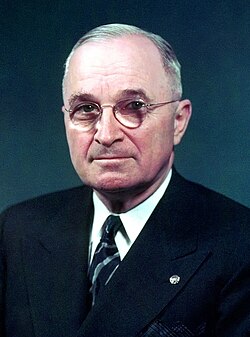
On June 29, 1947, Harry Truman became the first president to address the National Association for the Advancement of Colored People (NAACP), speaking at the steps of the Lincoln Memorial.
Image source: Harry S. Truman
Aug 28, 1963
% complete
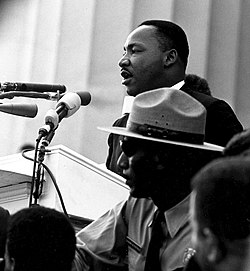
On August 28, 1963, the memorial grounds were the site of the March on Washington for Jobs and Freedom, a high point of the American Civil Rights Movement.
Image source: March on Washington for Jobs and Freedom
Aug 28, 1963
% complete
Martin Luther King Jr.'s 'I Have a Dream' speech was delivered on the steps of the Lincoln Memorial on August 28, 1963, during the rally at the end of the March on Washington for Jobs and Freedom.
Image source: I Have a Dream
May 9, 1970
% complete
At the memorial on May 9, 1970, President Richard Nixon held a middle-of-the-night impromptu, brief meeting with protesters who, just days after the Kent State shootings, were preparing to march against the Vietnam War.
Image source: Richard Nixon
Aug 28, 1983
% complete
On August 28, 1983, crowds gathered again at the memorial to mark the 20th Anniversary Mobilization for Jobs, Peace and Freedom, reflecting on progress in gaining civil rights for African Americans and committing to correcting continuing injustices.
2003
% complete
King's speech is such a part of the Lincoln Memorial story that the spot on which he stood, on the landing eighteen steps below Lincoln's statue, was engraved in 2003 in recognition of the 40th anniversary of the event.
Oct 15, 1966
% complete
The Lincoln Memorial has been listed on the National Register of Historic Places since October 15, 1966.
Image source: National Register of Historic Places
1989
% complete
Guided tours of the memorial's undercroft stopped abruptly in 1989 after a visitor noticed asbestos in the space beneath the memorial and notified the National Park Service.
2017
% complete
As of 2017, according to the National Park Service, filming and photography are prohibited above the white marble steps and the interior chamber of the Lincoln Memorial.
2022
% complete
For the memorial's centennial in 2022, the undercroft was planned to be opened to visitors following a rehabilitation project funded by philanthropist David Rubenstein.
2023
% complete
Work started in 2023 on the $69 million project to rehabilitate and open the undercroft beneath the Lincoln Memorial, with expected completion by 2026.
2024
% complete
As of 2024, the plan calls for six floor-to-ceiling glass walls providing views of the cathedral-like interior of the undercroft, and an immersive theater presentation projecting images of historic events onto screens and the undercroft's pillars.
Jun 25, 2026
% complete
The Lincoln Memorial Undercroft museum opened to the public on June 25, 2026, giving visitors access to the historic foundation space beneath the memorial.
Or browse the full history timeline directory, with more than 2,000 topics.
This Lincoln Memorial timeline was generated with the help of AI, using information found on the internet.
We work hard to keep these timelines accurate, but mistakes do get through. If you spot one, email us at [email protected] and we'll fix it for future visitors.
Generate yours with AI or build it from scratch, for free.
Export your timeline, add your own events, edit or remove AI-generated events, and much more
No credit card required.
Cancel anytime.
Cancel anytime.
You can create an unlimited number of timelines with up to 10 events on each one, customize how they look, export them to PDF, PNG, PowerPoint, CSV, and Excel, and share them with a link. Paid plans raise the event limit and add features like spreadsheet imports and collaborators.
Yes. You can cancel your subscription from your account page at any time, and you will not be charged again. Your subscription stays active for the rest of the period you already paid for.
Yes. We will email you a reminder before the annual renewal, and we will also email you a receipt.
Yes. You can email us within 15 days of any payment, and we will issue you a full refund.
Check out our pricing docs or send us an email anytime: [email protected].