
-
Use Cases
-
Resources
-
Pricing
Memorial Day is a U.S. federal holiday observed on the last Monday of May, dedicated to honoring the men and women who died while serving in the United States Armed Forces. Its origins trace back to the years following the American Civil War, when communities began decorating the graves of fallen soldiers. Originally known as Decoration Day, it gradually became known as Memorial Day, was officially proclaimed in 1968, and became a federal holiday in 1971. More Less
Jun 3, 1861
% complete
According to a 1906 article in the Richmond Times-Dispatch, the first Civil War soldier's grave to be decorated was in Warrenton, Virginia, on June 3, 1861. The decoration was for the funeral of John Quincy Marr, the first soldier killed during the Civil War, who died on June 1, 1861, during a skirmish at the Battle of Fairfax Courthouse in Virginia.
1863
% complete
The 1863 cemetery dedication at Gettysburg, Pennsylvania, included a ceremony of commemoration at the graves of dead soldiers, an early precedent for honoring fallen soldiers with organized ceremonies.
Jul 4, 1864
% complete
On July 4, 1864, ladies decorated soldiers' graves according to local historians in Boalsburg, Pennsylvania. However, no published reference to this event has been found earlier than the printing of the History of the 148th Pennsylvania Volunteers in 1904, and the original story did not account for Reuben Hunter's death occurring two months later on September 19, 1864. The town now claims that the original decoration was on one of the Sundays in October 1864.
Apr 1865
% complete
In April 1865, following Lincoln's assassination, commemorations were extensive across the nation as communities gathered to mourn and honor the war dead.
May 1, 1865
% complete
On May 1, 1865, in Charleston, South Carolina, the recently freed Black population held a parade of 10,000 people to honor 257 dead Union soldiers. However, no direct link has been established between this event and General John Logan's 1868 proclamation for a national holiday.
Image source: Memorial Day
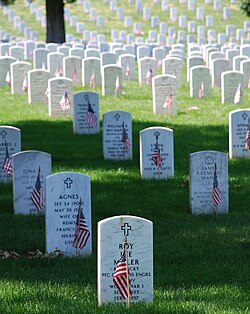
1865
% complete
In 1865, the federal government began creating the United States National Cemetery System for the Union war dead. By 1870, the remains of nearly 300,000 Union dead had been reinterred in 73 national cemeteries, located near major battlefields and thus mainly in the South.
Image source: United States National Cemetery System
Jul 4, 1866
% complete
General John Logan commented on the observances in a speech to veterans on July 4, 1866, in Salem, Illinois, helping build momentum toward a national day of remembrance for fallen soldiers.
Image source: John A. Logan
May 5, 1868
% complete
On May 5, 1868, General John A. Logan issued a proclamation to the Grand Army of the Republic calling for the observance of May 30, 1868, establishing what would become Memorial Day.
May 30, 1868
% complete
The first national observance of what would become Memorial Day occurred on May 30, 1868. In 1868, memorial events were held in 183 cemeteries in 27 states, and 336 cemeteries held events in 1869.
1873
% complete
Official recognition as a holiday spread among the states, beginning with New York in 1873, which made Decoration Day an official state holiday. By 1890, every northern state had followed suit, and every state had adopted it by 1890.
May 26, 1966
% complete
On May 26, 1966, President Lyndon B. Johnson officially recognized Waterloo, New York, as the birthplace of Memorial Day, lending presidential recognition to the town's long tradition of honoring fallen soldiers.
Image source: Waterloo, New York
1967
% complete
Although "Memorial Day" gradually became more common than "Decoration Day" after World War II, it was not declared the official name by federal law until 1967.
1865
% complete
Records show that by 1865, Mississippi, Virginia, and South Carolina all had precedents for Memorial Day. The earliest Southern Memorial Day celebrations were simple, somber occasions for veterans and their families to honor the dead and tend to local cemeteries.
Apr 26, 1865
% complete
On April 26, 1865, in Jackson, Mississippi, Sue Landon Vaughan decorated the graves of Confederate and Union soldiers, according to her account. Mention of this observance is inscribed on the southeast panel of the Confederate Monument in Jackson, erected in 1891.
Mar 11, 1866
% complete
Mary Ann Williams, who as association secretary wrote an open letter to the press on March 11, 1866, asking for assistance in establishing an annual holiday to decorate the graves of soldiers throughout the South. The date of April 26 was chosen, which corresponded with the end date of the war with the surrender agreement between Generals Johnston and Sherman in 1865.
Apr 25, 1866
% complete
Following Mary Williams' call for assistance, four women of Columbus, Mississippi, gathered together a day early on April 25, 1866, at Friendship Cemetery to decorate the graves of the Confederate soldiers.
1868
% complete
In 1868, following Logan's proclamation to the Grand Army of the Republic to observe May 30, 1868, some Southern public figures began adding the label "Confederate" to their commemorations and claimed that Northerners had appropriated the holiday. The earlier version of the holiday began to be referred to as Confederate Memorial Day.
Image source: Confederate Memorial Day
1874
% complete
The first official celebration of Confederate Memorial Day as a public holiday occurred in 1874, following a proclamation by the Georgia legislature. By 1916, ten states celebrated it, on June 3, the birthday of CSA President Jefferson Davis.
1867
% complete
Since 1867, Brooklyn, New York, has held an annual Memorial Day parade which it claims to be the nation's oldest. The Memorial Day parade in Rochester, Wisconsin, also predates the Doylestown, Pennsylvania, Grafton and Ironton parades by one year (1867).
1868
% complete
Grafton, West Virginia (West Virginia Memorial Day Parade), and Ironton, Ohio, have had an ongoing parade since 1868, making them among the oldest continuously running Memorial Day parades in the nation.
1882
% complete
The name "Memorial Day", which was first used in 1882, gradually became more common than "Decoration Day" after World War II but was not declared the official name by federal law until 1967. An 1884 GAR handbook explained that Memorial Day was "the day of all days" in the G.A.R.
1911
% complete
In 1911, the scheduling of the Indianapolis Motor Speedway car race, later named the Indianapolis 500, on Memorial Day was vehemently opposed by the increasingly elderly GAR. In 1913, an Indiana veteran complained that younger people born since the war showed a tendency to forget its meaning, and in 1923, the Indiana state legislature rejected holding the race on the holiday.
Image source: Indianapolis 500
1913
% complete
In the national capital in 1913, the four-day "Blue-Gray Reunion" featured parades, re-enactments, and speeches from a host of dignitaries, including President Woodrow Wilson, the first Southerner elected to the White House since the War. By 1913, David Blight argues, the theme of American nationalism shared equal time with the Confederate theme.
May 1915
% complete
In 1915, following the Second Battle of Ypres, Lieutenant Colonel John McCrae, a physician with the Canadian Expeditionary Force, wrote the poem "In Flanders Fields", which inspired the use of the poppy as a symbol of remembrance. The American Legion adopted the poppy as its official symbol of remembrance in 1920.
Image source: In Flanders Fields
Jun 28, 1968
% complete
On June 28, 1968, Congress passed the Uniform Monday Holiday Act, which changed Memorial Day's observance from May 30 to the last Monday in May, moving four holidays to specified Mondays in order to create three-day weekends. Congress also standardized the holiday's name as "Memorial Day."
Image source: Uniform Monday Holiday Act
Jan 1, 1971
% complete
The Uniform Monday Holiday Act took effect at the federal level in 1971, standardizing Memorial Day's observance on the last Monday in May and creating the three-day weekend associated with the modern holiday.
2000
% complete
In 2000, Congress passed the National Moment of Remembrance Act, asking Americans to pause at 3:00 pm local time on Memorial Day to stop and remember those who have died in service to the nation.
Or browse the full history timeline directory, with more than 2,000 topics.
This History of Memorial Day timeline was generated with the help of AI, using information found on the internet.
We work hard to keep these timelines accurate, but mistakes do get through. If you spot one, email us at [email protected] and we'll fix it for future visitors.
Generate yours with AI or build it from scratch, for free.
Export your timeline, add your own events, edit or remove AI-generated events, and much more
No credit card required.
Cancel anytime.
Cancel anytime.
You can create an unlimited number of timelines with up to 10 events on each one, customize how they look, export them to PDF, PNG, PowerPoint, CSV, and Excel, and share them with a link. Paid plans raise the event limit and add features like spreadsheet imports and collaborators.
Yes. You can cancel your subscription from your account page at any time, and you will not be charged again. Your subscription stays active for the rest of the period you already paid for.
Yes. We will email you a reminder before the annual renewal, and we will also email you a receipt.
Yes. You can email us within 15 days of any payment, and we will issue you a full refund.
Check out our pricing docs or send us an email anytime: [email protected].