
-
Use Cases
-
Resources
-
Pricing
Labor Day is an annual holiday honoring workers and their contributions to society. First celebrated in New York City on September 5, 1882, it grew out of the American labor movement's fight for fair wages, reasonable hours, and safer working conditions. After decades of activism, strikes, and tragic events like the Haymarket Affair and Pullman Strike, Congress made Labor Day a federal holiday in 1894. Today, it is observed on the first Monday of September each year in the United States. More Less
1880
Beginning in the late 19th century, as the trade union and labor movements grew, trade unionists proposed that a day be set aside to celebrate labor. Diverse groups of trade unionists chose a variety of days on which to honor the contributions of workers.
May 8, 1882
According to McGuire, on May 8, 1882, he made a proposition to the fledgling Central Labor Union in New York City that a day be set aside for a 'general holiday for the laboring classes'. After visiting Toronto where he saw parades celebrating labor that May, he put forward the initial proposal in spring 1882.
Image source: Peter J. McGuire

Sep 1882
According to one early history of Labor Day, the event originated in connection with a General Assembly of the Knights of Labor convened in New York City in September 1882. This gathering helped inspire the first celebrations honoring American workers.
Image source: Knights of Labor

1909
In 1909, the American Federation of Labor convention designated the Sunday preceding Labor Day as 'Labor Sunday', to be dedicated to the spiritual and educational aspects of the labor movement.
Image source: Labor Day

1885
The date of May 1 had its origins at the 1885 convention of the American Federation of Labor, which passed a resolution calling for the adoption of the eight-hour day effective May 1, 1886. This set in motion a nationwide movement for shorter working hours.
1886
The date of May 1, an ancient European folk holiday known as May Day, emerged in 1886 as a holiday for the celebration of labor, later becoming known as International Workers' Day around the world.
Image source: International Workers' Day

May 1, 1886 - May 4, 1886
A general labor strike swept the United States as part of the movement for an eight-hour workday. The strike and the events surrounding it culminated in Chicago, Illinois, from May 1 to May 4, 1886.
Image source: Haymarket affair

May 4, 1886
In Chicago, the strike culminated in the bloody Haymarket affair of May 4, 1886. The violent confrontation between police and demonstrators became a defining moment in the international labor movement.
1889
May Day was chosen by the Second International of socialist and communist parties to commemorate the general labor strike in the United States and events leading to the Haymarket affair, cementing May 1 as International Workers' Day.
Image source: Second International
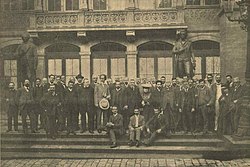
1887
In 1887, President Grover Cleveland publicly supported the September Labor Day holiday as a less inflammatory alternative to the May 1 observance associated with the Haymarket affair, formally adopting the September date.
Image source: Grover Cleveland

This History of Labor Day timeline was generated with the help of AI, using information found on the internet.
We work hard to keep these timelines accurate, but mistakes do get through. If you spot one, email us at [email protected] and we'll fix it for future visitors.
Generate yours with AI or build it from scratch, for free.

