-
Use Cases
-
Resources
-
Pricing
Franklin D. Roosevelt (FDR) was the 32nd President of the United States, serving an unprecedented four terms from 1933 to 1945. He led the nation through the Great Depression with his New Deal programs and guided America through most of World War II before dying in office in April 1945. His presidency transformed the role of the federal government and left a lasting impact on American society. More Less
Jan 30, 1882
% complete
Franklin Delano Roosevelt was born on January 30, 1882, at his family's estate in Hyde Park, New York. Born into a wealthy and prominent family, he was the only child of James Roosevelt and Sara Ann Delano. His privileged upbringing included private tutoring, extensive travel, and a strong emphasis on public service that would shape his future political career.
Jun 24, 1903
% complete
FDR graduated from Harvard College in 1903 with an A.B. degree in history after three years of study. He was an average student academically but was active in campus life, serving as editor-in-chief of The Harvard Crimson. He later attended Columbia Law School but left without completing a degree after passing the New York bar examination.
Image source: Franklin D. Roosevelt
Mar 17, 1905
% complete
On March 17, 1905, Franklin Roosevelt married Anna Eleanor Roosevelt, his fifth cousin once removed and the niece of President Theodore Roosevelt, who gave away the bride. Their marriage would become one of the most consequential political partnerships in American history, with Eleanor emerging as a powerful advocate for civil rights, women's rights, and humanitarian causes.
Image source: Eleanor Roosevelt
Jan 1, 1911
% complete
In 1910, Roosevelt won election to the New York State Senate representing Dutchess County, taking office in 1911. As a young reform-minded Democrat, he gained attention for opposing the Tammany Hall machine and championing progressive legislation, establishing himself as a rising star in Democratic politics.
Image source: New York State Senate
Mar 17, 1913 - Aug 15, 1920
% complete
Appointed by President Woodrow Wilson, Roosevelt served as Assistant Secretary of the Navy from 1913 to 1920. During World War I, he played a key role in expanding and modernizing the Navy, overseeing naval procurement and operations. The position gave him valuable administrative experience and national visibility.
Image source: Assistant Secretary of the Navy
Nov 2, 1920
% complete
In 1920, Roosevelt was chosen as the Democratic vice presidential nominee running with James M. Cox against Warren G. Harding. The ticket lost decisively, but the campaign gave Roosevelt nationwide exposure and established him as a prominent figure in the Democratic Party despite the defeat.
Image source: 1920 United States presidential election
Aug 10, 1921
% complete
While vacationing at Campobello Island in August 1921, Roosevelt was diagnosed with paralytic poliomyelitis, which left him permanently paralyzed from the waist down. He worked tirelessly to rehabilitate himself, founding the Warm Springs rehabilitation center in Georgia in 1927. His disability profoundly shaped his character and was largely concealed from the public during his political career.
Image source: Paralytic illness of Franklin D. Roosevelt
Nov 7, 1928
% complete
Roosevelt narrowly won the 1928 election for Governor of New York, returning to politics after his battle with polio. As governor during the onset of the Great Depression, he implemented pioneering relief programs and unemployment insurance measures that served as models for his later federal New Deal policies.
Image source: Governor of New York
Nov 8, 1932
% complete
Roosevelt defeated incumbent Herbert Hoover in a landslide, winning 42 states and promising a 'new deal' for the American people amid the depths of the Great Depression. His victory marked a dramatic realignment in American politics and began an era of Democratic dominance that would last for decades.
Image source: 1932 United States presidential election
Mar 4, 1933
% complete
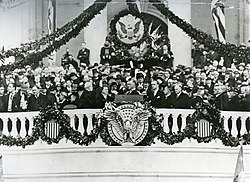
At his first inauguration, Roosevelt famously declared that 'the only thing we have to fear is fear itself.' Speaking to a nation gripped by economic despair and banking panics, he projected confidence and resolve, pledging bold action to combat the Great Depression and restore hope to millions of Americans.
Image source: First inauguration of Franklin D. Roosevelt
Mar 6, 1933 - Mar 13, 1933
% complete
Days after taking office, Roosevelt declared a national bank holiday, closing all banks to stop panicked withdrawals. He then pushed through the Emergency Banking Act, which stabilized the financial system. When banks reopened, deposits exceeded withdrawals, restoring public confidence in the banking system.
Mar 9, 1933 - Jun 16, 1933
% complete
During the First Hundred Days, Congress passed an unprecedented burst of legislation including the Emergency Banking Act, the Civilian Conservation Corps, the Agricultural Adjustment Act, and the National Industrial Recovery Act. These programs aimed to provide relief, recovery, and reform, fundamentally transforming the role of the federal government in American life.
Image source: First 100 days of Franklin D. Roosevelt's presidency
Mar 12, 1933
% complete
Roosevelt delivered his first fireside chat via radio, explaining his banking policies in plain, conversational language directly to Americans. The innovative use of radio allowed FDR to bypass hostile newspapers and build an intimate connection with citizens, becoming a defining feature of his presidency.
Image source: Fireside chats
May 18, 1933
% complete
The Tennessee Valley Authority was created to provide electricity, flood control, and economic development to the impoverished Tennessee Valley region. As one of the most ambitious New Deal projects, it brought modern infrastructure and affordable power to millions while serving as a model for regional planning.
Image source: Tennessee Valley Authority
May 6, 1935
% complete
The Works Progress Administration was created to employ millions of jobless Americans on public works projects. Under Harry Hopkins, the WPA built roads, bridges, schools, and hospitals, and also funded artists, writers, and musicians through Federal Project Number One, leaving a lasting cultural and physical legacy across the country.
Image source: Works Progress Administration
Aug 14, 1935
% complete
Roosevelt signed the Social Security Act, establishing old-age pensions, unemployment insurance, and aid to dependent children and the disabled. It remains one of the most enduring and transformative achievements of the New Deal, creating America's social safety net and reshaping the relationship between government and its citizens.
Feb 5, 1937
% complete
After his landslide 1936 reelection, Roosevelt proposed adding justices to the Supreme Court, which had struck down several New Deal laws. The controversial 'court-packing' plan failed in Congress and damaged his political standing, though the Court subsequently became more receptive to New Deal legislation.
Image source: Judicial Procedures Reform Bill of 1937
Jun 25, 1938
% complete
The Fair Labor Standards Act established a federal minimum wage, banned oppressive child labor, and set maximum working hours. Often called the last major piece of New Deal legislation, it codified fundamental labor protections that continue to govern American workplaces today.
Image source: Fair Labor Standards Act of 1938
Nov 5, 1940
% complete
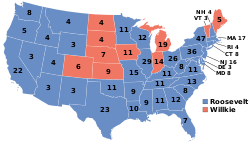
Breaking the two-term precedent set by George Washington, Roosevelt ran for and won an unprecedented third term, defeating Wendell Willkie as war raged in Europe. With global crisis looming, voters chose continuity, making FDR the only president ever elected to more than two terms.
Image source: 1940 United States presidential election
Jan 6, 1941
% complete
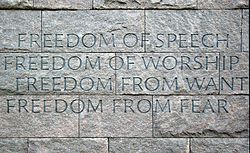
In his State of the Union address, Roosevelt articulated the Four Freedoms—freedom of speech, freedom of worship, freedom from want, and freedom from fear—as universal human rights worth defending. The speech became a defining statement of American values and inspired art, including Norman Rockwell's famous paintings.
Image source: Four Freedoms
Mar 11, 1941
% complete
The Lend-Lease Act authorized the United States to supply Britain, China, the Soviet Union, and other Allies with war materials without immediate payment. Roosevelt described America as the 'arsenal of democracy,' and Lend-Lease proved vital to sustaining Allied resistance against Nazi Germany before formal U.S. entry into the war.
Aug 14, 1941
% complete
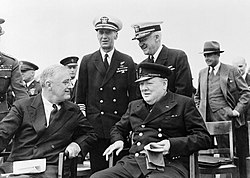
Meeting aboard warships off Newfoundland, Roosevelt and British Prime Minister Winston Churchill issued the Atlantic Charter, articulating shared goals for the postwar world including self-determination, free trade, and freedom from fear and want. The charter laid the ideological groundwork for the United Nations.
Image source: Atlantic Charter
Dec 7, 1941
% complete
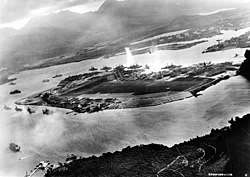
Japan's surprise attack on Pearl Harbor killed over 2,400 Americans and devastated the Pacific Fleet. Roosevelt delivered his famous 'Day of Infamy' speech to Congress the next day, and the United States declared war on Japan, fully committing the nation to World War II.
Image source: Attack on Pearl Harbor
Feb 19, 1942
% complete
Roosevelt signed Executive Order 9066, authorizing the forced relocation and incarceration of approximately 120,000 Japanese Americans, most of them U.S. citizens, in internment camps. Widely condemned in retrospect as a grave injustice driven by wartime fear and racial prejudice, it remains one of the darkest chapters of his presidency.
Image source: Internment of Japanese Americans
Jan 14, 1943 - Jan 24, 1943
% complete
Roosevelt met Churchill in Casablanca, Morocco, where they announced the policy of demanding the unconditional surrender of the Axis powers. The conference also planned the invasion of Sicily and Italy, coordinating Allied strategy for the Mediterranean theater of the war.
Image source: Casablanca Conference
Nov 28, 1943 - Dec 1, 1943
% complete
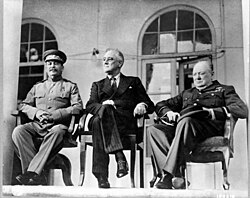
Roosevelt, Churchill, and Soviet leader Joseph Stalin met for the first time in Tehran, agreeing on plans for the cross-channel invasion of France and Soviet participation in the war against Japan. The conference solidified the Grand Alliance and set the timetable for the liberation of Western Europe.
Image source: Tehran Conference
Jun 6, 1944
% complete
As commander-in-chief, Roosevelt oversaw Operation Overlord, the largest amphibious invasion in history, as Allied forces stormed the beaches of Normandy. The successful landings opened the Western Front against Nazi Germany and marked the beginning of the end of Hitler's regime.
Image source: Operation Overlord
Nov 7, 1944
% complete
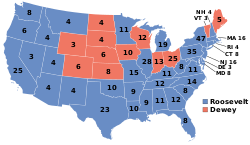
Despite declining health, Roosevelt defeated Thomas E. Dewey to win a fourth term, choosing Missouri Senator Harry S. Truman as his new vice president. Voters kept him at the helm as the war neared its conclusion, making him the longest-serving president in American history.
Image source: 1944 United States presidential election
Feb 4, 1945 - Feb 11, 1945
% complete
Roosevelt met with Churchill and Stalin at Yalta in Crimea to plan the postwar world, agreeing on the occupation of Germany, the creation of the United Nations, and Soviet entry into the Pacific war. His visibly frail condition at Yalta raised concerns about his health just months before his death.
Image source: Yalta Conference
Apr 12, 1945
% complete
Roosevelt died of a massive cerebral hemorrhage at his retreat in Warm Springs, Georgia, less than three months into his fourth term. His death stunned the nation and the world; Vice President Harry Truman succeeded him just weeks before the surrender of Germany ended the war in Europe.
Image source: Franklin D. Roosevelt
Oct 24, 1945
% complete
The United Nations officially came into existence, realizing Roosevelt's long-held dream of an international organization dedicated to maintaining peace and security. He had coined the term 'United Nations' and championed its creation throughout the war, making it a cornerstone of his postwar legacy.
Image source: United Nations
Or browse the full history timeline directory, with more than 2,000 topics.
This Franklin D. Roosevelt timeline was generated with the help of AI, using information found on the internet.
We work hard to keep these timelines accurate, but mistakes do get through. If you spot one, email us at [email protected] and we'll fix it for future visitors.
Generate yours with AI or build it from scratch, for free.
Export your timeline, add your own events, edit or remove AI-generated events, and much more
No credit card required.
Cancel anytime.
Cancel anytime.
You can create an unlimited number of timelines with up to 10 events on each one, customize how they look, export them to PDF, PNG, PowerPoint, CSV, and Excel, and share them with a link. Paid plans raise the event limit and add features like spreadsheet imports and collaborators.
Yes. You can cancel your subscription from your account page at any time, and you will not be charged again. Your subscription stays active for the rest of the period you already paid for.
Yes. We will email you a reminder before the annual renewal, and we will also email you a receipt.
Yes. You can email us within 15 days of any payment, and we will issue you a full refund.
Check out our pricing docs or send us an email anytime: [email protected].