-
Use Cases
-
Resources
-
Pricing
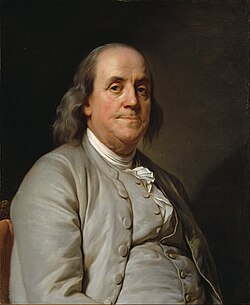
Benjamin Franklin (1706–1790) was an American polymath, Founding Father, inventor, scientist, writer, and diplomat. He is best known for his experiments with electricity, his inventions such as the lightning rod and bifocals, his role in drafting the Declaration of Independence, and his diplomacy in securing French support during the American Revolution. More Less
Jan 17, 1706
% complete
Benjamin Franklin was born on Milk Street in Boston, Massachusetts, the tenth son of soap and candle maker Josiah Franklin and his second wife Abiah Folger. Growing up in a large Puritan family, he was the youngest of seventeen children and would rise from humble origins to become one of the most celebrated figures of his era.
Image source: Benjamin Franklin
1714 - 1715
% complete
Franklin briefly attended Boston Latin School, where he showed great promise in reading and writing, but financial constraints forced his father to withdraw him after less than a year. His formal schooling ended at around age ten, after which he was largely self-educated through voracious reading.
Image source: Boston Latin School
Sep 1723
% complete
Frustrated by his brother's harsh treatment, the seventeen-year-old Franklin broke his apprenticeship and fled Boston, traveling by boat to Philadelphia, Pennsylvania. Arriving nearly penniless, he found work as a printer and began building his life in the city that would become his lifelong home.
Image source: Philadelphia
Nov 1724 - Oct 1726
% complete
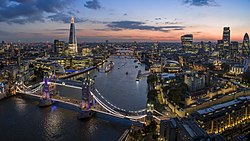
With the backing of Pennsylvania governor Sir William Keith, who promised letters of credit that never materialized, Franklin sailed to London. He spent about a year and a half working in printing houses there, gaining valuable experience before returning to Philadelphia in 1726.
Image source: London
Sep 1, 1730
% complete
Franklin entered a common-law marriage with Deborah Read, whom he had first met upon arriving in Philadelphia. Together they raised two children, Francis Folger Franklin, who died of smallpox at age four, and Sarah Franklin Bache.
Image source: Deborah Read
Apr 17, 1790
% complete
Benjamin Franklin died at his home in Philadelphia, attended by his daughter Sally. Around 20,000 people attended his funeral, and his death prompted tributes from the French National Assembly and mourners around the world, honoring a life devoted to science, letters, and liberty.
1718 - 1723
% complete
At age twelve, Franklin was apprenticed to his older brother James, a Boston printer. There he learned the trade, composed ballads and pamphlets, and honed his writing skills by studying and imitating the style of The Spectator.
Apr 2, 1722
% complete
Under the pseudonym 'Mrs. Silence Dogood,' the sixteen-year-old Franklin secretly submitted humorous and satirical letters to his brother's newspaper, The New-England Courant. The letters became popular, and their authorship was a closely kept secret until Franklin revealed it.
Image source: The New-England Courant
1728
% complete
With partner Hugh Meredith, Franklin opened his own printing house in Philadelphia. Through hard work, frugality, and skillful networking, he built the business into one of the most successful in the American colonies.
Oct 2, 1729
% complete
Franklin purchased the struggling Pennsylvania Gazette and turned it into one of the most widely read newspapers in the colonies. Under his editorship, it featured news, essays, advertisements, and his own witty writing, greatly expanding his influence.
Image source: The Pennsylvania Gazette
1732 - 1758
% complete
Writing under the pseudonym Richard Saunders, Franklin published Poor Richard's Almanack, an annual bestseller filled with proverbs, weather predictions, and humor. Aphorisms such as 'Early to bed and early to rise' made it a cornerstone of American folk wisdom.
Image source: Poor Richard's Almanack
1748
% complete
Having accumulated sufficient wealth, Franklin retired from his printing business, taking a partner to run daily operations. He devoted the rest of his life to science, civic projects, and public service, famously writing of his desire for 'leisure to read, study, make experiments.'
May 9, 1754
% complete
Franklin created 'Join, or Die,' widely considered America's first political cartoon, showing a snake cut into segments representing the colonies. Originally promoting colonial unity for the French and Indian War, the image was later revived as a revolutionary symbol.
Image source: Join, or Die
1771 - 1790
% complete
Franklin wrote his celebrated Autobiography over two decades, recounting his rise from poverty to prominence and outlining his famous thirteen virtues of self-improvement. Published after his death, it became one of the most influential memoirs in American literature.
Image source: The Autobiography of Benjamin Franklin
1727
% complete
Franklin organized the Junto, a group of young tradesmen and artisans who met weekly to discuss morals, politics, and natural philosophy. The club became a springboard for many of Franklin's civic projects and a model for mutual improvement societies.
1731
% complete
Franklin organized a subscription library that allowed members to pool money to buy books, creating the Library Company of Philadelphia. It became America's first successful lending library and inspired the creation of libraries throughout the colonies.
Image source: Library Company of Philadelphia
Dec 1736
% complete
After a devastating fire in Philadelphia, Franklin helped establish the Union Fire Company, one of the first volunteer firefighting organizations in America. The company set a model for organized fire protection in the colonies.
Image source: Union Fire Company
1751
% complete
Franklin published his 'Proposals Relating to the Education of Youth in Pensilvania' and helped found the Academy of Philadelphia, which opened in 1751. The institution later became the University of Pennsylvania, one of America's first secular colleges.
Image source: University of Pennsylvania
May 11, 1751
% complete
Working with Dr. Thomas Bond, Franklin helped raise funds and secure a charter for Pennsylvania Hospital, the first hospital in the American colonies. His clever fundraising strategy of matching donations helped win public support for the project.
Image source: Pennsylvania Hospital
Oct 18, 1785 - Oct 29, 1788
% complete
Returning home from France, Franklin was elected president of the Supreme Executive Council of Pennsylvania, effectively serving as the state's governor for three consecutive one-year terms, the last public office of his career.
Image source: Supreme Executive Council of Pennsylvania
1787 - 1790
% complete
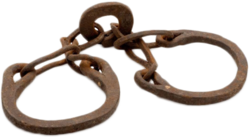
In his final years, Franklin served as president of the Pennsylvania Society for Promoting the Abolition of Slavery. He signed a memorial to Congress calling for the end of slavery, his last public act, having earlier freed his own slaves.
Image source: Pennsylvania Abolition Society
1741
% complete
Franklin designed an iron furnace stove that radiated heat more efficiently than traditional fireplaces while using less fuel. He famously refused to patent the design, believing his inventions should benefit the public freely.
Image source: Franklin stove
1743
% complete
Franklin founded the American Philosophical Society to promote useful knowledge and scientific inquiry. It became the leading learned society in colonial America and continues to operate today as one of the oldest scholarly organizations in the United States.
Image source: American Philosophical Society
1745 - 1752
% complete
Fascinated by electrical phenomena, Franklin proposed that electricity was a single fluid and coined terms like 'positive,' 'negative,' and 'battery.' His experiments, communicated to the Royal Society, established him as one of the era's foremost scientists.
Image source: Franklin's electrostatic machine
1751
% complete
Franklin's collected letters on electrical experiments were published in London and quickly became a scientific sensation. Translated into several languages, the work earned him honorary degrees and election as a Fellow of the Royal Society.
Image source: Experiments and Observations on Electricity
Jun 1752
% complete
Franklin famously flew a kite with a metal key attached during a thunderstorm, demonstrating that lightning is electrical in nature. The experiment led to his invention of the lightning rod, which protected buildings from fire and brought him international fame.
Image source: Kite experiment
1753
% complete
In recognition of his groundbreaking electrical research, the Royal Society awarded Franklin the Copley Medal, its highest honor. The following year he was elected a Fellow of the Royal Society, cementing his reputation among Europe's leading scientists.
Image source: Copley Medal
Oct 1751 - 1764
% complete
Franklin was elected to the Pennsylvania Assembly, where he served as clerk and later as a member. He used his position to advocate for public works, colonial defense, and greater autonomy from the Penn family proprietors.
Image source: Pennsylvania General Assembly
1753 - 1774
% complete
Franklin and William Hunter were appointed joint deputy postmasters general for British North America. Franklin reformed the postal service, improving efficiency and profitability, and created the foundation for the later United States Post Office.
Image source: United States Postmaster General
Jul 10, 1754
% complete
At the Albany Congress, Franklin proposed a plan to unite the thirteen colonies under a central government for defense and western expansion. Though rejected at the time, it anticipated the federal structure of the United States Constitution.
Image source: Albany Plan
1757 - 1762
% complete
Franklin traveled to London as the Pennsylvania Assembly's agent to dispute the Penn family's authority over the colony. He spent years in Britain, becoming a celebrated intellectual figure and advocating for colonial interests at the imperial court.
Feb 13, 1766
% complete
Appearing before the House of Commons, Franklin answered nearly two hours of questions about colonial resistance to the Stamp Act. His testimony helped persuade Parliament to repeal the unpopular tax the following month.
Image source: Stamp Act 1765
1772
% complete
Franklin sent to Massachusetts letters from Governor Thomas Hutchinson urging restraint of colonial liberties. Their publication inflamed tensions, and Franklin was publicly reprimanded by the British Privy Council in 1774, ending his career as a colonial diplomat in London.
Image source: Hutchinson letters affair
May 1775
% complete
Franklin was chosen as a Pennsylvania delegate to the Second Continental Congress, where he served on committees drafting the Declaration of Independence and working to secure colonial unity and foreign alliances.
Image source: Second Continental Congress
May 5, 1775
% complete
Franklin sailed home from England just after the battles of Lexington and Concord, arriving in Philadelphia as the Revolutionary War began. He was immediately chosen as a delegate to the Second Continental Congress, throwing himself into the cause of independence.
Image source: American Revolution
Aug 2, 1776
% complete
As a member of the drafting committee, Franklin helped revise Thomas Jefferson's draft of the Declaration of Independence and was one of its signers. At seventy, he was the oldest member of the Continental Congress.
Image source: United States Declaration of Independence
Dec 1776 - 1785
% complete
Franklin sailed to Paris to seek French support for the American Revolution. His charm, wit, and scientific fame made him a celebrity in France, and he skillfully cultivated French goodwill over nearly a decade of diplomacy.
Feb 6, 1778
% complete
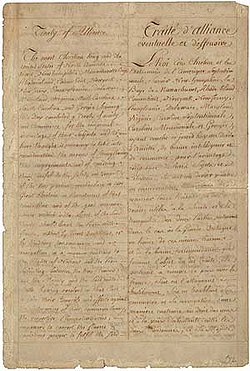
Franklin negotiated the Treaty of Alliance and Treaty of Amity and Commerce with France, bringing French military and financial support into the American Revolution. The alliance proved decisive in the eventual American victory.
Image source: Treaty of Alliance (1778)
Sep 3, 1783
% complete
Along with John Adams and John Jay, Franklin negotiated the Treaty of Paris, in which Great Britain recognized American independence. He helped secure generous boundaries for the new nation, extending it to the Mississippi River.
Image source: Treaty of Paris (1783)
May 1787 - Sep 17, 1787
% complete
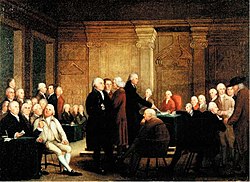
At age 81, Franklin was the oldest delegate at the Philadelphia convention that drafted the United States Constitution. His calls for compromise helped smooth disputes, and he urged unanimous approval of the finished document.
Image source: Constitutional Convention (United States)
Or browse the full history timeline directory, with more than 2,000 topics.
This Benjamin Franklin timeline was generated with the help of AI, using information found on the internet.
We work hard to keep these timelines accurate, but mistakes do get through. If you spot one, email us at [email protected] and we'll fix it for future visitors.
Generate yours with AI or build it from scratch, for free.
Export your timeline, add your own events, edit or remove AI-generated events, and much more
No credit card required.
Cancel anytime.
Cancel anytime.
You can create an unlimited number of timelines with up to 10 events on each one, customize how they look, export them to PDF, PNG, PowerPoint, CSV, and Excel, and share them with a link. Paid plans raise the event limit and add features like spreadsheet imports and collaborators.
Yes. You can cancel your subscription from your account page at any time, and you will not be charged again. Your subscription stays active for the rest of the period you already paid for.
Yes. We will email you a reminder before the annual renewal, and we will also email you a receipt.
Yes. You can email us within 15 days of any payment, and we will issue you a full refund.
Check out our pricing docs or send us an email anytime: [email protected].