-
Use Cases
-
Resources
-
Pricing
Franklin Pierce was the 14th President of the United States, serving from 1853 to 1857. A Democrat from New Hampshire, he is remembered for the Kansas-Nebraska Act, his support of the Compromise of 1850, and a presidency marked by deepening sectional divisions that foreshadowed the Civil War. More Less
Nov 23, 1804
% complete
Franklin Pierce was born in a log cabin in Hillsborough, New Hampshire, the son of Benjamin Pierce, a Revolutionary War veteran who later became governor of New Hampshire. He grew up in a politically engaged household that shaped his ambitions for public service.
Image source: Franklin Pierce
1820 - 1824
% complete
Pierce enrolled at Bowdoin College in Maine, where he befriended writers Nathaniel Hawthorne and Henry Wadsworth Longfellow. Though initially an indifferent student, he improved academically and graduated third in his class in 1824.
Image source: Bowdoin College
1827
% complete
After studying law with judges in Hillsborough and Amherst, Pierce passed the bar examination and began practicing law in Hillsborough. He quickly gained a reputation as an effective advocate and a charming, sociable attorney.
Nov 19, 1834
% complete
Pierce married Jane Means Appleton, daughter of a Bowdoin College president. The marriage was often unhappy; Jane disliked politics and Washington society, and she suffered from poor health and depression throughout her life.
Image source: Jane Pierce
Jan 1836
% complete
The Pierces' first child, Franklin Jr., died in infancy just days after arriving in Washington, casting a shadow over their marriage. Two more sons, Frank Robert and Benjamin, would follow, though tragedy continued to haunt the family.
Mar 1829
% complete
At age 24, Pierce won election to the state legislature as a Democrat, following in his father's footsteps. He served two terms and became Speaker of the House during his second term, demonstrating early political skill.
Image source: New Hampshire House of Representatives
Mar 4, 1833 - Mar 3, 1837
% complete
Pierce won election to Congress at age 28, becoming one of its youngest members. He served four years as a loyal Jacksonian Democrat, supporting President Andrew Jackson's policies including opposition to the Second Bank of the United States.
Image source: United States House of Representatives
Mar 4, 1837 - Feb 28, 1842
% complete
Elected by the New Hampshire legislature to the Senate at age 32, Pierce served one term. He supported President Van Buren but found Washington life unsatisfying and struggled financially, eventually resigning to return to law practice.
Image source: United States Senate
Feb 1842
% complete
Disillusioned with congressional life and facing financial pressures, Pierce resigned his Senate seat and moved to Concord, New Hampshire, to practice law. He remained active in Democratic politics behind the scenes.
1845 - 1847
% complete
President James K. Polk appointed Pierce as United States District Attorney for New Hampshire. He held the position until resigning to join the Mexican-American War, balancing legal duties with party leadership in the state.
Image source: United States Attorney General
1846
% complete
President Polk offered to nominate Pierce as Attorney General of the United States, but he declined the honor, citing family and financial obligations in New Hampshire. This decision reflected his ambivalence about national office.
Feb 16, 1847 - Jul 12, 1848
% complete
Pierce accepted a commission as brigadier general of volunteers during the Mexican-American War. He fought under General Winfield Scott, though he suffered injuries when his horse fell during the Battle of Contreras, which critics later used against him.
Jun 5, 1852
% complete
At the deadlocked 1852 Democratic National Convention in Baltimore, Pierce emerged as a compromise candidate on the 49th ballot. His obscurity made him palatable to all factions of the divided party, and he defeated Whig Winfield Scott decisively in November.
Image source: 1852 Democratic National Convention
Jan 6, 1853
% complete
Two months before inauguration, the Pierces' surviving son, 11-year-old Benjamin, was killed when their train derailed near Andover, Massachusetts. Jane viewed it as God's punishment and entered deep mourning, while Pierce began his presidency devastated.
Mar 4, 1853
% complete
Pierce became the 14th President of the United States at age 48. He is the only president to have delivered his inaugural address entirely from memory. His speech pledged expansion, prosperity, and harmony between North and South.
Image source: Inauguration of Franklin Pierce
Dec 30, 1853
% complete
Pierce sent James Gadsden to negotiate the purchase of land from Mexico, acquiring roughly 29,600 square miles of present-day southern Arizona and New Mexico for $10 million. It facilitated a potential southern transcontinental railroad route.
Image source: Gadsden Purchase
Mar 31, 1854
% complete
Under Pierce's administration, Commodore Matthew Perry signed the Treaty of Kanagawa, opening Japanese ports to American trade after over two centuries of isolation. It marked a landmark achievement in American diplomacy in Asia.
Image source: Convention of Kanagawa
May 30, 1854
% complete
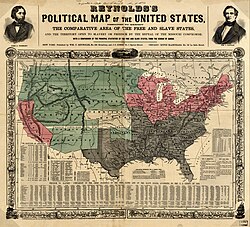
Pierce signed the Kansas-Nebraska Act, championed by Senator Stephen Douglas, which repealed the Missouri Compromise and allowed settlers to decide slavery through popular sovereignty. The act shattered the Whig Party, fueled violence in Kansas, and propelled the rise of the Republican Party.
Image source: Kansas–Nebraska Act
Oct 9, 1854
% complete
American diplomats in Europe drafted the Ostend Manifesto, recommending that the U.S. purchase or take Cuba from Spain by force if necessary. When leaked, it provoked outrage in the North and further damaged the administration's reputation.
Image source: Ostend Manifesto
Nov 21, 1855 - Dec 8, 1855
% complete
Pro-slavery and antislavery settlers clashed violently in the Kansas Territory, most notably in the Sack of Lawrence and John Brown's Pottawatomie massacre. Pierce's recognition of the proslavery Lecompton government intensified sectional conflict.
Image source: Bleeding Kansas
May 22, 1856
% complete
Representative Preston Brooks brutally beat Senator Charles Sumner with a cane on the Senate floor after Sumner denounced proslavery forces in Kansas. The attack shocked the nation and symbolized the breakdown of civil discourse over slavery.
Image source: Caning of Charles Sumner
Jun 6, 1856
% complete
The Democratic Party rejected Pierce's bid for a second term, making him the first elected president denied renomination by his own party. James Buchanan received the nomination instead, reflecting widespread Northern repudiation of Pierce's pro-Southern policies.
Image source: 1856 Democratic National Convention
Mar 4, 1857
% complete
Pierce departed Washington widely criticized and unpopular, having alienated Northerners with concessions to Southern interests while failing to win Southern trust. He retired to Concord, New Hampshire, with his wife Jane.
Apr 1857 - Oct 1859
% complete
Following his presidency, Pierce traveled extensively through Europe with his wife Jane, visiting England, Italy, and other countries. They returned to Concord in 1859 as Jane's health continued to decline.
1860 - May 19, 1864
% complete
Pierce maintained a lifelong friendship with novelist Nathaniel Hawthorne, his Bowdoin classmate. Hawthorne dedicated his final novel 'Our Old Home' to Pierce, and the two traveled together until Hawthorne's death in 1864, which deeply affected Pierce.
Image source: Nathaniel Hawthorne
Jan 1, 1863
% complete
During the Civil War, Pierce openly opposed President Lincoln's Emancipation Proclamation and other war measures, aligning himself with Peace Democrats. His criticism of the Union cause further damaged his already tarnished reputation.
Image source: Emancipation Proclamation
Dec 2, 1863
% complete
Jane Pierce died of tuberculosis in Andover, Massachusetts, at age 57. She had blamed her husband for their son's death and never fully recovered from the loss. Her death left Pierce increasingly isolated and prone to heavy drinking.
Oct 8, 1869
% complete
Franklin Pierce died in Concord, New Hampshire, from cirrhosis of the liver at age 64. He was buried next to his wife and two of his sons in Minot enclosure in Concord's Old North Cemetery.
1948
% complete
Scholars have consistently ranked Pierce among the worst presidents in American history, citing his failure to stem the drift toward civil war, support for the Kansas-Nebraska Act, and deference to pro-slavery interests.
Image source: Historical rankings of presidents of the United States
Or browse the full history timeline directory, with more than 2,000 topics.
This Franklin Pierce timeline was generated with the help of AI, using information found on the internet.
We work hard to keep these timelines accurate, but mistakes do get through. If you spot one, email us at [email protected] and we'll fix it for future visitors.
Generate yours with AI or build it from scratch, for free.
Export your timeline, add your own events, edit or remove AI-generated events, and much more
No credit card required.
Cancel anytime.
Cancel anytime.
You can create an unlimited number of timelines with up to 10 events on each one, customize how they look, export them to PDF, PNG, PowerPoint, CSV, and Excel, and share them with a link. Paid plans raise the event limit and add features like spreadsheet imports and collaborators.
Yes. You can cancel your subscription from your account page at any time, and you will not be charged again. Your subscription stays active for the rest of the period you already paid for.
Yes. We will email you a reminder before the annual renewal, and we will also email you a receipt.
Yes. You can email us within 15 days of any payment, and we will issue you a full refund.
Check out our pricing docs or send us an email anytime: [email protected].