-
Use Cases
-
Resources
-
Pricing
Crazy Horse (c. 1840–1877) was an Oglala Lakota war leader renowned for his courage, humility, and fierce resistance to the U.S. government's encroachment on Native American lands. He played a pivotal role in victories such as the Battle of the Rosebud and the Battle of the Little Bighorn in 1876, and remains one of the most iconic figures of Native American resistance. More Less
1810
% complete
Crazy Horse's father, born in 1810, was also named Tȟašúŋke Witkó (Crazy Horse), sharing the same name as his famous son. The elder Crazy Horse, later known as Worm, would play an important role in his son's life, including speaking to him in his final moments in 1877.
Image source: Crazy Horse
1840
% complete
Crazy Horse (Lakota: Tȟašúŋke Witkó) was born around 1840, though conflicting reports exist about his birth year. Biographer Kingsley Bray claims 1840, while He Dog's testimony and census records suggest 1842. Oral history accounts from relatives on the Cheyenne River Reservation place his birth in the spring of 1840, a year also affirmed by Lakota author Joseph Marshall.
1844
% complete
In 1844, an Oglala raiding party attempted to steal horses from the Crow but was discovered. Among the raiders was Rattling Blanket Woman's brother, He Crow, who was killed along with thirty-eight other Oglala tribesmen, an event that touched Crazy Horse's family circle.
1854
% complete
In 1854, a dispute over a cow belonging to a Mormon emigrant party encamped near Fort Laramie precipitated a confrontation that would prove formative for the young Crazy Horse, shaping his views of American encroachment on Lakota lands.
Image source: Grattan massacre
1857
% complete
According to trader William Garnett, who claimed to have heard it from Crazy Horse himself in 1868, Crazy Horse fasted for two days on the open plains, keeping himself awake with sharp stones beneath his body. When no vision came, he descended toward his horse hobbled near a lake, where the vision overtook him, possibly because he fainted.
1857
% complete
Following the transformative visionary experiences of 1857 and Crazy Horse's demonstrated war-fighting abilities, his father became a convinced believer in his son's singular capacity for leadership, supporting his rise within Oglala society.
1865
% complete
Because of his fighting ability and his generosity to the tribe, in 1865 Crazy Horse was named an Ogle Tanka Un ('Shirt Wearer', or war leader) by the tribe, formalizing his status as one of the leading warriors of the Oglala Lakota.
1870
% complete
It was after a substantial battle with the Crow in 1870 and their subsequent pursuit by Crazy Horse's retinue that Black Buffalo Woman 'gave in to Crazy Horse's attention' and left her children in the care of friends to accompany him on the endeavor.
1871
% complete
Crazy Horse married Black Shawl in 1871, a member of the Oglala Lakota. She would remain devoted to him through the turbulent years that followed and outlived both him and their daughter by many years.
1873
% complete
Black Shawl gave birth to Crazy Horse's only child, a daughter named They Are Afraid Of Her, who died in 1873, a personal tragedy for the war leader and his wife.
1859
% complete
During the spring of 1859, Crazy Horse participated in a raid of repudiation, accompanied by his Oglala friend He Dog, against some Crow raiders who had killed two sons belonging to the Miniconjou chief Black Shield.
1863
% complete
At Pryor Creek in the summer of 1863, a combined Oglala, Cheyenne, Miniconjou, and Arapaho war party engaged a disciplined Crow defensive line protecting a tightly drawn village circle. The engagement entered both Lakota and Crow annals as a defining encounter of the war years 1858–1865, marking the moment Crazy Horse's name first passed from mouth to mouth beyond local reputation.
1864
% complete
In 1864, after the Third Colorado Cavalry decimated Cheyenne and Arapaho people in the Sand Creek Massacre, Oglala and Minneconjou bands allied with them against the United States, drawing Crazy Horse deeper into armed resistance.
Image source: Sand Creek massacre
Jul 1865
% complete
Crazy Horse was present at the Battle of Platte Bridge and the Battle of Red Buttes in July 1865, further demonstrating his fighting ability during the Plains Indian Wars.
Dec 21, 1866
% complete
On December 21, 1866, during Red Cloud's War, Crazy Horse led a decoy party that lured Captain William J. Fetterman's U.S. Army detachment into an ambush. A combined Lakota, Cheyenne, and Arapaho force annihilated the entire detachment, one of the worst defeats suffered by the Army on the Plains to that date.
Image source: Fetterman Fight
Aug 2, 1867
% complete
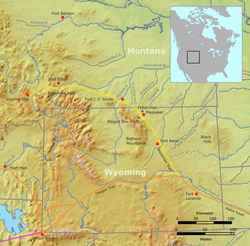
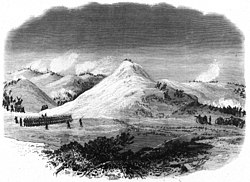
On August 2, 1867, Crazy Horse led the Oglala contingent in the Wagon Box Fight, part of a coordinated Lakota and Cheyenne strike against Fort Phil Kearny's wood-cutting operation near Fort Phil Kearny in Wyoming Territory.
Image source: Wagon Box Fight
Jun 17, 1876
% complete
On June 17, 1876, Crazy Horse was among the Lakota and Cheyenne leaders who struck General George Crook's column of more than 1,000 troops and 250 Crow and Shoshone auxiliaries along Rosebud Creek in Montana Territory, halting Crook's advance and keeping him out of the coming campaign on the Little Bighorn.
Image source: Battle of the Rosebud
Jun 25, 1876
% complete
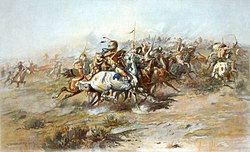
On June 25, 1876, Custer's 7th Cavalry attacked a massive Lakota, Northern Cheyenne, and Arapaho encampment along the Little Bighorn River, badly underestimating both the size of the village and the resolve of its defenders. Crazy Horse helped lead the combined Native forces that annihilated Custer and five companies of the 7th Cavalry—the worst U.S. Army defeat of the Indian Wars.
Image source: Battle of the Little Bighorn
Sep 9, 1876 - Sep 10, 1876
% complete
The Battle of Slim Buttes on September 9, 1876 comprised four distinct engagements: Captain Anson Mills's pre-dawn assault on a sleeping Lakota village, the ravine fight surrounding the surrender and death of Old Man American Horse, Crazy Horse's counterattack that afternoon with an estimated six to eight hundred warriors, and a rear-guard skirmish the following morning.
Image source: Battle of Slim Buttes
Jan 8, 1877
% complete
On January 8, 1877, Crazy Horse's warriors fought their last major engagement at the Battle of Wolf Mountain, pitting roughly 600 Lakota and Cheyenne against 450 soldiers in a blizzard along the Tongue River in Montana Territory.
Image source: Battle of Wolf Mountain
1877
% complete
The Last Sun Dance of 1877 is significant in Lakota history as the Sun Dance held to honor Crazy Horse one year after the victory at the Battle of the Little Bighorn, and to offer prayers for him in the trying times ahead. Five warrior cousins sacrificed blood and flesh for Crazy Horse at the ceremony.
May 1877
% complete
After Crazy Horse's surrender in May 1877, Bourke described Crazy Horse as being 'five feet eight inches high, lithe and sinewy, with a scar in his face,' providing a rare firsthand account of his appearance.
May 1877
% complete
A report in the New York Sun from May 1877 recorded, 'A bullet wound through his left cheek,' offering one of the few contemporary physical descriptions of Crazy Horse following his surrender.
May 6, 1877
% complete
Crazy Horse's courtship of Nellie coincided with his surrender—along with some nine hundred Oglalas—at Camp Robinson on May 6, 1877, a personal matter unfolding amid the momentous events surrounding his capitulation.
May 6, 1877
% complete
After months of pursuit during the Great Sioux War of 1876–1877, Crazy Horse surrendered at Fort Robinson, Nebraska on May 6, 1877, seeking to secure the survival of his band amid famine and military pressure. Roughly 900 Oglala warriors accompanied him when he arrived at the Red Cloud Agency, and his retinue was the last significant Lakota holdout to come in.
Aug 1877
% complete
In August 1877, when Lieutenant Clark asked him to join the Army against the Nez Perce of Chief Joseph, Crazy Horse and Touch the Clouds objected, citing the peace terms of their surrender; he ultimately agreed, reportedly saying he would fight 'till all the Nez Perce were killed'—but scout Frank Grouard misinterpreted his words, reporting instead that Crazy Horse had said he would 'go north and fight until not a white man is left.' The mistranslation, compounded by rumors from supporters of Red Cloud and Spotted Tail, proved fatal to whatever trust remained.
Sep 4, 1877
% complete
On September 4, 1877, Young Black Fox commanded Crazy Horse's warriors in the latter's absence—a display of courage that earned him the regard of both Lakota and white observers alike. That same day, two columns moved against Crazy Horse's village, only to find it had scattered overnight—Crazy Horse having fled to the Spotted Tail Agency with his ailing wife.
Sep 5, 1877
% complete
In September 1877, after being brought to Camp Robinson in northwestern Nebraska, Crazy Horse was fatally wounded by a bayonet in the course of an alleged struggle with a guard while being confined to the post guardhouse. Refusing a cot and lying on the floor, he was administered morphine; his father, Worm, spoke to him, and Crazy Horse roused himself long enough to say: 'Father, it is no good for the people to depend on me any longer—I am bad hurt.' McGillycuddy recorded that he 'died about midnight,' though military records place the time before midnight—making the date September 5, 1877 rather than September 6.
1881
% complete
Crazy Horse's capitulation proved part of a broader post-war reckoning that would claim his life in September 1877, that of Spotted Tail in 1881, and Sitting Bull in 1890—marking the end of an era of Lakota resistance leadership.
Image source: Spotted Tail
1890
% complete
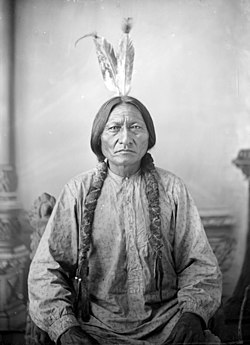
Sitting Bull was killed in 1890, completing the broader post-war reckoning that had begun with Crazy Horse's death in 1877 and Spotted Tail's in 1881, and closing the chapter on the great Lakota leaders of the Plains Wars.
Image source: Sitting Bull
1903 - 1919
% complete
Interviews conducted by Ricker between 1903 and 1919 preserved valuable Lakota testimony about Crazy Horse, yet they equally reflect the methodological assumptions of white interviewers and translators, complicating the historical record.
1941
% complete
Anthony Quinn played Crazy Horse in They Died With Their Boots On (1941), directed by Raoul Walsh and starring Errol Flynn as George Armstrong Custer, bringing the story of Crazy Horse to Hollywood audiences.
Image source: They Died with Their Boots On
1942
% complete
Mari Sandoz's Crazy Horse: The Strange Man of the Oglalas (1942) popularized a romanticized portrait rooted partly in family oral history but heavily elaborated through reconstructed dialogue and interpretive embellishment, shaping popular perceptions of Crazy Horse for decades.
Image source: Mari Sandoz
1948
% complete
The Crazy Horse Memorial sculpture was begun in 1948 by Polish-American sculptor Korczak Ziółkowski, who had previously worked under Gutzon Borglum on Mount Rushmore. Upon completion, it will measure 641 feet wide and 563 feet high, making it the largest sculpture in the world.
Image source: Crazy Horse Memorial
1955
% complete
In the film Chief Crazy Horse (1955), directed by George Sherman, Crazy Horse is played by Victor Mature, continuing Hollywood's fascination with the Lakota war leader.
1967
% complete
Lakota and Cheyenne authors, among them John Stands In Timber (1967), reasserted Indigenous frameworks emphasizing cultural context, spiritual practice, and the authority of oral testimony, rejecting the Eurocentric paradigm in favor of worldviews that acknowledge the unseen and treat elder transmission as historically authoritative.
Image source: Lame White Man
1982
% complete
Crazy Horse was honored by the U.S. Postal Service in 1982 with a 13¢ Great Americans series postage stamp, cementing his place among the most renowned figures in American history.
1996
% complete
In the film Crazy Horse (1996), Crazy Horse is played by Native American actor Michael Greyeyes, offering a portrayal grounded in Indigenous representation.
Image source: Crazy Horse (1996 film)
1998
% complete
The 87-foot head of Crazy Horse was completed and dedicated in 1998, a major milestone in the decades-long effort to carve the world's largest sculpture into the Black Hills of South Dakota.
2005
% complete
Lakota author Joseph Marshall III (2005) reasserted Indigenous frameworks emphasizing cultural context, spiritual practice, and the authority of oral testimony, affirming Crazy Horse's birth year as 1840 in keeping with oral history accounts from relatives on the Cheyenne River Reservation.
Nov 2010
% complete
In November 2010, Nebraska Governor Dave Heineman approved designating US 20 from Hay Springs to Fort Robinson in honor of Crazy Horse, capping a year-long effort by citizens of Chadron.
Image source: U.S. Route 20 in Nebraska
2015
% complete
The middle-grade novel In the Footsteps of Crazy Horse (2015) by Joseph M. Marshall introduced young readers to the life and legacy of the Lakota war leader through a contemporary journey across historic sites.
2016
% complete
Crazy Horse is a major figure in the 2016 AMC docu-series The American West, portrayed by Will Strongheart in reenactment scenes, bringing his story to modern television audiences.
Or browse the full history timeline directory, with more than 2,000 topics.
This Crazy Horse timeline was generated with the help of AI, using information found on the internet.
We work hard to keep these timelines accurate, but mistakes do get through. If you spot one, email us at [email protected] and we'll fix it for future visitors.
Generate yours with AI or build it from scratch, for free.
Export your timeline, add your own events, edit or remove AI-generated events, and much more
No credit card required.
Cancel anytime.
Cancel anytime.
You can create an unlimited number of timelines with up to 10 events on each one, customize how they look, export them to PDF, PNG, PowerPoint, CSV, and Excel, and share them with a link. Paid plans raise the event limit and add features like spreadsheet imports and collaborators.
Yes. You can cancel your subscription from your account page at any time, and you will not be charged again. Your subscription stays active for the rest of the period you already paid for.
Yes. We will email you a reminder before the annual renewal, and we will also email you a receipt.
Yes. You can email us within 15 days of any payment, and we will issue you a full refund.
Check out our pricing docs or send us an email anytime: [email protected].