-
Use Cases
-
Resources
-
Pricing
1834
% complete
Maria Kornilieva came from a well-known family of Tobolsk merchants, founders of the first Siberian printing house, who traced their ancestry to Yakov Korniliev, a 17th-century posad man who became a wealthy merchant.
Jan 27, 1834
% complete
Dmitri Mendeleev was born in the village of Verkhnie Aremzyani, near Tobolsk in Siberia, to Ivan Pavlovich Mendeleev and Maria Dmitrievna Mendeleeva (née Kornilieva).
Image source: Dmitri Mendeleev
1849
% complete
In 1849, Mendeleev's mother took him across Russia from Siberia to Moscow with the aim of getting him enrolled at Moscow University.
1850
% complete
The now poor Mendeleev family relocated to Saint Petersburg, where he entered the Main Pedagogical Institute in 1850.
1855
% complete
After graduation, Mendeleev contracted tuberculosis, causing him to move to the Crimean Peninsula on the northern coast of the Black Sea in 1855.
1857
% complete
In 1857, Mendeleev returned to Saint Petersburg with fully restored health.
1889
% complete
In 1889, a local librarian published an article in the Tobolsk newspaper claiming that Yakov Korniliev was a baptized Teleut, an ethnic minority known as 'white Kalmyks' at the time.
1859 - 1861
% complete
Between 1859 and 1861, Mendeleev worked in Heidelberg on the capillarity of liquids and the workings of the spectroscope.
1861
% complete
Later in 1861, Mendeleev published a textbook named Organic Chemistry. That same year, he anticipated Thomas Andrews' conception of the critical temperature of gases by defining the absolute boiling-point of a substance.
1864
% complete
In 1864, Mendeleev became a professor at the Saint Petersburg Technological Institute.
1865
% complete
In 1865, Mendeleev became a Doctor of Science for his dissertation 'On the Combinations of Water with Alcohol'. He also became a professor at Saint Petersburg State University that year.
1867
% complete
Mendeleev achieved tenure in 1867 at St. Petersburg University and began teaching inorganic chemistry while succeeding Voskresenskii; by 1871, he had transformed Saint Petersburg into an internationally recognized center for chemistry research.
Image source: Saint Petersburg State University
1868
% complete
Mendeleev was one of the founders, in 1868, of the Russian Chemical Society.
Image source: European Chemical Society
Apr 4, 1862
% complete
On 4 April 1862, Mendeleev became engaged to Feozva Nikitichna Leshcheva.
Apr 27, 1862
% complete
Mendeleev married Feozva Nikitichna Leshcheva on 27 April 1862 at Nikolaev Engineering Institute's church in Saint Petersburg, where he taught.
1876
% complete
In 1876, Mendeleev met Anna Ivanovna Popova and began courting her; in 1881 he proposed to her and threatened suicide if she refused.
1882
% complete
Mendeleev married Anna Ivanovna Popova in early 1882; his divorce from Leshcheva was finalized one month after, on 2 April.
1863
% complete
In 1863, there were 56 known elements, with a new element being discovered at a rate of approximately one per year, providing the context for Mendeleev's work on organizing the elements.
Image source: Periodic table
1864
% complete
John Newlands described a Law of Octaves, noting periodicity according to relative atomic weight in 1864, publishing it in 1865. The concept was criticized and not recognized by the Society of Chemists until 1887.
Image source: John Newlands (chemist)
1864
% complete
Another person to propose a periodic table was Lothar Meyer, who published a paper in 1864 describing 28 elements classified by their valence, but with no predictions of new elements.
Image source: Lothar Meyer
1868 - 1870
% complete
After becoming a teacher in 1867, Mendeleev wrote Principles of Chemistry, which became the definitive textbook of its time. It was published in two volumes between 1868 and 1870 as he prepared a textbook for his course.
Image source: Outline of physical science
Mar 6, 1869
% complete
On 6 March 1869, Mendeleev made a formal presentation to the Russian Chemical Society titled The Dependence between the Properties of the Atomic Weights of the Elements, describing elements according to both atomic weight and valence.
1875
% complete
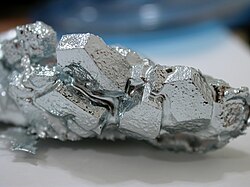
Some dismissed Mendeleev for predicting more elements, but he was proven correct when gallium was discovered in 1875, fitting perfectly into one of the missing spaces in his periodic table.
Image source: Gallium
1882
% complete
Though widely honored by scientific organizations all over Europe, including the Davy Medal from the Royal Society of London in 1882, Mendeleev later resigned from Saint Petersburg University on 17 August 1890.
Image source: Davy Medal
1886
% complete
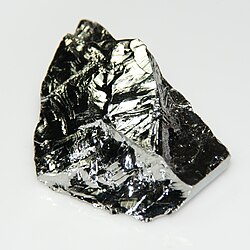
The discovery of germanium in 1886 fit perfectly into another missing space predicted by Mendeleev's periodic table, further confirming the validity of his periodic law.
Image source: Germanium
1889
% complete
In 1889, Mendeleev was elected as an honorary member of the Manchester Literary and Philosophical Society. In 1890, he resigned his professorship at St. Petersburg University.
Image source: Manchester Literary and Philosophical Society
1892
% complete
Mendeleev was elected a Foreign Member of the Royal Society (ForMemRS) in 1892.
Image source: Royal Society
1905
% complete
The Royal Society of London, which had awarded Mendeleev the Davy Medal in 1882, also awarded him the Copley Medal in 1905.
Image source: Copley Medal
1905 - 1907
% complete
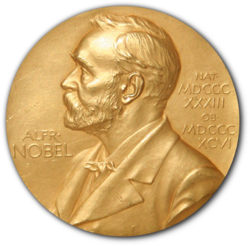
Mendeleev was elected a member of the Royal Swedish Academy of Sciences in 1905 and received three nominations. In 1906 he received four nominations and the Nobel Committee recommended awarding him the prize, but Svante Arrhenius pressed for rejection, arguing the periodic system was too old to acknowledge in 1906. His two nominations in 1907 were again frustrated by Arrhenius's absolute opposition. In total he received 9 nominations over the last three years of his life.
Image source: Nobel Prize in Chemistry
1891
% complete
Although not well-grounded in economics, Mendeleev had observed industry throughout his European travels, and in 1891 helped convince the Ministry of Finance to impose temporary tariffs aimed at fostering Russian infant industries.
1893
% complete
Mendeleev organized its manufacture in 1892, headed the Archive of Weights and Measures in Saint Petersburg, and evolved it into a government bureau the following year. In 1893 he was appointed director of the Bureau of Weights and Measures, a post he occupied until his death, leading efforts to standardize fundamental prototypes and measurement procedures.
Feb 2, 1907
% complete
In 1907, Mendeleev died at the age of 72 in Saint Petersburg from influenza.
1894
% complete
Russian Standard vodka advertises that Mendeleev set the Imperial quality standard for Russian vodka in 1894. In fact, the 40% standard had already been introduced by the Russian government in 1843, and his dissertation only discussed medical-strength alcohol concentrations over 70%; he never wrote anything about vodka.
Image source: Russian Standard (vodka)
1908
% complete
In 1908, shortly after Mendeleev's death, one of his nieces published Family Chronicles.
1965
% complete
The Russian Academy of Sciences has occasionally awarded a Mendeleev Golden Medal since 1965.
Image source: Dmitri Mendeleev
2010
% complete
The mineral mendeleevite-Ce, Cs6(Ce22Ca6)(Si70O175)(OH,F)14(H2O)21, was named in Mendeleev's honor in 2010.
2015
% complete
The related species mendeleevite-Nd, Cs6[(Nd,REE)23Ca7](Si70O175)(OH,F)19(H2O)16, was described in 2015.
Feb 8, 2016
% complete
On 8 February 2016, Mendeleev's 182nd birthday was celebrated with a Google doodle.
Image source: Google Doodle
Or browse the full history timeline directory, with more than 2,000 topics.
This Dmitri Mendeleev timeline was generated with the help of AI, using information found on the internet.
We work hard to keep these timelines accurate, but mistakes do get through. If you spot one, email us at [email protected] and we'll fix it for future visitors.
Generate yours with AI or build it from scratch, for free.
Export your timeline, add your own events, edit or remove AI-generated events, and much more
No credit card required.
Cancel anytime.
Cancel anytime.
You can create an unlimited number of timelines with up to 10 events on each one, customize how they look, export them to PDF, PNG, PowerPoint, CSV, and Excel, and share them with a link. Paid plans raise the event limit and add features like spreadsheet imports and collaborators.
Yes. You can cancel your subscription from your account page at any time, and you will not be charged again. Your subscription stays active for the rest of the period you already paid for.
Yes. We will email you a reminder before the annual renewal, and we will also email you a receipt.
Yes. You can email us within 15 days of any payment, and we will issue you a full refund.
Check out our pricing docs or send us an email anytime: [email protected].