-
Use Cases
-
Resources
-
Pricing
The History of Chemistry traces humanity's understanding of matter, beginning with ancient metallurgy and alchemy, advancing through the scientific revolution with figures like Robert Boyle and Antoine Lavoisier, the development of atomic theory by John Dalton and Dmitri Mendeleev's periodic table, and culminating in modern quantum chemistry and molecular biology. More Less
350 BC
% complete
Aristotle formalized the idea that all matter is composed of four elements: earth, water, air, and fire. This theory dominated Western thought about matter for nearly two thousand years.
Image source: Classical element
300 AD
% complete
The Greco-Egyptian alchemist Zosimos produced some of the oldest known books on alchemy, describing distillation apparatus and mystical interpretations of transmutation that shaped alchemical tradition.
Image source: Zosimos of Panopolis
800 AD
% complete
Known as the father of Arabic chemistry, Jabir ibn Hayyan systematized laboratory techniques such as crystallization and distillation and introduced experimental methodology to the study of substances.
Image source: Jabir ibn Hayyan
900 AD
% complete
The Persian physician Rhazes classified minerals, plants, and animal substances chemically and wrote the Kitab al-Asrar (Book of Secrets), an important early laboratory manual.
Image source: Abu Bakr al-Razi
1300
% complete
This influential Latin alchemical text, attributed to a pseudo-Geber, presented a corpuscular theory of matter and detailed practical laboratory procedures used for centuries.
Image source: Pseudo-Geber
1527
% complete
Paracelsus rejected classical element theory in favor of sulfur, mercury, and salt principles, promoting the use of chemistry in medicine and founding the tradition of iatrochemistry.
Image source: Paracelsus
1543
% complete
While primarily astronomical, Copernicus's heliocentric model encouraged a broader shift toward observation and mathematics in natural science, indirectly influencing the scientific approach to matter.
Image source: De revolutionibus orbium coelestium
1648
% complete
Van Helmont identified carbon dioxide and introduced the word 'gas' into scientific vocabulary, recognizing distinct vapors produced by chemical reactions and bridging alchemy and modern chemistry.
Image source: Jan Baptist van Helmont
1661
% complete
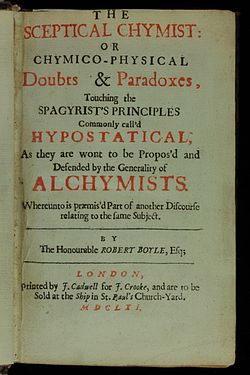
Boyle's landmark work criticized Aristotelian elements and defined an element as a substance that cannot be broken down further, establishing chemistry as a rigorous experimental science.
Image source: The Sceptical Chymist
1662
% complete
Robert Boyle demonstrated that the pressure of a gas is inversely proportional to its volume at constant temperature, one of the first quantitative laws in chemistry.
Image source: Boyle's law
1667
% complete
Becher and later Georg Ernst Stahl proposed that combustion released a substance called phlogiston. The theory dominated explanations of burning until it was overturned by Lavoisier's oxygen chemistry.
Image source: Phlogiston theory
1669
% complete
The German alchemist Hennig Brand isolated phosphorus from urine while searching for the philosopher's stone, becoming the first person credited with discovering a new chemical element.
Image source: Hennig Brand
Aug 1, 1774
% complete
Priestley isolated 'dephlogisticated air' by heating mercuric oxide. His discovery of oxygen was pivotal, though he interpreted it through phlogiston theory, which Lavoisier soon replaced.
Image source: Joseph Priestley
1777
% complete
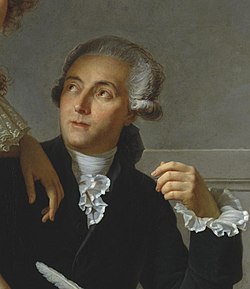
Antoine Lavoisier demonstrated that combustion involves combination with oxygen, named the gas, and established the law of conservation of mass, founding modern quantitative chemistry.
Image source: Antoine Lavoisier
1789
% complete
Lavoisier's textbook presented a systematic nomenclature and a list of 33 elements, cementing the Chemical Revolution and providing the foundation for modern chemistry education.
Image source: Traité Élémentaire de Chimie
1800
% complete
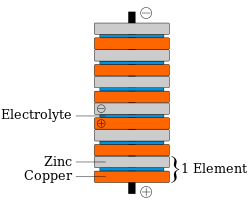
Alessandro Volta created the first battery, enabling continuous electric current. This tool allowed chemists like Davy and Berzelius to use electrolysis to discover new elements.
Image source: Voltaic pile
1803
% complete
Dalton proposed that matter consists of indivisible atoms combining in fixed ratios, explaining chemical reactions quantitatively and transforming chemistry into an atomic science.
Image source: John Dalton
1807
% complete
Using electrolysis, Davy isolated the highly reactive metals potassium and sodium, followed by calcium, strontium, barium, and magnesium, dramatically expanding the known elements.
Image source: Humphry Davy
1811
% complete
Avogadro suggested that equal volumes of gases contain equal numbers of molecules, distinguishing atoms from molecules and later enabling accurate determination of atomic weights.
Image source: Amedeo Avogadro
1813
% complete
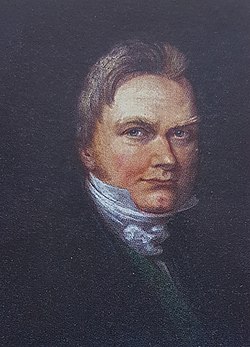
Berzelius devised the system of using letters to symbolize elements, such as O for oxygen and H for hydrogen, creating the universal language of chemical formulas still used today.
Image source: Jöns Jacob Berzelius
1828
% complete
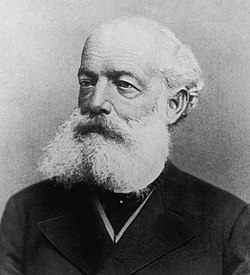
Friedrich Wöhler converted ammonium cyanate into urea, disproving vitalism and demonstrating that organic compounds could be made from inorganic materials, founding organic synthesis.
Image source: Friedrich Wöhler
1865
% complete
August Kekulé proposed that benzene consists of a six-membered carbon ring with alternating bonds, unlocking the structural understanding of aromatic organic chemistry.
Image source: August Kekulé
1867
% complete
Nobel stabilized nitroglycerin in absorbent material to create dynamite, revolutionizing construction and mining and illustrating the industrial power of applied chemistry.
Image source: Dynamite
1869
% complete
Mendeleev arranged elements by atomic weight and predicted undiscovered elements like gallium and germanium. His periodic table became the organizing framework of all chemistry.
Image source: Periodic table
1884
% complete
Arrhenius explained that salts dissolve into charged ions in solution, establishing the foundations of acid-base chemistry and physical chemistry.
Image source: Svante Arrhenius
1897
% complete
Thomson's identification of the electron revealed that atoms have internal structure, launching the study of subatomic particles and eventually quantum theories of bonding.
Image source: J. J. Thomson
1898
% complete
Marie and Pierre Curie isolated two new radioactive elements from pitchblende. Marie Curie's pioneering radiochemistry earned her Nobel Prizes in both physics and chemistry.
Image source: Marie Curie
1909
% complete
Haber's catalytic synthesis of ammonia from nitrogen and hydrogen enabled large-scale fertilizer production, feeding billions, though it was also used for explosives during wartime.
Image source: Haber process
1916
% complete
Lewis described covalent bonding as shared pairs of electrons between atoms, giving chemists a powerful visual model for molecular structure and reactivity.
Image source: Gilbert N. Lewis
1935
% complete
Carothers at DuPont created nylon, the first fully synthetic fiber, ushering in the age of polymer science and synthetic materials that transformed everyday life.
Image source: Nylon
Dec 1938
% complete
Hahn and Fritz Strassmann split uranium nuclei, and Meitner explained the process as fission, opening the era of nuclear energy and profoundly altering science and geopolitics.
Image source: Nuclear fission
Apr 1953
% complete
Building on Rosalind Franklin's X-ray data, Watson and Crick revealed DNA's double helix, merging chemistry with biology and launching molecular biology and biotechnology.
Image source: Nucleic acid double helix
1985
% complete
Harry Kroto, Richard Smalley, and Robert Curl discovered C60 buckminsterfullerene, a soccer-ball-shaped carbon molecule, opening new frontiers in nanotechnology and materials chemistry.
Image source: Fullerene
Or browse the full history timeline directory, with more than 2,000 topics.
This History of Chemistry timeline was generated with the help of AI, using information found on the internet.
We work hard to keep these timelines accurate, but mistakes do get through. If you spot one, email us at [email protected] and we'll fix it for future visitors.
Generate yours with AI or build it from scratch, for free.
Export your timeline, add your own events, edit or remove AI-generated events, and much more
No credit card required.
Cancel anytime.
Cancel anytime.
You can create an unlimited number of timelines with up to 10 events on each one, customize how they look, export them to PDF, PNG, PowerPoint, CSV, and Excel, and share them with a link. Paid plans raise the event limit and add features like spreadsheet imports and collaborators.
Yes. You can cancel your subscription from your account page at any time, and you will not be charged again. Your subscription stays active for the rest of the period you already paid for.
Yes. We will email you a reminder before the annual renewal, and we will also email you a receipt.
Yes. You can email us within 15 days of any payment, and we will issue you a full refund.
Check out our pricing docs or send us an email anytime: [email protected].