-
Use Cases
-
Resources
-
Pricing
The formation of the Solar System began approximately 4.6 billion years ago when a giant molecular cloud collapsed under gravity, forming a rotating disk of gas and dust around the young Sun. Over millions of years, dust particles collided and clumped together, eventually forming planetesimals, protoplanets, and finally the eight planets, moons, asteroids, and comets we know today. More Less
1990
These discs extend to several hundred AU—the Hubble Space Telescope has observed protoplanetary discs of up to 1000 AU in diameter in star-forming regions such as the Orion Nebula—and are rather cool, reaching a surface temperature of only about 1,000 K (730 °C; 1,340 °F) at their hottest. Such observations provide modern evidence for the nebular hypothesis.
Image source: Protoplanetary disk

Jun 6, 2011
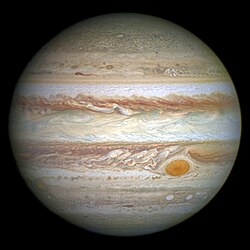
A study by Southwest Research Institute, San Antonio, Texas, published June 6, 2011 (called the Grand tack hypothesis), proposes that Jupiter had migrated inward to 1.5 AU. This inward-and-back migration would have sculpted the inner Solar System, truncating Mars's growth and shaping the asteroid belt.
Image source: Grand tack hypothesis
50000 BC
That impacts continue to happen is evidenced by the impact that created Meteor Crater in Arizona. Formed roughly 50,000 years ago by an iron meteorite, this remarkably well-preserved crater became a key site for studying impact processes on Earth and other planets.
Image source: Meteor Crater

Jun 30, 1908
That impacts continue to happen is evidenced by the Tunguska event, an enormous air burst over Siberia in 1908 that flattened roughly 2,000 square kilometers of forest. It demonstrated the destructive potential of small bodies striking Earth and remains one of the largest impact events in recorded history.
Image source: Tunguska event

Jul 1994
That impacts continue to happen is evidenced by the collision of Comet Shoemaker–Levy 9 with Jupiter in 1994. The spectacular string of impacts provided astronomers a rare live view of planetary bombardment, confirming that collisional processes still shape the Solar System today.
Image source: Comet Shoemaker–Levy 9

2006
A population of main-belt comets discovered in 2006 has also been suggested as a possible source for Earth's water. These icy asteroids blur the line between comets and asteroids and offer another candidate reservoir for the volatile materials delivered to the early Earth.
Image source: Asteroid belt

Jul 19, 2009
That impacts continue to happen is evidenced by the 2009 Jupiter impact event, when an object—likely an asteroid or comet—struck Jupiter's atmosphere, leaving a dark scar visible to amateur and professional astronomers alike. The event underscored the ongoing role of collisions in the Solar System.
Image source: 2009 Jupiter impact event

Feb 15, 2013
That impacts continue to happen is evidenced by the Chelyabinsk meteor, which exploded over Russia in 2013. The airburst shattered windows and injured around 1,500 people, highlighting that even modest near-Earth objects pose real hazards in the modern era.
Image source: Chelyabinsk meteor

1543
This process began with Nicolaus Copernicus in 1543, whose heliocentric model placed the Sun at the center of the Solar System. His work continued over the course of the Scientific Revolution, fundamentally changing humanity's understanding of the cosmos and laying the groundwork for later theories about how the Solar System formed.
Image source: Formation and evolution of the Solar System

1704
The first recorded use of the term "Solar System" dates from 1704, marking a milestone in how astronomers described the Sun and its orbiting bodies as a unified system. This terminology reflected the growing acceptance of the heliocentric view established during the Scientific Revolution.
Image source: Solar System

This Formation of the Solar System timeline was generated with the help of AI, using information found on the internet.
We work hard to keep these timelines accurate, but mistakes do get through. If you spot one, email us at [email protected] and we'll fix it for future visitors.
Generate yours with AI or build it from scratch, for free.