
-
Use Cases
-
Resources
-
Pricing
The Galveston Hurricane of 1900 was a Category 4 storm that struck Galveston, Texas, on September 8, 1900, killing an estimated 6,000 to 12,000 people and making it the deadliest natural disaster in United States history. The hurricane devastated the city, destroyed thousands of buildings, and prompted major engineering efforts, including the construction of a seawall and raising the city's elevation. More Less
1839
% complete
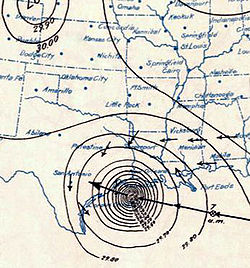
Galveston, Texas was founded in 1839. Over the following decades it weathered numerous storms, all of which the city survived with ease.
Image source: 1900 Galveston hurricane
1875
% complete
A powerful hurricane nearly destroyed the town of Indianola on Matagorda Bay, which had been undergoing its own boom a quarter century before the Galveston disaster.
1886
% complete
Though Indianola was rebuilt after the 1875 storm, a second hurricane in 1886 caused most of the town's residents to move elsewhere.
1891
% complete
Isaac Cline, director of the Weather Bureau's Galveston office, wrote an article in the Galveston Daily News stating it would be impossible for a hurricane of significant strength to strike Galveston Island, and arguing that a seawall was not needed.
1900
% complete
In the late 19th century, Galveston was a boomtown with its population increasing from 29,084 people in 1890 to 37,788 in 1900. It was the fourth largest municipality in Texas and had among the highest per capita income rates in the U.S.
Aug 27, 1900
% complete
On August 27, 1900, a ship east of the Windward Islands detected a tropical cyclone, the first observed that year and the strongest storm of the 1900 Atlantic hurricane season.
Sep 8, 1900
% complete
Throughout its path, the storm caused more than $35.4 million in damages ($1.3 billion in 2023). Itemized estimates from 1901 indicated just over $17 million in damages throughout Galveston alone.
Sep 8, 1900
% complete
Quintana experienced extensive damage during this storm and a flood in 1899, causing portions of the community to be abandoned.
Sep 8, 1900
% complete
Along the coast, storm surge inundated Johnson Bayou, while tides at some locations reached their highest level since the 1875 Indianola hurricane. At the time of the hurricane, the highest point in Galveston was only 8.7 ft above sea level.
Sep 8, 1900
% complete
The 1900 Galveston hurricane became the deadliest natural disaster in the history of the United States, giving the storm the third-highest number of deaths of all Atlantic hurricanes, after the Great Hurricane of 1780 and Hurricane Mitch in 1998.
Sep 8, 1900
% complete
The catastrophic hurricane struck Galveston on September 8, 1900, causing great loss of life with a death toll between 6,000 and 12,000; the number most cited in official reports is 8,000. The city experienced its worst weather since 1877.
Sep 1900
% complete
Clara Barton, founder and president of the American Red Cross, responded to the disaster and visited Galveston with a team of eight Red Cross workers. This would be the last disaster she responded to, as she retired in 1904 at age 78.
1901
% complete
The Galveston city government was reorganized into a commission government in 1901, a newly devised structure made of a small group of commissioners, each responsible for one aspect of governance.
1901
% complete
A survey conducted by the Morrison and Fourmy Company in early 1901 indicated a population loss of 8,124, though the company believed about 2,000 people left the city after the storm and never returned.
Jan 10, 1901
% complete
After the storm, development shifted north to Houston, which reaped the benefits of the oil boom, particularly after the discovery of oil at Spindletop on January 10, 1901.
Mar 1901
% complete
By March 1901, 1,073 cottages were built and 1,109 homes had been repaired as the city worked to recover from the hurricane's devastation.
1902
% complete
The first 3 miles of the Galveston Seawall, 17 ft high, were built beginning in 1902 under the direction of Robert McComb.
Nov 1902
% complete
In November 1902, residents of Galveston overwhelmingly approved a bond referendum to fund building a seawall, passing the measure by a vote of 3,085–21.
Jul 1904
% complete
In July 1904, the first segment of the seawall was completed, though construction continued for several decades, with the final segment finished in 1963.
1907 - 1914
% complete
Between 1907 and 1914, Congregation B'nai Israel rabbi Henry Cohen and philanthropist Jacob Schiff spearheaded the Galveston Movement.
1909 - 1914
% complete
The dredging of the Houston Ship Channel began by 1909 and opened in 1914, ending Galveston's hopes of regaining its former status as a major commercial center.
1910
% complete
The 1910 Census reported a population of 36,891 people in Galveston. Although a decline from the 1900 Census, the population loss of thousands of people was nearly reversed.
1911
% complete
Under Robert McComb's direction, the grade of about 500 blocks in Galveston had been raised by 1911 as part of the city's massive engineering efforts to protect against future storms.
1912
% complete
William Marsh Rice's estate was used to open an institute for higher learning in Houston in 1912, which was named Rice University in his honor.
1915
% complete
A 1915 storm brought storm surge up to 12 ft, testing the integrity of the seawall. Although 53 people on Galveston Island lost their lives, this was a great reduction from the thousands who died in 1900.
1920
% complete
The apparent success of Galveston's new form of government inspired about 500 cities across the United States to adopt a commission government by 1920, though it fell out of favor after World War I.
1960
% complete
The commission government fell out of favor after World War I, with Galveston itself switching to council–manager government in 1960.
1961
% complete
Other powerful tropical cyclones tested the effectiveness of the seawall, including Hurricane Carla in 1961, during which CBS Evening News anchor Dan Rather gained fame for his coverage.
1963
% complete
Construction of the Galveston Seawall, begun in 1902, concluded with the final segment finished in 1963, decades after the devastating 1900 hurricane prompted its construction.
Aug 18, 1977
% complete
The Galveston Seawall was listed among the National Register of Historic Places on August 18, 1977.
1983
% complete
Hurricane Alicia in 1983 was one of the powerful tropical cyclones that tested the effectiveness of the Galveston Seawall built after the 1900 hurricane.
Jan 1998
% complete
To commemorate the hurricane's 100th anniversary in 2000, the 1900 Storm Committee was established and began meeting in January 1998.
Sep 3, 2000
% complete
The Galveston Daily News published a special 100th anniversary commemorative edition newspaper on September 3, 2000, marking a century since the Great Storm.
Oct 11, 2001
% complete
The seawall and raising of the island were jointly named a National Historical Civil Engineering Landmark by the American Society of Civil Engineers on October 11, 2001.
Nov 14, 2004
% complete
Maude Conic of Wharton, Texas, the last reported survivor of the Galveston hurricane of 1900, died November 14, 2004, at the claimed age of 116, although records indicate she was about 10 years younger.
2008
% complete
Hurricane Ike in 2008 was among the powerful tropical cyclones that tested the effectiveness of the Galveston Seawall, alongside Carla in 1961 and Alicia in 1983.
Or browse the full history timeline directory, with more than 2,000 topics.
This Galveston Hurricane timeline was generated with the help of AI, using information found on the internet.
We work hard to keep these timelines accurate, but mistakes do get through. If you spot one, email us at [email protected] and we'll fix it for future visitors.
Generate yours with AI or build it from scratch, for free.
Export your timeline, add your own events, edit or remove AI-generated events, and much more
No credit card required.
Cancel anytime.
Cancel anytime.
You can create an unlimited number of timelines with up to 10 events on each one, customize how they look, export them to PDF, PNG, PowerPoint, CSV, and Excel, and share them with a link. Paid plans raise the event limit and add features like spreadsheet imports and collaborators.
Yes. You can cancel your subscription from your account page at any time, and you will not be charged again. Your subscription stays active for the rest of the period you already paid for.
Yes. We will email you a reminder before the annual renewal, and we will also email you a receipt.
Yes. You can email us within 15 days of any payment, and we will issue you a full refund.
Check out our pricing docs or send us an email anytime: [email protected].