
-
Use Cases
-
Resources
-
Pricing
Jane Addams (1860–1935) was an American social reformer, sociologist, and peace activist best known for co-founding Hull House in Chicago, a pioneering settlement house that served immigrants and the poor. A leading figure of the Progressive Era, she championed social justice, women's suffrage, and world peace, becoming the first American woman to win the Nobel Peace Prize in 1931. More Less
Sep 6, 1860
% complete
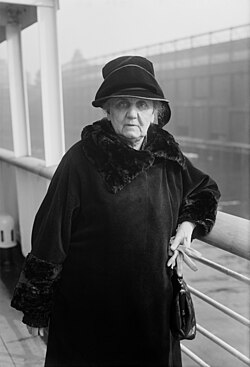
Jane Addams was born in Cedarville, Illinois, the youngest of eight children of John Huy Addams, a prosperous miller and state senator, and Sarah Weber Addams. Her mother died when Jane was two years old, and she was raised largely by her father.
Image source: Jane Addams
1864
% complete
As a young child, Jane Addams contracted tuberculosis of the spine (Pott's disease), which left her with a curved back and a lifelong slight physical disability, shaping her early sensitivity to suffering and vulnerability in others.
1881
% complete
Addams graduated at the top of her class from the Rockford Female Seminary in Illinois, delivering the valedictory address. She had hoped to attend Smith College but family circumstances kept her closer to home.
Image source: Rockford University
1881 - 1882
% complete
After graduating, Addams briefly studied medicine at the Woman's Medical College of Philadelphia but withdrew due to health problems, depression, and uncertainty about her future path.
Image source: Woman's Medical College of Pennsylvania
Aug 17, 1881
% complete
Jane's father, John Huy Addams, died suddenly while on a trip to Michigan. His death deeply affected Jane, who lost both a beloved parent and her most trusted moral guide, contributing to a period of aimlessness and depression.
Image source: John H. Addams
1888
% complete
During a second European tour with her friend Ellen Gates Starr, Addams visited Toynbee Hall, a settlement house serving London's East End poor. Inspired by what she saw, she resolved to establish a similar institution in Chicago.
Image source: Ellen Gates Starr
Sep 18, 1889
% complete
Jane Addams and Ellen Gates Starr moved into a decaying mansion built by Charles J. Hull on Chicago's Near West Side, founding Hull House, one of America's first settlement houses dedicated to helping immigrants and the urban poor.
Image source: Hull House
1891
% complete
Hull House established one of the first public kindergartens in Chicago along with day care services for children of working mothers, reflecting its mission to support immigrant families adapting to American life.
1892
% complete
In this landmark essay delivered at a summer school in Plymouth, Massachusetts, Addams articulated the philosophical foundations of the settlement movement, arguing that educated people needed direct engagement with the poor to give meaning to their lives and democracy.
Image source: Environmental, social, and governance
1893
% complete
Emerging from Hull House investigations into child welfare conditions, the Juvenile Protective Association worked to protect Chicago children from exploitation, including child labor and prostitution, becoming a model for child advocacy organizations.
1895 - 1897
% complete
Appointed by the city after Hull House campaigns exposed unsanitary conditions, Addams served as garbage inspector for her ward, monitoring collection and pressing for better sanitation in immigrant neighborhoods.
1895
% complete
This pioneering sociological study, co-edited by Addams, mapped ethnicity, wages, and working conditions in the neighborhoods around Hull House, becoming an important early work of American empirical social science.
Image source: Florence Kelley
1897
% complete
Through Hull House, Addams championed public playgrounds, gymnasiums, and baths for poor urban children, advocating that cities provide recreational spaces accessible to all residents regardless of income.
Sep 22, 1910 - Nov 1910
% complete
Addams and Hull House supported thousands of mostly immigrant garment workers, many of them women, who struck for better wages and working conditions; mediation eventually won significant gains for the workers.
Image source: 1910 Chicago garment workers' strike
1909
% complete
Addams was elected the first woman president of the National Conference of Charities and Corrections, a major professional honor recognizing her leadership in social work and reform.
Image source: National Conference of Charities and Correction
1910
% complete
Addams published her best-selling autobiographical account of two decades at Hull House, which became a classic of American letters and cemented her national reputation as a leading social reformer.
1914 - 1926
% complete
Over her career, Addams received numerous honorary degrees from institutions including Yale University, which in 1914 made her among the first women honored in that way, recognizing her contributions to sociology and reform.
1930
% complete
A sequel to her famous memoir, this volume covered her later years of activism, including her international peace work and continued involvement in social reform movements of the Progressive Era.
Dec 10, 1931
% complete
Jane Addams became the first American woman to receive the Nobel Peace Prize, honored jointly with Nicholas Murray Butler for her decades of peace activism and humanitarian work. Illness prevented her from attending the ceremony in Oslo.
Image source: Nobel Peace Prize
May 21, 1935
% complete
Jane Addams died of cancer in Chicago at the age of 74. She was buried in Cedarville, Illinois. Thousands mourned the loss of one of America's most influential reformers, whose legacy shaped social work, feminism, and pacifism.
1953
% complete
Eighteen years after her death, Jane Addams was elected to the Hall of Fame for Great Americans, affirming her enduring place in the nation's memory as a pioneer of social justice.
Image source: Hall of Fame for Great Americans
1967
% complete
The surviving original Hull mansion was preserved as the Jane Addams Hull-House Museum, operated by the University of Illinois at Chicago, honoring Addams's legacy and educating visitors about the settlement house movement.
1912
% complete
Addams seconded Theodore Roosevelt's nomination at the Progressive Party convention, becoming the first woman to give a nominating address at a major U.S. party convention, supporting the party's social justice platform.
Image source: Progressive Party (United States, 1912–1920)
Jan 1915
% complete
Addams helped organize and preside over the Women's Peace Party, the first major American pacifist organization formed by women in response to World War I, advocating negotiated peace rather than military intervention.
Image source: Women's International League for Peace and Freedom
Apr 28, 1915 - May 1, 1915
% complete
Addams chaired the International Congress of Women in The Hague, where over 1,200 delegates from warring and neutral nations met to propose mechanisms for ending World War I through mediation and international arbitration.
Image source: International Congress of Women
May 1915 - Jun 1915
% complete
Following The Hague congress, Addams led delegations to London, Berlin, Vienna, Budapest, Rome, and Paris, meeting heads of state including President Wilson's advisors to present women's proposals for a mediated end to the war.
1917 - 1919
% complete
After the United States entered World War I, Addams faced harsh criticism, accusations of disloyalty, and even surveillance by authorities for her pacifism, though she maintained her stance that militarism endangered democracy.
1919
% complete
Addams helped found the WILPF at an international congress in Zurich and served as its president from 1919 until 1929, building a global organization committed to disarmament, peace, and women's rights.
1919 - 1920
% complete
Despite her earlier opposition to the war, Addams collaborated with Herbert Hoover's relief agencies to deliver food aid to starving women and children in Germany and other war-torn regions of Europe.
Image source: American Relief Administration
1920
% complete
Addams served on the board of the National Civil Liberties Bureau, which became the American Civil Liberties Union in 1920, defending free speech rights during the Red Scare era.
Image source: American Civil Liberties Union
1922
% complete
Addams chronicled her peace work during World War I in this book, arguing that lasting peace required addressing economic insecurity and hunger, not merely ending armed conflict.
Image source: Jules Rabin
Or browse the full history timeline directory, with more than 2,000 topics.
This Jane Addams timeline was generated with the help of AI, using information found on the internet.
We work hard to keep these timelines accurate, but mistakes do get through. If you spot one, email us at [email protected] and we'll fix it for future visitors.
Generate yours with AI or build it from scratch, for free.
Export your timeline, add your own events, edit or remove AI-generated events, and much more
No credit card required.
Cancel anytime.
Cancel anytime.
You can create an unlimited number of timelines with up to 10 events on each one, customize how they look, export them to PDF, PNG, PowerPoint, CSV, and Excel, and share them with a link. Paid plans raise the event limit and add features like spreadsheet imports and collaborators.
Yes. You can cancel your subscription from your account page at any time, and you will not be charged again. Your subscription stays active for the rest of the period you already paid for.
Yes. We will email you a reminder before the annual renewal, and we will also email you a receipt.
Yes. You can email us within 15 days of any payment, and we will issue you a full refund.
Check out our pricing docs or send us an email anytime: [email protected].