
-
Use Cases
-
Resources
-
Pricing
Jane Austen (1775–1817) was an English novelist whose works of romantic fiction, set among the landed gentry, earned her a place as one of the most widely read and beloved writers in English literature. Her six major novels—including Pride and Prejudice, Sense and Sensibility, and Emma—explore themes of love, marriage, social class, and women's economic dependence, and continue to inspire adaptations and scholarly study worldwide. More Less
Dec 16, 1775
% complete
Jane Austen was born at the rectory in Steventon, Hampshire, the seventh of eight children of George Austen, a clergyman, and his wife Cassandra Leigh. She grew up in a close-knit, literary family that encouraged her early reading and writing.
Image source: Jane Austen
1783
% complete
In 1783, Jane and her sister Cassandra were sent to Oxford to be tutored by Mrs. Ann Cawley, then moved with her to Southampton. Both girls caught typhus, and Jane nearly died. The sisters then attended the Abbey House School in Reading before returning home.
1787
% complete
Between 1787 and 1793, Austen wrote a large body of humorous and satirical pieces known as her juvenilia, including stories like 'The Beautifull Cassandra' and 'Love and Freindship.' These works were compiled into three notebooks later known as Volume the First, Second, and Third.
Image source: Love and Freindship
Jan 1796
% complete
In January 1796, Austen flirted with young Irish law student Tom Lefroy, as she recorded in letters to her sister Cassandra. The romance came to nothing, likely because neither had money, but it is often cited as an inspiration for Pride and Prejudice.
Image source: Thomas Langlois Lefroy
1801
% complete
In 1801 George Austen retired from the Steventon parish, and the family relocated to Bath, a move Jane reportedly disliked. Her social life in Bath featured balls, promenades, and visits to resorts like Sidmouth and Lyme Regis.
Dec 2, 1802
% complete
At Manydown Park, Harris Bigg-Wither, heir to a substantial estate, proposed to Austen. She accepted him initially for financial security but withdrew her acceptance the next morning, choosing not to marry without love.
Image source: Charles Bigg Wither
Jan 21, 1805
% complete
Rev. George Austen died suddenly in Bath, leaving his wife and daughters financially dependent on his sons. This loss plunged the Austen women into years of reduced circumstances and frequent moves.
1795
% complete
Around 1795, Austen composed 'Elinor and Marianne,' an epistolary novel that would later be revised into Sense and Sensibility, her first published novel.
Image source: Sense and Sensibility
Oct 1796 - Aug 1797
% complete
From October 1796 to August 1797, Austen wrote 'First Impressions,' which her father offered to publisher Thomas Cadell in 1797; it was declined unseen. The novel was heavily revised and eventually published as Pride and Prejudice.
Image source: Pride and Prejudice
1798 - 1799
% complete
In 1798–1799 Austen completed 'Susan,' a satire of Gothic novels that became Northanger Abbey, and continued revising earlier manuscripts while living at Steventon.
Image source: Northanger Abbey
1810
% complete
After revising 'Elinor and Marianne' into Sense and Sensibility, Austen arranged publication on commission with London bookseller Thomas Egerton in 1810, using the pseudonym 'By a Lady.'
Image source: Thomas Egerton (publisher)
Oct 30, 1811
% complete
Published anonymously as 'Sense and Sensibility: A Novel. In Three Volumes. By a Lady,' the book received favorable reviews and sold out its first print run, earning Austen about £140 and encouraging further writing.
Jan 28, 1813
% complete
Austen sold the copyright of Pride and Prejudice to Egerton for £110. It proved an instant success, receiving critical praise and popular acclaim, and a second edition appeared later that same year.
May 9, 1814
% complete
Mansfield Park, Austen's most serious novel dealing with themes of morality, slavery, and social mobility, was published by Egerton. Though reviews were mixed, it sold out its first edition within six months, becoming her most profitable book during her lifetime.
Image source: Mansfield Park
Aug 8, 1815
% complete
Austen started composing Persuasion in August 1815 and finished it around August 1816. Her final completed novel tells the story of Anne Elliot and Captain Wentworth's second chance at love.
Image source: Persuasion
Dec 1815
% complete
Published by John Murray in December 1815, Emma carried a dedication to the Prince Regent at his request, despite Austen's personal dislike of him following his librarian James Stanier Clarke's suggestion she write a historical romance about his ancestors.
Image source: Emma (novel)
Dec 23, 1815
% complete
Emma, a comedy of manners centered on the well-meaning but misguided heroine Emma Woodhouse, appeared in December 1815 (dated 1816). Sir Walter Scott wrote a laudatory review in the Quarterly Review, recognizing Austen's gift for realistic social depiction.
Jul 13, 1816
% complete
Henry Austen bought back the long-dormant copyright of 'Susan' (Northanger Abbey) from Crosby & Co., who had threatened to publish it unsold, and sold both manuscripts to John Murray for £250.
Image source: John Murray (publishing house)
Jan 27, 1817
% complete
Despite declining health, Austen began writing Sanditon, a satirical novel about a seaside resort under development. She abandoned it in March 1817 after twelve chapters due to illness, leaving it unfinished.
Image source: Sanditon
Jul 7, 1809
% complete
With help from her brother Edward, who owned Chawton Great House, Jane, Cassandra, and their mother moved into a cottage on his Hampshire estate. The stable security of Chawton marked the beginning of Austen's most productive period as a writer.
Image source: Jane Austen's House Museum
May 24, 1817
% complete
Suffering from what modern scholars believe may have been Addison's disease or lymphoma, Austen moved to lodgings at 8 College Street in Winchester to be near her physician Giles King Lyford.
Jul 18, 1817
% complete
Jane Austen died in Winchester at age 41. She was buried four days later in the north aisle of Winchester Cathedral. Her death went largely unnoticed by the wider public, and her obituary was brief.
Image source: Causes of Jane Austen's death
Dec 20, 1817
% complete
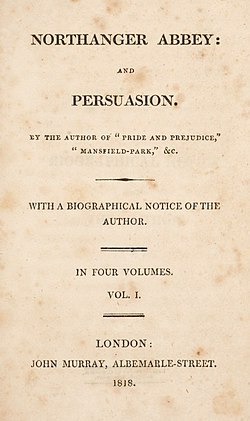
Four months after Austen's death, John Murray published Northanger Abbey and Persuasion together as a four-volume set, with her brother Henry revealing her identity in a 'Biographical Notice' identifying her as author of all six novels.
1832
% complete
Publisher Richard Bentley acquired the copyrights to Austen's six novels and issued them in his Standard Novels series in 1833, making them widely available and helping establish her enduring popular readership.
Image source: Richard Bentley (publisher)
1870
% complete
Her nephew's memoir introduced Austen to a Victorian audience, presenting her as a gentle, domestic figure. Though idealized, it sparked renewed interest in her life and letters and led to increased scholarly attention.
Image source: A Memoir of Jane Austen
1884
% complete
Edward Knatchbull-Hugessen, Lord Brabourne, a great-grandnephew, published the first major edition of Austen's surviving correspondence, giving readers unprecedented insight into her personality and daily life.
Image source: Henry Thomas Austen
1923
% complete
Oxford University Press released R.W. Chapman's annotated five-volume edition of Austen's works, marking the beginning of serious academic Austen studies and cementing her status in the literary canon.
1940
% complete
MGM released the Hollywood adaptation of Pride and Prejudice starring Greer Garson and Laurence Olivier, launching a century-long tradition of screen adaptations of Austen's novels across film and television.
Image source: Pride and Prejudice (1940 film)
1949
% complete
The cottage in Chawton where Austen lived during her most productive years opened as a public museum, preserving her writing table and personal effects, and remains a site of pilgrimage for Austen admirers worldwide.
Jul 19, 1995
% complete
Amy Heckerling's Clueless transplanted Emma to a Beverly Hills high school, demonstrating the adaptability of Austen's plots to contemporary settings and introducing her stories to new generations.
Image source: Clueless
Sep 24, 1995
% complete
The BBC's six-part miniseries starring Colin Firth and Jennifer Ehle became a cultural phenomenon, famously featuring Firth's lake scene, and triggered a wave of renewed global enthusiasm for Austen's works.
Image source: Pride and Prejudice (1995 TV series)
Sep 14, 2017
% complete
The Bank of England issued the polymer £10 note featuring Jane Austen, alongside a quote from Pride and Prejudice ('I declare after all there is no enjoyment like reading!'), honoring one of Britain's greatest writers.
Image source: Banknotes of the pound sterling
Or browse the full history timeline directory, with more than 2,000 topics.
This Jane Austen timeline was generated with the help of AI, using information found on the internet.
We work hard to keep these timelines accurate, but mistakes do get through. If you spot one, email us at [email protected] and we'll fix it for future visitors.
Generate yours with AI or build it from scratch, for free.
Export your timeline, add your own events, edit or remove AI-generated events, and much more
No credit card required.
Cancel anytime.
Cancel anytime.
You can create an unlimited number of timelines with up to 10 events on each one, customize how they look, export them to PDF, PNG, PowerPoint, CSV, and Excel, and share them with a link. Paid plans raise the event limit and add features like spreadsheet imports and collaborators.
Yes. You can cancel your subscription from your account page at any time, and you will not be charged again. Your subscription stays active for the rest of the period you already paid for.
Yes. We will email you a reminder before the annual renewal, and we will also email you a receipt.
Yes. You can email us within 15 days of any payment, and we will issue you a full refund.
Check out our pricing docs or send us an email anytime: [email protected].