-
Use Cases
-
Resources
-
Pricing
1485
% complete
Cortés was born around 1485 in the town of Medellín, Extremadura, a poor and desolate province of the Kingdom of Castile.
Image source: Hernán Cortés
1504
% complete
He finally left for Hispaniola in 1504 and became a colonist. Upon his arrival in Santo Domingo, the 18-year-old Cortés registered as a citizen, which entitled him to a building plot and land to farm.
1506
% complete
In 1506, Cortés took part in the conquests of Hispaniola and Cuba, helping establish himself in the colony during his first five years there.
1511
% complete
In 1511, Cortés accompanied Diego Velázquez de Cuéllar, an aide of the Governor of Hispaniola, in his expedition to conquer Cuba.
Image source: Diego Velázquez de Cuéllar
1514
% complete
In 1514, Cortés led a group which demanded that more Indians be assigned to the settlers.
1518
% complete
He missed the first two expeditions, under the orders of Francisco Hernández de Córdoba and then Juan de Grijalva, sent by Diego Velázquez to Mexico in 1518.
Oct 1518
% complete
Cortés was appointed captain-general of this new expedition in October 1518, but was advised to move fast before Velázquez changed his mind. In an act of open mutiny, he ignored the orders to halt and went anyway.
Feb 1519
% complete
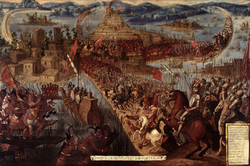
With soldiers, enslaved people accustomed to post-1492 America, 13 horses, and a small number of cannon, Cortés landed on the Yucatán Peninsula in Maya territory.
Image source: Spanish conquest of the Aztec Empire
Mar 1519
% complete
In March 1519, Cortés formally claimed the land for the Spanish crown.
Apr 1519
% complete
At San Juan de Ulúa on Easter Sunday 1519, Cortés met with Moctezuma II's Aztec Empire governors Tendile and Pitalpitoque.
Image source: San Juan de Ulúa
Jul 1519
% complete
Aug 1519
% complete
Leaving a hundred men in Veracruz, Cortés marched on Tenochtitlán in mid-August 1519, along with 600 soldiers, 15 horsemen, 15 cannons, and hundreds of indigenous carriers and warriors.
Sep 2, 1519 - Sep 5, 1519
% complete
The Otomis and then the Tlaxcalans clashed with the Spanish in a series of three battles from 2 to 5 September 1519, and at one point Diaz remarked, "they surrounded us on every side".
Oct 1519
% complete
In October 1519, Cortés and his men, accompanied by about 1,000 Tlaxcalteca, marched to Cholula, the second-largest city in central Mexico.
Image source: Cholula massacre
Nov 8, 1519
% complete
On 8 November 1519, they were peacefully received by Moctezuma II in Tenochtitlán.
Image source: Moctezuma II
Apr 1520
% complete
Meanwhile, Velázquez sent another expedition, led by Pánfilo de Narváez, to oppose Cortés, arriving in Mexico in April 1520 with 1,100 men.
Image source: Pánfilo de Narváez
Jun 30, 1520 - Jul 1, 1520
% complete
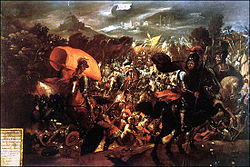
During the Noche Triste (30 June – 1 July 1520), the Spaniards managed a narrow escape from Tenochtitlán across the Tlacopan causeway, while their rearguard was being massacred.
Image source: La Noche Triste
Jul 1, 1520
% complete
On 1 July 1520, Moctezuma was killed; he was stoned to death by his own people according to Spanish accounts, although some claim he was murdered by the Spaniards once they realized his inability to placate the locals.
Jan 1521
% complete
In January 1521, Cortés countered a conspiracy against him, headed by Antonio de Villafana, who was hanged for the offence.
Aug 13, 1521
% complete
With the capture of Cuauhtémoc, the tlatoani (ruler) of Tenochtitlán, on 13 August 1521, the Mexica were conquered, and Cortés claimed it for Spain, renaming the city Mexico City.
1521 - 1524
% complete
From 1521 to 1524, Cortés personally governed Mexico. Thinking himself beyond restraint, he disobeyed many orders of the Crown and said so in a letter to the emperor dated October 15, 1524.
1522
% complete
Cortés's wife, Catalina Súarez, arrived in New Spain around the summer of 1522, along with her sister and brother.
Image source: Hernán Cortés
Nov 1, 1522 - Nov 2, 1522
% complete
Catalina Suárez died under mysterious circumstances the night of 1–2 November 1522. The investigation documentation was published in the nineteenth century in Mexico and uncovered in archives in the twentieth century.
1524
% complete
Cortés managed the founding of new cities and appointed men to extend Spanish rule to all of New Spain, imposing the encomienda system in 1524.
Image source: Encomienda
May 1524
% complete
The Franciscans arrived in May 1524, a symbolically powerful group of twelve known as the Twelve Apostles of Mexico, led by Fray Martín de Valencia.
Image source: Twelve Apostles of Mexico
Oct 12, 1524 - 1526
% complete
Before leaving on 12 October 1524, Cortés left officials in charge of the government. From 1524 to 1526 he headed an expedition to Honduras where he defeated Cristóbal de Olid, who had claimed Honduras under the influence of Governor Diego Velázquez.
May 1525
% complete
Salazar and Almíndez Chirino spread a rumour that Cortés had died, and in May 1525 assumed all power for themselves, including seizing Cortés' property and torturing his cousin Rodrigo de Paz to reveal the whereabouts of alleged treasure.
Jan 1526
% complete
At the end of January 1526, Cortés got a message back to his supporters that he was still alive.
1526
% complete
In 1526, he built an imposing residence for himself, the Palace of Cortés in Cuernavaca, in a region close to the capital where he had extensive encomienda holdings.
Image source: Palace of Cortés, Cuernavaca
Aug 1527
% complete
In February 1527 the aged Aguilar fell ill and before his death appointed Alonso de Estrada governor, in which function Estrada was confirmed by royal decree in August 1527. His authority circumscribed and persecutors unpunished, Cortés sailed for Spain in early 1528.
May 1528
% complete
In May 1528, Cortés arrived in Spain with treasures and 40 Aztecs to impress and to appeal to the justice of his master, Charles V.
1529
% complete
In return for expanding the Spanish Empire, Cortés was accorded the noble title of don and named Marqués del Valle de Oaxaca, and married the Spanish noblewoman Doña Juana Zúñiga after the 1522 death of his first wife Catalina Suárez.
1530
% complete
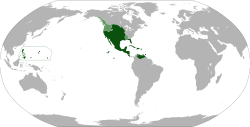
Cortés returned to Mexico in 1530 with new titles and honours, remaining until 1541 while quarrelling with Nuño Beltrán de Guzmán and disputing exploration rights with viceroy Antonio de Mendoza.
Image source: New Spain
1534
% complete
1536
% complete
In 1536, Cortés explored the northwestern part of Mexico and discovered the Baja California peninsula.
Image source: Baja California peninsula
1539
% complete
The Gulf of California was originally named the Sea of Cortés by its discoverer Francisco de Ulloa in 1539.
Image source: Gulf of California
1541
% complete
The emperor finally permitted Cortés to join him and his fleet commanded by Andrea Doria at the great expedition against Algiers in the Barbary Coast in 1541, then part of the Ottoman Empire.
Image source: Battle of Algiers (1541)
1541
% complete
After his exploration of Baja California, Cortés returned to Spain in 1541, hoping to confound his angry civilians, who had brought many lawsuits against him for debts and abuse of power.
Feb 1544
% complete
In February 1544, he made a claim on the royal treasury, but was ignored for the next three years. Disgusted, he decided to return to Mexico in 1547.
Dec 2, 1547
% complete
He died in Castilleja de la Cuesta, Seville province, on 2 December 1547, from pleurisy at the age of 62.
Dec 4, 1547
% complete
On 4 December 1547, he was buried in the mausoleum of the Duke of Medina in the church of San Isidoro del Campo, Sevilla. Three years later (1550), due to space requirements, his body was moved to the altar of Santa Catarina in the same church.
Dec 16, 1560
% complete
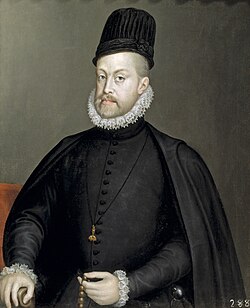
On 16 December 1560, the lawsuits related to vassals of the Cortes estate were resolved by a royal order issued by Philip II.
Image source: Philip II of Spain
1566
% complete
So in 1566, his body was sent to New Spain and buried in the church of San Francisco de Texcoco, where his mother and one of his sisters were buried.
1629
% complete
In 1629, Cortés's last male descendant, Don Pedro Cortés, fourth Marquez del Valle, died.
1716
% complete
In 1716, his remains were moved to another place in the same church. In 1794, his bones were moved to the "Hospital de Jesus" (founded by Cortés), where a statue by Tolsá and a mausoleum were made.
1823
% complete
In 1823, after the independence of México, it seemed imminent that his body would be desecrated, so the mausoleum was removed and the statue and coat of arms were sent to Palermo, Sicily, protected by the Duke of Terranova. In 1836, his bones were moved elsewhere in the same building.
Nov 24, 1946
% complete
It was not until 24 November 1946 that his bones were rediscovered, thanks to the discovery of a secret document by Lucas Alamán.
Image source: Lucas Alamán
1947
% complete
Cortés was portrayed (as "Hernando Cortez") by actor Cesar Romero in the 1947 historical adventure film Captain from Castile.
Image source: Captain from Castile
1981 - 1982
% complete
In 1981, President López Portillo tried to bring Cortés to public recognition. A Maldonado statue commissioned for the Zócalo of Coyoacan had to be moved to the little-known Jardín Xicoténcatl park to quell protests.
Image source: José López Portillo
2000
% complete
Cortés, voiced by Jim Cummings, is a villainous character in The Road to El Dorado (2000), an animated feature set against the Spanish invasion of Mexico.
Image source: The Road to El Dorado
Or browse the full history timeline directory, with more than 2,000 topics.
This Hernán Cortés timeline was generated with the help of AI, using information found on the internet.
We work hard to keep these timelines accurate, but mistakes do get through. If you spot one, email us at [email protected] and we'll fix it for future visitors.
Generate yours with AI or build it from scratch, for free.
Export your timeline, add your own events, edit or remove AI-generated events, and much more
No credit card required.
Cancel anytime.
Cancel anytime.
You can create an unlimited number of timelines with up to 10 events on each one, customize how they look, export them to PDF, PNG, PowerPoint, CSV, and Excel, and share them with a link. Paid plans raise the event limit and add features like spreadsheet imports and collaborators.
Yes. You can cancel your subscription from your account page at any time, and you will not be charged again. Your subscription stays active for the rest of the period you already paid for.
Yes. We will email you a reminder before the annual renewal, and we will also email you a receipt.
Yes. You can email us within 15 days of any payment, and we will issue you a full refund.
Check out our pricing docs or send us an email anytime: [email protected].