-
Use Cases
-
Resources
-
Pricing
Francisco Pizarro was a Spanish conquistador who led the expedition that conquered the Inca Empire in present-day Peru. Born illegitimate in Trujillo, Spain around 1478, he rose through military service in the Americas, captured and executed the Inca emperor Atahualpa in 1533, and founded Lima in 1535 before being assassinated by rival conquistadors in 1541. More Less
1475
% complete
Francisco Pizarro was born around 1475, likely in Trujillo, Spain, the illegitimate son of infantry colonel Gonzalo Pizarro (1446–1522) and Francisca González, a woman of poor means. His exact date of birth is uncertain but is believed to be sometime in the 1470s.
Image source: Francisco Pizarro
Nov 10, 1509
% complete
On 10 November 1509, Pizarro sailed from Spain to the New World with Alonso de Ojeda on an expedition to Urabá, beginning his career as a conquistador in the Americas.
1513
% complete
Pizarro sailed to Cartagena and joined the fleet of Martín Fernández de Enciso and, in 1513, accompanied Vasco Núñez de Balboa in his historic crossing of the Isthmus of Panama to the Pacific Ocean.
Image source: Vasco Núñez de Balboa
1519 - 1523
% complete
For his loyalty to Dávila, Pizarro was rewarded with the positions of mayor (Alcalde) and magistrate of the recently founded Panama City, serving from 1519 to 1523.
Image source: Panama City
Jan 1519
% complete
Balboa was beheaded in January 1519. For his loyalty to Dávila during this affair, Pizarro was rewarded with important positions in Panama City.
1522
% complete
The first attempt to explore western South America was undertaken in 1522 by Pascual de Andagoya. His reports of a wealthy land further south helped inspire Pizarro's own expeditions.
1524
% complete
While still in Panama, Pizarro formed a partnership with the priest Hernando de Luque and the soldier Diego de Almagro to explore and conquer the lands to the south, laying the foundation for the conquest of Peru.
Image source: Diego de Almagro
Nov 1524
% complete
In November 1524, the first of three expeditions left Panama for the conquest of Peru with about 80 men and four horses, marking Pizarro's initial attempt to reach the rumored rich lands to the south.
Image source: Spanish conquest of the Inca Empire
Mar 10, 1526
% complete
On 10 March 1526, Pizarro left Panama with two ships carrying 160 men and several horses, reaching as far as the Colombian San Juan River before being halted by orders from new colonial authorities.
Jul 1526
% complete
Pedro de los Ríos took charge as the new colonial administrator in July 1526 and initially approved Pizarro's expeditions; he would later join him in Peru several years afterward.
1528
% complete
Pizarro sailed from Panama for Spain in the spring of 1528, accompanied by Pedro de Candia, some natives and llamas, plus samples of fabric, gold and silver, to secure royal authorization for his conquest.
Apr 1528
% complete
By April 1528, Pizarro's expedition finally reached the northwestern Peruvian Tumbes Region, where they encountered evidence of the wealth and sophistication of the Inca Empire.
Image source: Tumbes, Peru
Jul 6, 1529
% complete
In 1529, Pizarro obtained permission from the Crown of Castile to lead a campaign to conquer Peru. In the king's absence, Queen Isabel signed the Capitulación de Toledo on 6 July 1529, a licence document authorizing Pizarro to proceed with the conquest of Peru.
Image source: Francisco Pizarro
Jan 1530
% complete
Unable to raise the number of men the Capitulación required, Pizarro sailed clandestinely from the port of Sanlúcar de Barrameda for the Canary Island of La Gomera in January 1530.
Image source: Sanlúcar de Barrameda
Dec 27, 1530
% complete
Pizarro's third and final expedition left Panama for Peru on 27 December 1530, setting out on the voyage that would culminate in the Spanish conquest of the Inca Empire.
1531
% complete
In 1531, Pizarro once again landed on the coasts near Ecuador, the province of Coaque and the region of Esmeraldas, where some gold, silver and emeralds were procured and then dispatched to Almagro.
Image source: Coaque River
May 1532
% complete
As Tumbes no longer afforded safe accommodations, Pizarro led an excursion into the hinterland in May 1532 and established San Miguel de Piura, the first Spanish settlement in Peru, along with a repartimiento.
Image source: Piura
Sep 24, 1532
% complete
Leaving 50 men back at the settlement under the command of Antonio Navarro, Pizarro proceeded with his conquest accompanied by 200 men on 24 September 1532, marching into the Andes toward the Inca emperor Atahualpa.
Image source: Battle of Cajamarca
Nov 15, 1532
% complete
Arriving at Cajamarca on 15 November 1532, Pizarro had a force of just 110 foot soldiers, 67 cavalry, three arquebuses and two falconets, facing the vast Inca army camped nearby.
Nov 16, 1532
% complete
After Atahualpa's refusal to submit led Pizarro and his force to attack, the Battle of Cajamarca erupted on 16 November 1532. Relying heavily on Spanish guns and cavalry, Pizarro captured the Inca emperor Atahualpa in a stunning victory against overwhelming odds.
Feb 1533
% complete
By February 1533, Diego de Almagro had joined Pizarro in Cajamarca with an additional 150 men and 50 horses, reinforcing the Spanish position in the heart of the Inca Empire.
Jul 1533
% complete
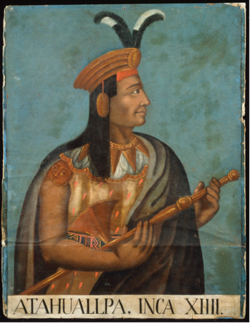
A ransom for the emperor's release was demanded and Atahualpa filled a room with gold to the highest point he could reach, but Pizarro charged him with various crimes and executed him by garrotting in July 1533.
Image source: Atahualpa
Aug 29, 1533
% complete
Atahualpa was formally executed by garrote on 29 August 1533, removing the Inca emperor and dealing a decisive blow to organized Inca resistance to the Spanish conquest.
Nov 15, 1533
% complete
The Spanish sealed the conquest of Peru by entering Cuzco, the Inca capital, on 15 November 1533, completing their takeover of the heart of the Inca Empire.
Image source: Cusco
Apr 1534
% complete
Jauja, in the fertile Mantaro Valley, was established as Peru's provisional capital in April 1534, but it was high up in the mountains and too distant from the sea to serve effectively as the capital.
Image source: Jauja
Jan 6, 1535
% complete
In January 1535, Pizarro founded the city of Lima on Peru's central coast on 6 January 1535, which he considered one of the most important things he had created in life. It replaced Jauja as the capital.
Image source: Lima
Jan 1, 1536 - Mar 31, 1536
% complete
By early 1536, Manco Inca Yupanqui, supported by an army of perhaps 100,000 people, initiated a siege of Cuzco, launching a major indigenous uprising against Spanish rule.
Image source: Siege of Cusco
1538
% complete
Rivalry between the Pizarro brothers and Almagro escalated, leading to confrontations in which Almagro was eventually defeated during the Battle of Las Salinas in 1538 and executed.
Image source: Battle of Las Salinas
Oct 10, 1537
% complete
Francisca Pizarro Yupanqui eventually married her uncle Hernando Pizarro in Spain on 10 October 1537; a third son of Pizarro who was never legitimized, Francisco, by Doña Angelina, died shortly after reaching Spain.
Image source: Hernando Pizarro
1538
% complete
By 1538, it was known that Pizarro had fathered two sons, Juan and Francisco, adding to his complicated personal legacy alongside the conquest itself.
Jun 26, 1541
% complete
In Lima, on 26 June 1541, a group of 20 heavily armed supporters of Diego de Almagro II stormed Pizarro's palace, assassinating him and then forcing the terrified city council to appoint young Almagro as the new governor of Peru. Pizarro had fallen victim to political power struggles.
1799
% complete
Pizarro is the title and subject of a dramatic tragedy by Richard Brinsley Sheridan, presented in 1799, cementing the conquistador's place in popular culture and drama.
Image source: Pizarro (play)
1892
% complete
In 1892, in preparation for the anniversary of Christopher Columbus' discovery of the Americas, a body believed to be that of Pizarro was exhumed and put on display in a glass coffin.
1926
% complete
A statue associated with Pizarro was presented to the city by his widow in 1926. It was later taken to Lima in 1934 and re-purposed to represent Pizarro.
1952
% complete
In 1952 the Pizarro statue was moved to Plaza Pizarro, continuing its journey through various locations in Lima over the decades.
1977
% complete
In 1977, workers on the cathedral's foundation discovered a lead box in a sealed niche bearing an inscription identifying it as containing the head of Marquess Don Francisco Pizarro, prompting forensic examination.
1977
% complete
A team of forensic scientists from the United States, led by William R. Maples, examined the two bodies and soon determined that the body honored in the glass case for nearly a century had been incorrectly identified as Pizarro.
2003
% complete
In 2003 the statue was relocated to Parque de La Muralla after 17 months in a warehouse, placed on a concrete base without its original pedestal, which it had throughout its history since inauguration.
2025
% complete
Pizarro appears in 2025's Civilization VII as a conquistador leader unit for the Spanish Empire, demonstrating his enduring presence in popular culture and video games.
Image source: Civilization VII
Jan 15, 2025 - Jan 18, 2025
% complete
On 15 January 2025, the statue was again moved to a pedestrian street next to the Plaza Mayor to be inaugurated, with the pedestal restored, as part of the city's 490th anniversary celebrations on the 18th.
Or browse the full history timeline directory, with more than 2,000 topics.
This Francisco Pizarro timeline was generated with the help of AI, using information found on the internet.
We work hard to keep these timelines accurate, but mistakes do get through. If you spot one, email us at [email protected] and we'll fix it for future visitors.
Generate yours with AI or build it from scratch, for free.
Export your timeline, add your own events, edit or remove AI-generated events, and much more
No credit card required.
Cancel anytime.
Cancel anytime.
You can create an unlimited number of timelines with up to 10 events on each one, customize how they look, export them to PDF, PNG, PowerPoint, CSV, and Excel, and share them with a link. Paid plans raise the event limit and add features like spreadsheet imports and collaborators.
Yes. You can cancel your subscription from your account page at any time, and you will not be charged again. Your subscription stays active for the rest of the period you already paid for.
Yes. We will email you a reminder before the annual renewal, and we will also email you a receipt.
Yes. You can email us within 15 days of any payment, and we will issue you a full refund.
Check out our pricing docs or send us an email anytime: [email protected].