
-
Use Cases
-
Resources
-
Pricing
Mar 30, 1746
% complete
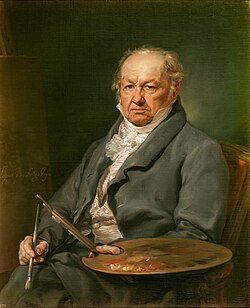
Francisco José de Goya y Lucientes was born in Fuendetodos, Aragón, Spain, to José Benito de Goya y Franque and Gracia de Lucientes y Salvador, a middle-class family. He would become the most important Spanish artist of the late 18th and early 19th centuries.
Image source: Francisco Goya
1749
% complete
Around 1749, Goya's parents José and Gracia bought a home in Zaragoza and returned to live in the city, where Goya spent much of his youth and began his artistic education.
1760 - 1803
% complete
At school Goya formed a close and lifelong friendship with fellow pupil Martín Zapater. The 131 letters Goya wrote to him from 1775 until Zapater's death in 1803 give valuable insight into Goya's early years at the court in Madrid.
1763 - 1766
% complete
Goya submitted entries for the Real Academia de Bellas Artes de San Fernando in 1763 and again in 1766, but was denied entrance into the academy on both occasions, a setback in his early training.
Image source: Real Academia de Bellas Artes de San Fernando
1771
% complete
In 1771, Goya won second prize in a painting competition organized by the City of Parma. It is possible he also completed two surviving mythological paintings during the visit, a Sacrifice to Vesta and a Sacrifice to Pan, both dated 1771.
Jul 25, 1773
% complete
Goya befriended Francisco Bayeu and married his sister Josefa (nicknamed "Pepa") on 25 July 1773. The marriage into the Bayeu family helped advance his artistic career in Madrid.
Aug 29, 1774
% complete
Goya and Josefa's first child, Antonio Juan Ramon Carlos, was born on 29 August 1774. Of the couple's many children, only one would survive into adulthood.
1779
% complete
Goya's c. 1779 etching of The Garrotted Man ("El agarrotado") was the largest etching he had produced to date and clearly foreshadows his later Disasters of War series.
1775
% complete
Francisco Bayeu's influence, his own 1765 membership of the Real Academia de Bellas Artes de San Fernando, and Bayeu's directorship of the tapestry works from 1777 helped Goya earn a commission for a series of Rococo-style tapestry cartoons for the Royal Tapestry Factory.
1783
% complete
In 1783, the Count of Floridablanca, favorite of King Charles III, commissioned Goya to paint his portrait, a significant step in Goya's rise among the Spanish elite.
1786
% complete
In 1786, Goya became a court painter to the Spanish Crown, given a salaried position as painter to Charles III. His early career was marked by portraits of the Spanish aristocracy and royalty and tapestry cartoons for the royal palace.
Image source: Charles III of Spain
1789
% complete
In 1789, Goya was appointed court painter to the new king, Charles IV, continuing his rise within the Spanish court and securing commissions from royalty and nobility.
Image source: Charles IV of Spain
1795
% complete
Goya was appointed Director of the Royal Academy in 1795, the same year Manuel Godoy made an unfavorable treaty with France, signaling turbulent political times in Spain.
1798
% complete
In 1798, Goya painted luminous and airy scenes for the pendentives and cupola of the Real Ermita (Chapel) of San Antonio de la Florida in Madrid, one of his most celebrated decorative works.
Image source: Royal Chapel of St. Anthony of La Florida
1799
% complete
In 1799, Goya became Primer Pintor de Cámara (Prime Court Painter), the highest rank for a Spanish court painter, cementing his position at the top of the royal artistic establishment.
1800 - 1801
% complete
In 1800–01, Goya painted Charles IV of Spain and His Family, a monumental royal group portrait influenced by Velázquez, whose work Goya greatly admired.
Image source: Charles IV of Spain and His Family
1801
% complete
In 1801, Goya painted Godoy in a commission to commemorate the victory in the brief War of the Oranges against Portugal. The two were friends, even if the 1801 portrait is usually seen as satire.
Image source: Manuel Godoy
1793
% complete
At some time between late 1792 and early 1793, a severe and undiagnosed illness left Goya deaf, after which his work became progressively darker and more pessimistic in tone.
1793 - 1794
% complete
While convalescing between 1793 and 1794, Goya completed a set of eleven small pictures painted on tin that marked a significant change in the tone and subject matter of his art, drawing from the dark and dramatic realms of fantasy and nightmare.
1799
% complete
In 1799, Goya published 80 Caprichos prints, a series of aquatinted etchings depicting "the innumerable foibles and follies to be found in any civilized society" and the prejudices and deceitful practices made usual by custom, ignorance, or self-interest.
Image source: Los caprichos
1807 - 1814
% complete
In 1807, Napoleon led the French army into the Peninsular War against Spain, and the French army invaded Spain in 1808. The conflict's violence would profoundly shape Goya's darkest works.
Image source: Peninsular War
1808 - 1836
% complete
In 1808, all of Godoy's property was seized by Ferdinand VII after his fall from power and exile, and in 1813 the Inquisition confiscated Goya's Maja paintings as 'obscene', returning them in 1836 to the Academy of Fine Arts of San Fernando.
1811 - 1812
% complete
The middle series of The Disasters of War (plates 48 to 64) record the effects of the famine that hit Madrid in 1811–12 before the city was liberated from the French, while the final 17 plates reflect liberals' bitter disappointment at the rejection of the Spanish Constitution of 1812.
Image source: The Disasters of War
1812
% complete
Goya's wife Josefa died in 1812. By that time, he was painting The Second of May 1808 and The Third of May 1808, and preparing the series of etchings later known as The Disasters of War.
1814
% complete
After the restoration of Ferdinand VII in 1814, Goya denied any involvement with the French. His paintings The Second of May 1808 and The Third of May 1808 powerfully depict the Dos de Mayo Uprising and its brutal suppression, revealing thoughts he did not speak publicly.
Image source: The Third of May 1808
1814
% complete
Ferdinand VII returned to Spain in 1814, but relations with Goya were not cordial. Art historians assume Goya felt alienated from the reactionary social and political trends that followed the restoration of the Bourbon monarchy.
Image source: Ferdinand VII
1814 - 1819
% complete
Goya's works from 1814 to 1819 are mostly commissioned portraits, but also include the altarpiece of Santa Justa and Santa Rufina for the Cathedral of Seville, the print series La Tauromaquia depicting scenes from bullfighting, and probably the etchings of Los Disparates.
Image source: La Tauromaquia
1819 - 1823
% complete
Goya's late period culminates with the Black Paintings of 1819–1823, applied in oil on the plaster walls of his house the Quinta del Sordo (House of the Deaf Man), where, disillusioned by political and social developments in Spain, he lived in near isolation.
Image source: Black Paintings
1814
% complete
Leocadia Weiss, Goya's maid and companion, younger by 35 years, bore a daughter, Rosario, in 1814. Separated from her husband Isidore Weiss since 1811, she stayed with Goya in his Quinta del Sordo villa and may have been his lover.
Image source: Leocadia Zorrilla
1824
% complete
Goya abandoned Spain in 1824 to retire to the French city of Bordeaux, accompanied by his much younger maid and companion, Leocadia Weiss, who may have been his lover.
Apr 16, 1828
% complete
Following a stroke that left him paralyzed on his right side, Goya died and was buried on 16 April 1828 at the age of 82, closing the life of one of Spain's greatest artists.
1863
% complete
Although Goya did not make his intentions known when creating The Disasters of War, the series was not published until 1863, 35 years after his death, and is viewed by art historians as a visual protest against the violence of war and repression.
1874
% complete
Around 1874, 50 years after Goya's death, the Black Paintings were taken down from the walls of the Quinta del Sordo and transferred to canvas support by owner Baron Frédéric Émile d'Erlanger.
1900
% complete
Among the 20th-century painters influenced by Goya are the Spanish masters Pablo Picasso and Salvador Dalí, who drew influence from Los Caprichos and Goya's Black Paintings, extending his legacy into modern art.
1911
% complete
The Spanish composer Enrique Granados wrote a suite for solo piano in 1911 based on Goya's paintings called Goyescas, and later wrote an opera of the same name based on the suite.
Image source: Goyescas
1919
% complete
In 1919, Goya's body was re-interred in the Real Ermita de San Antonio de la Florida in Madrid, the chapel whose cupola he had painted with luminous frescoes in 1798.
1958
% complete
The Naked Maja (1958), directed by Henry Koster, was a Hollywood film depicting Goya's life and his relationship with the model of his famous painting, bringing the artist's story to a wide audience.
Image source: The Naked Maja (film)
1971
% complete
Goya or the Hard Way to Enlightenment (German: Goya – oder der arge Weg der Erkenntnis) is a 1971 East German drama film directed by Konrad Wolf, dramatizing the painter's life and artistic development.
Image source: Goya or the Hard Way to Enlightenment
1990 - 2002
% complete
In the 21st century, American postmodern painters such as Michael Zansky and Bradley Rubenstein draw inspiration from "The Sleep of Reason Produces Monsters" (1796–98) and Goya's Black Paintings. Zansky's "Giants and Dwarf Series" (1990–2002) of large-scale paintings and wood carvings uses imagery from Goya.
2024
% complete
In 2024, an extensive exhibition of Goya's etchings was held at the Norton Simon Museum in Southern California, continuing the artist's enduring influence on art lovers and scholars.
Image source: Norton Simon Museum
Or browse the full history timeline directory, with more than 2,000 topics.
This Francisco Goya timeline was generated with the help of AI, using information found on the internet.
We work hard to keep these timelines accurate, but mistakes do get through. If you spot one, email us at [email protected] and we'll fix it for future visitors.
Generate yours with AI or build it from scratch, for free.
Export your timeline, add your own events, edit or remove AI-generated events, and much more
No credit card required.
Cancel anytime.
Cancel anytime.
You can create an unlimited number of timelines with up to 10 events on each one, customize how they look, export them to PDF, PNG, PowerPoint, CSV, and Excel, and share them with a link. Paid plans raise the event limit and add features like spreadsheet imports and collaborators.
Yes. You can cancel your subscription from your account page at any time, and you will not be charged again. Your subscription stays active for the rest of the period you already paid for.
Yes. We will email you a reminder before the annual renewal, and we will also email you a receipt.
Yes. You can email us within 15 days of any payment, and we will issue you a full refund.
Check out our pricing docs or send us an email anytime: [email protected].