-
Use Cases
-
Resources
-
Pricing
The History of Artificial Intelligence traces the development of machines capable of performing tasks that require human-like intelligence. Beginning with theoretical foundations laid by mathematicians like Alan Turing in the 1940s and 1950s, the field was formally established at the 1956 Dartmouth Conference. It has since experienced cycles of optimism and disappointment known as 'AI winters,' followed by major advances in machine learning, deep learning, and generative AI that have transformed industries worldwide. More Less
1943
% complete
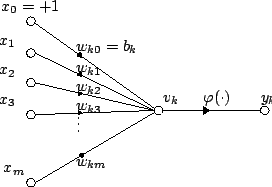
Warren McCulloch and Walter Pitts published a landmark paper proposing the first mathematical model of an artificial neuron, showing how simple neural units could compute logical functions. This work laid the theoretical foundation for neural networks and computational theories of the mind.
Image source: Artificial neuron
1950
% complete
Alan Turing published 'Computing Machinery and Intelligence,' introducing the imitation game, later known as the Turing Test. It proposed that a machine could be considered intelligent if its conversational responses were indistinguishable from a human's, framing the philosophical debate about machine intelligence.
Image source: Turing test
1956
% complete
Allen Newell, Herbert Simon, and Cliff Shaw unveiled Logic Theorist, often called the first AI program. It proved mathematical theorems from Whitehead and Russell's Principia Mathematica, demonstrating that machines could perform tasks requiring reasoning.
Jun 18, 1956 - Aug 17, 1956
% complete
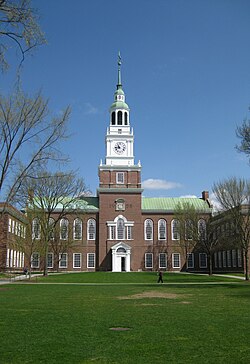
John McCarthy organized a summer workshop at Dartmouth College with Marvin Minsky, Nathaniel Rochester, and Claude Shannon. The conference coined the term 'artificial intelligence' and is widely regarded as the founding event of AI as an academic discipline.
Image source: Dartmouth workshop
1957
% complete
Frank Rosenblatt at Cornell Aeronautical Laboratory created the perceptron, an early artificial neural network capable of learning to classify patterns. Funded by the U.S. Navy, it generated enormous excitement about machine learning's potential.
Image source: Perceptron
1958
% complete
John McCarthy developed LISP at MIT, the second-oldest high-level programming language still in use. Its flexibility for symbolic computation made it the dominant language of AI research for decades.
Image source: Lisp (programming language)
1966
% complete
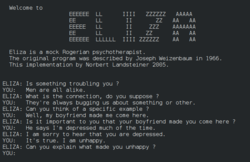
Joseph Weizenbaum created ELIZA, a natural language processing program that simulated a Rogerian psychotherapist through pattern matching. Despite its simplicity, many users attributed human-like understanding to it, sparking discussion about human-computer relationships.
Image source: ELIZA
1966 - 1972
% complete
SRI International developed Shakey, the first general-purpose mobile robot able to reason about its own actions. Shakey integrated perception, planning, and execution, pioneering techniques in computer vision and pathfinding.
Image source: Shakey the robot
1969
% complete
Marvin Minsky and Seymour Papert published 'Perceptrons,' mathematically demonstrating the limitations of single-layer perceptrons, such as their inability to solve XOR problems. The book contributed to a sharp decline in neural network funding and research.
Image source: Perceptrons (book)
1972
% complete
Researchers at Stanford developed MYCIN, an expert system that diagnosed blood infections and recommended antibiotics. Using a rule-based knowledge base of around 600 rules, it performed comparably to junior doctors and inspired a wave of commercial expert systems.
Image source: Mycin
1974 - 1980
% complete
Criticism from reports like the 1973 Lighthill Report in Britain and reduced DARPA funding led to the first AI winter. Overly optimistic predictions had failed to materialize, and governments dramatically cut support for AI research.
Image source: AI winter
1982 - 1992
% complete
Japan's Ministry of International Trade and Industry launched a ten-year, $400 million initiative to build computers using massively parallel computing and logic programming. The ambitious project spurred competing investments in AI by the United States and Britain.
1986
% complete
David Rumelhart, Geoffrey Hinton, and Ronald Williams published a paper popularizing backpropagation for training multi-layer neural networks. This algorithm overcame earlier limitations and revived interest in connectionist approaches to AI.
1987 - 1993
% complete
The collapse of the specialized LISP machine market and disappointing returns on expert systems triggered the second AI winter. Funding dried up again as the industry reassessed the commercial viability of symbolic AI approaches.
May 11, 1997
% complete
IBM's Deep Blue chess computer defeated world champion Garry Kasparov in a six-game match, marking the first time a computer beat a reigning world champion under standard tournament conditions. The victory showcased the power of brute-force search combined with evaluation heuristics.
Image source: Deep Blue versus Garry Kasparov
Sep 2002
% complete
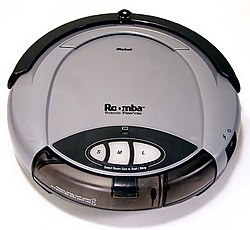
iRobot released the Roomba, an autonomous robotic vacuum cleaner using sensor-based navigation algorithms. It became one of the first commercially successful consumer robots, bringing practical AI-driven automation into millions of households.
Image source: Roomba
Oct 8, 2005
% complete
Stanford's Stanley, led by Sebastian Thrun, won the second DARPA Grand Challenge by autonomously navigating 132 miles of desert terrain. The milestone accelerated development of self-driving car technology and machine perception.
Image source: DARPA Grand Challenge
Oct 2006 - Sep 2009
% complete
Netflix offered $1 million to improve its movie recommendation algorithm by 10 percent. The three-year competition energized collaborative filtering research and was won in 2009 by team BellKor's Pragmatic Chaos, advancing recommender systems broadly.
Image source: Netflix Prize
2007
% complete
Fei-Fei Li began building ImageNet, a massive database of over 14 million labeled images. The dataset enabled rigorous benchmarking of computer vision systems and became the catalyst for the deep learning revolution.
Image source: ImageNet
Feb 14, 2011 - Feb 16, 2011
% complete
IBM's Watson defeated champions Ken Jennings and Brad Rutter on the quiz show Jeopardy!, demonstrating advanced natural language processing and question answering. The win highlighted AI's ability to handle ambiguous, knowledge-intensive queries.
Image source: IBM Watson
Jun 2012
% complete
Andrew Ng and Jeff Dean's Google Brain team trained a massive neural network on YouTube frames, which famously learned to recognize cats without labeled data. The experiment demonstrated the scalability of unsupervised feature learning.
Image source: Google Brain
Sep 2012
% complete
Alex Krizhevsky, Ilya Sutskever, and Geoffrey Hinton's AlexNet crushed the ImageNet Large Scale Visual Recognition Challenge, halving error rates using GPUs and convolutional neural networks. The result ignited the modern deep learning boom across industry and academia.
Image source: AlexNet
Jun 2014
% complete
Ian Goodfellow introduced generative adversarial networks, where two neural networks compete — one generating synthetic data and the other judging authenticity. GANs revolutionized image generation and opened new frontiers in generative modeling.
Dec 11, 2015
% complete
Elon Musk, Sam Altman, and other tech leaders founded OpenAI as a nonprofit research lab dedicated to ensuring artificial general intelligence benefits all humanity. The lab later became a leading force behind large language models and generative AI.
Image source: OpenAI
Mar 9, 2016 - Mar 15, 2016
% complete
DeepMind's AlphaGo defeated world Go champion Lee Sedol 4–1 in Seoul, achieving what experts had predicted was a decade away. Combining deep neural networks with Monte Carlo tree search, AlphaGo's creative moves stunned the Go community and captivated the world.
Jun 2017
% complete
Eight Google researchers published 'Attention Is All You Need,' introducing the transformer architecture based entirely on attention mechanisms. Transformers became the foundation for virtually all modern large language models and generative AI systems.
Feb 2019
% complete
OpenAI announced GPT-2, a 1.5-billion-parameter language model capable of generating coherent text. Citing potential misuse, OpenAI initially withheld the full model, sparking unprecedented debate about responsible publication of powerful AI systems.
Image source: GPT-2
Jun 2020
% complete
OpenAI released GPT-3, a 175-billion-parameter language model exhibiting remarkable few-shot capabilities without fine-tuning. Its API launch made advanced generative AI accessible to developers and foreshadowed the mainstream AI boom.
Nov 30, 2020
% complete
DeepMind's AlphaFold 2 achieved near-experimental accuracy at CASP14, effectively solving the 50-year grand challenge of protein folding prediction. The breakthrough promised to accelerate drug discovery and biological research worldwide.
Jan 5, 2021
% complete
OpenAI unveiled DALL-E, a transformer-based model that creates original images from textual descriptions. Demonstrating compositional understanding and creativity, DALL-E marked the rise of text-to-image generation as a major frontier in generative AI.
Image source: DALL-E
Or browse the full history timeline directory, with more than 2,000 topics.
This History of Artificial Intelligence timeline was generated with the help of AI, using information found on the internet.
We work hard to keep these timelines accurate, but mistakes do get through. If you spot one, email us at [email protected] and we'll fix it for future visitors.
Generate yours with AI or build it from scratch, for free.
Export your timeline, add your own events, edit or remove AI-generated events, and much more
No credit card required.
Cancel anytime.
Cancel anytime.
You can create an unlimited number of timelines with up to 10 events on each one, customize how they look, export them to PDF, PNG, PowerPoint, CSV, and Excel, and share them with a link. Paid plans raise the event limit and add features like spreadsheet imports and collaborators.
Yes. You can cancel your subscription from your account page at any time, and you will not be charged again. Your subscription stays active for the rest of the period you already paid for.
Yes. We will email you a reminder before the annual renewal, and we will also email you a receipt.
Yes. You can email us within 15 days of any payment, and we will issue you a full refund.
Check out our pricing docs or send us an email anytime: [email protected].