-
Use Cases
-
Resources
-
Pricing
The World Wide Web is a global system of interconnected hypertext documents accessed via the Internet, invented by Tim Berners-Lee in 1989 at CERN. This timeline traces its evolution from early text-based browsers and the first website through the dot-com boom, the rise of search engines and social media, to today's dynamic, mobile-first, and decentralized web. More Less
1945
% complete
Vannevar Bush's 1945 essay "As We May Think" described the memex, a microfilm-based device for storing and linking information. Both Ted Nelson and Douglas Engelbart were inspired by this vision, which later influenced the development of hypertext and ultimately the World Wide Web.
Image source: As We May Think
1980
% complete
In 1980, Tim Berners-Lee, working on a contract from June to December at CERN in Switzerland, built ENQUIRE, a personal database of people and software models. Each new page of information had to be linked to another page, allowing him to experiment with hypertext concepts that would later shape the Web.
1985
% complete
By 1985, the Domain Name System (DNS), upon which the Uniform Resource Locator is built, came into being, providing the hierarchical naming infrastructure essential for addressing resources on the future World Wide Web.
Image source: Domain Name System
1987
% complete
Apple Computer released HyperCard in 1987, one of many small, self-contained hypertext systems created during this era. HyperCard demonstrated the power of linked information cards and influenced thinking about hypermedia systems.
Image source: HyperCard
1984
% complete
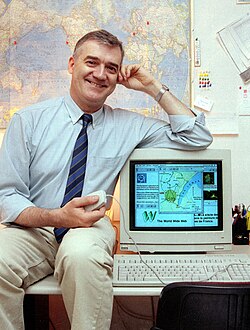
In 1984, Tim Berners-Lee returned to CERN in a permanent role and considered its problems of information management: physicists from around the world needed to share data, yet they lacked common machines and any shared presentation software.
Image source: Tim Berners-Lee

1988
% complete
In 1988, the first direct IP connection between Europe and North America was established, and Berners-Lee began to openly discuss the possibility of a web-like system at CERN.
Image source: History of the Internet
Mar 12, 1989
% complete
On 12 March 1989, Tim Berners-Lee submitted a memorandum titled "Information Management: A Proposal" to CERN management, inventing the World Wide Web while working there. The proposal used the term "web" and was based on "a large hypertext database with typed links."
Image source: History of the World Wide Web
Mar 12, 1989
% complete
The proposal described a system called "Mesh" referencing ENQUIRE, with links embedded as text: readers could skip to references with a click of the mouse. The system used the existing meaning of the word hypertext, a term coined in the 1950s.
Image source: History of the World Wide Web

Sep 1990
% complete
Berners-Lee and Cailliau pitched Berners-Lee's ideas to the European Conference on Hypertext Technology in September 1990, but found no vendors who could appreciate his vision.
Image source: Robert Cailliau
Nov 12, 1990
% complete
With help from Robert Cailliau, Berners-Lee published a more formal proposal on 12 November 1990 to build a "hypertext project" called WorldWideWeb (abbreviated "W3") as a "web" of "hypertext documents" viewed by "browsers" using a client–server architecture.
Image source: World Wide Web
Dec 20, 1990
% complete
By December 1990, Berners-Lee's team had built all the tools necessary for a working Web: HTTP, HTML, the first web browser (named WorldWideWeb, also a web editor), the first web server (later known as CERN httpd), and the first website at info.cern.ch, published on 20 December 1990.
Jan 1991
% complete
In January 1991, the first web servers outside CERN were switched on, marking the beginning of the Web's expansion beyond its birthplace.
Aug 6, 1991
% complete
On 6 August 1991, Berners-Lee published a short summary of the World Wide Web project on the newsgroup alt.hypertext, inviting collaborators to join in developing the new system.
Sep 1991
% complete
Paul Kunz from the Stanford Linear Accelerator Center (SLAC) visited CERN in September 1991 and was captivated by the Web, helping spread adoption of the technology to the United States.
1992
% complete
In 1992, the Computing and Networking Department of CERN, headed by David Williams, withdrew support of Berners-Lee's work, though he continued developing the Web project.
1992
% complete
In 1992, the first tests between browsers on different platforms concluded successfully between buildings 513 and 31 at CERN, between browsers on the NeXT station and the X11-ported Mosaic browser.
Apr 30, 1993
% complete
After the University of Minnesota declared Gopher proprietary in 1993, CERN responded on 30 April 1993 by announcing that the World Wide Web would be free to anyone, with no fees due, releasing their code into the public domain.
May 1994
% complete
In May 1994, the first International WWW Conference, organized by Robert Cailliau, was held at CERN; the conference has been held every year since.
Image source: The Web Conference
1991
% complete
Following the introduction of the Web, several media formats based on discrete cosine transform (DCT) were introduced for practical media distribution and streaming over the Web, including the MPEG video format in 1991.
Image source: MP3
1991
% complete
A DCT variation, the modified discrete cosine transform (MDCT) algorithm, led to the development of MP3, introduced in 1991, which became the first popular audio format on the Web.
Image source: MP3
1991
% complete
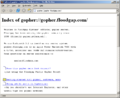
Gopher was a document browsing system for the Internet, released in 1991 by the University of Minnesota. It competed with the early Web before licensing restrictions led to its decline.
Image source: Gopher (protocol)
1992
% complete
The JPEG image format, based on discrete cosine transform compression, was introduced in 1992 as one of several media formats enabling practical image distribution over the Web.
Image source: JPEG
1992
% complete
A shortcoming of the first browser was discussed in January 1992 and alleviated by the release of ViolaWWW, created by Pei-Yuan Wei, followed by Erwise from Helsinki University of Technology students and MidasWWW by Tony Johnson at SLAC.
Image source: ViolaWWW
Nov 1992
% complete
The National Center for Supercomputing Applications (NCSA) at the University of Illinois at Urbana–Champaign established a website in November 1992, setting the stage for the Mosaic browser developed there.
Image source: National Center for Supercomputing Applications
1993
% complete
Students at the University of Kansas adapted an existing text-only hypertext browser, Lynx, to access the web in 1993, providing another popular way to browse early websites.
Image source: Lynx (web browser)
1993 - 1994
% complete
Websites for use by the general public began to emerge in 1993–94, expanding the Web beyond academic and scientific communities. By October 1993 there were over five hundred servers online, up from fifty in January 1993.
Feb 1993
% complete
After Marc Andreessen saw ViolaWWW in late 1992, he began work on Mosaic with Eric Bina at UIUC, funded by the High-Performance Computing and Communications Initiative initiated by Senator Al Gore. A Unix version was released in February 1993; Mac and Windows versions followed in August 1993. Historians agree Mosaic was a turning point for the Web.
Image source: Mosaic (web browser)
Jun 1993
% complete
Cello, a web browser for Microsoft Windows, was released in June 1993, bringing web access to users of the increasingly popular Windows platform.
1994
% complete
By 1994, Marc Andreessen's Netscape Navigator superseded Mosaic in popularity, holding the leading position among web browsers for some time.
Image source: Netscape Navigator
Jan 1994
% complete
In January 1994, Yahoo! was founded by Jerry Yang and David Filo, then students at Stanford University, becoming one of the most popular directories and portals of the early Web.
Image source: Yahoo!
1994
% complete
After 1993 the World Wide Web saw many advances to indexing and ease of access through search engines, which often neglected Gopher. By the middle of 1994, the Web was outcompeting Gopher and other Internet browsing systems.
Apr 1994
% complete
After graduating from UIUC, Marc Andreessen and Jim Clark, former CEO of Silicon Graphics, met and formed Mosaic Communications Corporation in April 1994 to develop the Mosaic Netscape browser commercially.
Image source: Netscape
1995
% complete
Bill Gates outlined Microsoft's strategy to dominate the Internet in his Tidal Wave memo in 1995, redirecting the company's focus toward the Web and setting up the browser wars.
Image source: History of Microsoft
1995
% complete
Netscape followed up with Navigator 2 in 1995, introducing frames, Java applets and JavaScript, greatly expanding what web pages could do.
Image source: JavaScript
1995 - 2002
% complete
Following the complete removal of commercial restrictions on Internet use by 1995 when NSFNET was shut down, commercialization of the Web amidst macroeconomic factors led to the dot-com boom and bust in the late 1990s and early 2000s.
Image source: Dot-com bubble
1995
% complete
Online shopping began to emerge with the launch of Amazon's shopping site by Jeff Bezos in 1995 and eBay by Pierre Omidyar the same year, pioneering e-commerce on the Web.
Image source: Amazon (company)
1998
% complete
In 1998, Netscape made Navigator open source and launched Mozilla. That same year AOL bought Netscape, and IE captured the majority of the desktop browser market. AOL disbanded Netscape in 2003.
Image source: Mozilla
Oct 1994
% complete
The World Wide Web Consortium (W3C) was founded by Tim Berners-Lee after he left CERN in September/October 1994 in order to create open standards for the Web. A second site was later founded at INRIA, and in 1996 a third continental site was created in Japan at Keio University.
Image source: World Wide Web Consortium
1995
% complete
The features of HTML evolved over time, leading to HTML version 2 in 1995, an early standardization of the markup language underlying the Web.
Image source: HTML
1995
% complete
In 1995, Brian Behlendorf and Cliff Skolnick created a mailing list to coordinate efforts to fix bugs and make improvements to HTTPd, leading to the Apache web server. Following its success, the Apache Software Foundation was founded in 1999.
Image source: Apache HTTP Server
1998
% complete
Frustrated by inconsistent browser implementations despite the W3C's HTML 4 standard of 1997 (which included CSS), web designers formed the Web Standards Project (WaSP) in 1998 with the goal of cajoling compliance with standards.
1999
% complete
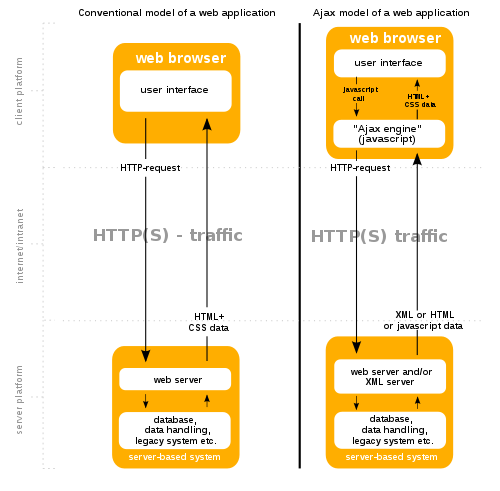
Microsoft added a little-noticed feature called XMLHttpRequest to Internet Explorer in 1999, which enabled a web page to communicate with the server while remaining visible, laying the groundwork for Ajax applications.
Image source: XMLHttpRequest
1999
% complete
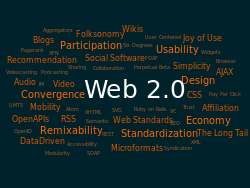
The term Web 2.0 was coined in 1999 by Darcy DiNucci and later popularized in 2004 at the Web 2.0 Conference, describing a new media-rich model featuring user-generated and user-edited websites. Web 1.0 refers retroactively to the Web's first stage, roughly 1989 to 2004.
Image source: Web 2.0
2002
% complete
Developers at Oddpost used XMLHttpRequest in 2002 to create the first Ajax application, a webmail client that performed as well as a desktop application, demonstrating the power of dynamic web interfaces.
Image source: Ajax (programming)
2004
% complete
In 2004, representatives from Mozilla, Opera, and Apple formed the Web Hypertext Application Technology Working Group (WHATWG), dedicated to improving HTML while maintaining backward compatibility, opposing the W3C's XHTML direction.
2007
% complete
Apple introduced the first smartphone in 2007 with a full-featured browser, transforming how people accessed the Web. Other companies followed suit, and in 2011 smartphone sales overtook PCs.
Image source: IPhone
2007 - 2009
% complete
By 2007, the W3C conceded and announced they were restarting work on HTML, and in 2009 they officially abandoned XHTML, aligning with the WHATWG's approach.
2008
% complete
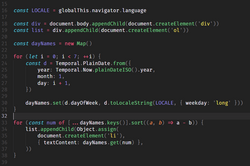
Google released their Chrome browser in 2008 with the first JIT JavaScript engine, V8, dramatically improving JavaScript performance and reshaping the browser landscape.
Image source: Google Chrome
2009
% complete
Ryan Dahl used Chromium's V8 engine in 2009 to power Node.js, an event-driven runtime system that allowed JavaScript code to be used on servers as well as browsers.
Image source: Node.js
2011
% complete
Acer and Samsung began selling Chromebooks, cheap laptops running ChromeOS capable of running web apps, in 2011. The same year, Mozilla announced Web APIs to allow webapps to access hardware features such as audio, camera or GPS.
Image source: ChromeOS
2012 - 2015
% complete
Mozilla released a mobile OS designed to run web apps in 2012, but discontinued it in 2015, an ambitious attempt to make the Web itself the mobile application platform.
Image source: Firefox OS
2014
% complete
The features of HTML evolved over time, culminating in HTML5 in 2014, a major revision supporting multimedia, graphics, and rich applications natively in the browser.
2015
% complete
Google announced specifications for Accelerated Mobile Pages (AMP) and progressive web applications (PWA) in 2015, aiming to make web experiences faster and more app-like on mobile devices.
Image source: Accelerated Mobile Pages
2016
% complete
Since 2016, most visitors access websites with mobile devices, which led to the widespread adoption of responsive web design so pages adapt to screens of all sizes.
Image source: Responsive web design
2019
% complete
In 2019, the W3C ceded control of the HTML specification, now called the HTML Living Standard, to WHATWG, unifying the governance of the core web markup language.
2021
% complete
Microsoft rewrote their Edge browser in 2021 to use Chromium as its code base in order to be more compatible with Chrome, consolidating the dominance of Chromium-based browsers.
Image source: Microsoft Edge
Or browse the full history timeline directory, with more than 2,000 topics.
This History of the World Wide Web timeline was generated with the help of AI, using information found on the internet.
We work hard to keep these timelines accurate, but mistakes do get through. If you spot one, email us at [email protected] and we'll fix it for future visitors.
Generate yours with AI or build it from scratch, for free.
Export your timeline, add your own events, edit or remove AI-generated events, and much more
No credit card required.
Cancel anytime.
Cancel anytime.
You can create an unlimited number of timelines with up to 10 events on each one, customize how they look, export them to PDF, PNG, PowerPoint, CSV, and Excel, and share them with a link. Paid plans raise the event limit and add features like spreadsheet imports and collaborators.
Yes. You can cancel your subscription from your account page at any time, and you will not be charged again. Your subscription stays active for the rest of the period you already paid for.
Yes. We will email you a reminder before the annual renewal, and we will also email you a receipt.
Yes. You can email us within 15 days of any payment, and we will issue you a full refund.
Check out our pricing docs or send us an email anytime: [email protected].