-
Use Cases
-
Resources
-
Pricing
The World's Fair, also known as an International Exposition or World Expo, is a large global exhibition designed to showcase achievements of nations in industry, science, culture, and technology. Beginning with London's Great Exhibition of 1851, these events have introduced iconic innovations such as the Eiffel Tower, the telephone, and the Ferris wheel, while fostering international cooperation and cultural exchange. More Less
1791
% complete
In 1791, Prague organized the first World's Fair, in Bohemia (modern-day Czech Republic), marking the earliest known instance of a world exhibition.
Image source: World's fair
1844
% complete
France had a tradition of national exhibitions, which culminated with the French Industrial Exposition of 1844 held in Paris, setting the stage for the great international expositions that followed.
Image source: French Industrial Exposition of 1844
1851
% complete
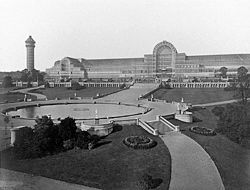
In 1851, the 'Great Exhibition of the Works of Industry of All Nations' was held in the Crystal Palace in Hyde Park, London, United Kingdom, widely regarded as the first modern world's fair.
Image source: Great Exhibition
1853
% complete
The 1853 New York world exposition was among the notable fairs of the industrialization era, bringing the exhibition concept to America.
Image source: Exhibition of the Industry of All Nations
1862
% complete
The 1862 London world exposition was one of the notable fairs of the era of industrialization, showcasing industry and technology from around the world.
Image source: 1862 International Exhibition
1876
% complete
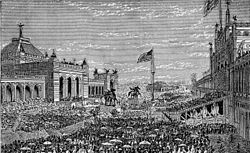
The 1876 Philadelphia Centennial Exposition was a landmark fair celebrating American independence; its main building, Memorial Hall, still stands in Fairmount Park as the home of the Please Touch Museum.
Image source: Centennial Exposition
1878
% complete
The 1878 Paris world exposition was one of the notable fairs of the industrialization era, demonstrating France's recovery and industrial prowess after the Franco-Prussian War.
Image source: Exposition Universelle (1878)
1888
% complete
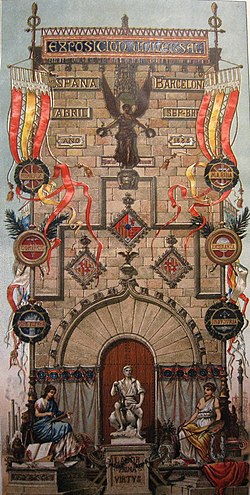
The 1888 Barcelona world exposition was among the notable fairs of the industrialization era, boosting the city's international profile.
Image source: 1888 Barcelona Universal Exposition
1889
% complete
By far the most famous structure built for any world's fair is the Eiffel Tower, constructed for the Exposition Universelle of 1889 in Paris.
Image source: Exposition Universelle (1889)
1891
% complete
The 1891 Prague world exposition was one of the notable fairs of the era of industrialization.
1893
% complete
The 1893 Chicago World's Columbian Exposition was one of the most influential fairs of the industrialization era. The Museum of Science and Industry now occupies the former Palace of Fine Arts, one of the last remaining buildings.
Image source: World's Columbian Exposition
1897
% complete
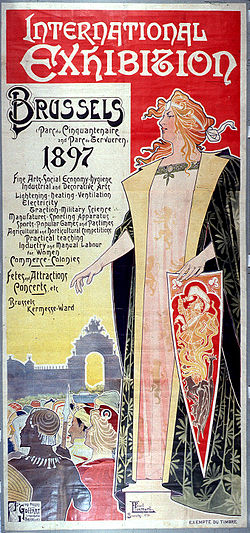
The 1897 Brussels world exposition was among the notable fairs of the industrialization era.
Image source: Brussels International Exposition (1897)
1900
% complete
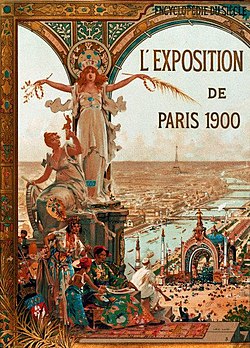
The 1900 Paris world exposition was a celebrated fair of the industrialization era; it left behind the Grand Palais and Petit Palais, and its Peruvian Pavilion was partially rebuilt in Lima while the Japanese Tower was relocated to Laken in Brussels at the request of King Leopold II.
Image source: Exposition Universelle (1900)
1904
% complete
The 1904 St. Louis world exposition was one of the notable fairs of the industrialization era.
Image source: Louisiana Purchase Exposition
1915
% complete
The 1915 San Francisco world exposition was notable for celebrating the completion of the Panama Canal. The Palace of Fine Arts and its lagoon are the only major remnants still in their original locations, though the building is almost entirely a reconstruction completed after the crumbling original was demolished in 1964.
Image source: Panama–Pacific International Exposition
1929
% complete
Spain hosted two simultaneous fairs in 1929, in Seville and Barcelona, and much survives from both exhibitions today.
Image source: 1929 Barcelona International Exposition
1933 - 1934
% complete
The 1933–1934 Chicago world's fair was one of the final notable fairs of the industrialization era, which roughly covered the years from 1850 to 1938.
Image source: Century of Progress
1851 - 1936
% complete
The Crystal Palace, designed so it could be recycled to recoup losses, was such a success that it was moved and intended to be permanent, only to be destroyed by a fire in 1936.
Image source: The Crystal Palace
1889 - 1932
% complete
The Argentine Pavilion from the 1889 Paris Exposition Universelle was relocated to Buenos Aires, Argentina, where it stood until its demolition in 1932.
1897
% complete
A full-scale replica of the Parthenon was built for the Tennessee Centennial and International Exposition and stands today in Nashville's Centennial Park, featuring plaster reproductions of the Elgin Marbles and, since 1990, a re-created Athena Parthenos statue.
Image source: Parthenon (Nashville)
1906
% complete
The Civic Aquarium of Milan, built for the 1906 Milan Exposition, is still open more than a century later and has been recently renovated. In June 2006 the ICOH celebrated the first century of its life in Milan.
Image source: Civic Aquarium of Milan
1909
% complete
The landscaping created by the Olmsted brothers for the 1909 Alaska–Yukon–Pacific Exposition in Seattle still forms much of the University of Washington campus.
Image source: Alaska–Yukon–Pacific Exposition
1915
% complete
Large ornamental wooden gates and a pagoda from the 1915 Panama–Pacific International Exposition were brought into the Japanese Tea Garden, itself the last major remnant of the 1894 California Midwinter International Exposition, making it a rare survivor incorporating features from two separate fairs.
Image source: Japanese Tea Garden (San Francisco)
1936
% complete
The Empire Exhibition, South Africa was built close to the University of the Witwatersrand; by the late 1970s the university had grown to incorporate the permanent buildings, purchasing further structures including the South African Government Building in 1985.
Image source: Empire Exhibition, South Africa
1942
% complete
A special case is the EUR quarter in Rome, built for a World's Fair planned for 1942 but cancelled because of World War II.
Image source: EUR, Rome
1928
% complete
Since the adoption of the 1928 Convention Relating to International Exhibitions, the Paris-based Bureau International des Expositions (BIE) has served as an international sanctioning body for international exhibitions.
Image source: Bureau International des Expositions
1992
% complete
Spain used Expo '92 alongside the 1992 Summer Olympics in Barcelona to underscore its new position as a modern, democratic country and prominent member of the European Union. The Seville pavilions were converted into a technological square and a theme park.
Image source: Expo '92
1995
% complete
Since 1995, the interval between two World Expos has been at least five years, and in the 21st century the BIE has moved to sanction World Expos every five years, seen by some as a means to cut expenditure for participating nations.
1996 - 2016
% complete
The semi-regular Milan Triennial art and design exhibition received official international exhibition status from the BIE for 14 editions between 1996 and 2016.
Image source: Triennale di Milano
1998
% complete
The main buildings of Expo '98 in Lisbon were completely integrated into the city itself, and many of the art exhibition pieces still remain.
Image source: Expo '98
2000
% complete
At Expo 2000 Hanover, countries created their own architectural pavilions investing on average €12 million each. A study by Tjaco Walvis showed improving national image was the main goal for 73% of participating countries, and an independent study estimated the Dutch pavilion generated around €350 million of potential revenues for the Dutch economy. The Portugal Pavilion was later relocated to Coimbra.
Image source: Expo 2000
2005
% complete
The home of Satsuki & Mei Kusakabe, built for the 2005 Expo in Aichi, remains operating at its original site in Morikoro Park as a popular tourist attraction, eventually being incorporated into Ghibli Park in 2022.
Image source: Expo 2005
2010
% complete
The China pavilion from Expo 2010 in Shanghai, the largest display in the history of the World Expo, is now the China Art Museum, the largest art museum in Asia.
Image source: Expo 2010
2012
% complete
Specialized Expos are united by precise themes, such as 'The Living Ocean and Coast', the theme of Expo 2012 Yeosu in South Korea.
Image source: Expo 2012
May 1, 2015 - Oct 31, 2015
% complete
World Expo 2015 was held in Milan, Italy, from May 1 to October 31, 2015. The Italian Pavilion remains on the original site, the Bahrain Pavilion was relocated to Bahrain, and the Save the Children Italy pavilion was rebuilt as a school for Syrian refugee children in Lebanon.
2017
% complete
Astana, Kazakhstan hosted the most recent Specialised Expo in 2017, themed 'Future Energy'. Specialized Expos are usually united by a precise theme.
Image source: Expo 2017
2019
% complete
Like other horticultural expos, Expo 2019 was organized around a precise theme: 'Building a Beautiful Home Featuring Harmonious Coexistence between Man and Nature'. The Chinese Pavilion was brought back to Qingdao, on the site of the 2014 horticultural exhibition.
Image source: Expo 2019
2022
% complete
Horticultural expos such as Floriade 2022 carry themes like 'Growing Green Cities'; these joint BIE and AIPH-sanctioned garden fairs feature participants presenting gardens and garden pavilions.
Image source: Floriade 2022
2023
% complete
Doha, Qatar held the most recent Horticultural Expo in 2023, under the theme 'Green Desert, Better Environment'.
2025
% complete
Osaka, Japan held the most recent World Expo in 2025, continuing the BIE's practice of sanctioning World Expos every five years.
Image source: Expo 2025
Apr 30, 1939 - 1940
% complete
The 1939–1940 New York World's Fair took a different approach than earlier fairs, less focused on technology and aimed more at cultural themes and social progress, under the theme 'Building the World of Tomorrow'. Its New York City Building was reused for the 1964 fair and is now the Queens Museum, while the Belgium Pavilion was relocated to Virginia Union University.
Image source: 1939 New York World's Fair
1958
% complete
The Atomium still stands at the site of the 1958 Brussels World Fair, whose popular use of the term 'expo' helped establish the naming convention for future events. Until June 2012, the 'American Theatre' on the Expo grounds was frequently used as a television studio by the VRT.
Image source: Atomium
1962
% complete
The Space Needle theme building of the Century 21 Exposition, commonly known as the Seattle World's Fair, still stands as a Seattle icon and landmark.
Image source: Century 21 Exposition
1964 - 1965
% complete
The 1964–1965 New York World's Fair carried the theme 'Peace Through Understanding'. Many Disney-created attractions were moved to Disneyland after closing and later duplicated at Walt Disney World, and subway signs directing visitors to Flushing Meadows–Corona Park remain. The New York State Pavilion is mostly derelict but iconic, appearing in Men in Black, with restoration ongoing as of 2019.
Image source: 1964 New York World's Fair
Apr 27, 1967 - Oct 29, 1967
% complete
The 1967 International and Universal Exposition in Montreal, promoted as Expo 67, carried the theme 'Man and His World'. Surviving structures include Habitat 67, the Montreal Biosphere, the Jamaica, Tunisia, and French pavilions (now the Montreal Casino). The Montreal Expos baseball team was named for the fair, and organizers retired the term 'world's fair' in favor of Expo.
Image source: Expo 67
1968
% complete
San Antonio kept the Tower of the Americas and the Convention Center from HemisFair '68.
Image source: HemisFair '68
1970
% complete
The Tower of the Sun was left standing after Expo '70 in Osaka but was neglected until restoration was completed and the museum inside the tower re-opened on March 18, 2018.
Image source: Expo '70
1974
% complete
Spokane still has its Riverfront Park, created for Expo '74; the park remains a popular and iconic part of Spokane's downtown.
Image source: Expo '74
1982
% complete
The Sunsphere from the 1982 Knoxville World's Fair remains a feature of Knoxville's skyline.
Image source: 1982 World's Fair
1984
% complete
The main pavilions of the 1984 New Orleans World's Fair became the Ernest N. Morial Convention Center, also known as a shelter of last resort during Hurricane Katrina and host of Miss Universe 2022.
Image source: 1984 Louisiana World Exposition
1986
% complete
In Vancouver, many Expo 86 projects were designed as legacy projects for the city.
Image source: Expo 86
1988
% complete
The Skyneedle, the symbol tower of Expo '88 in Brisbane, Australia, still stands. In 2018 the World Expo 88 Art Trail was dramatically expanded for the fair's 30th anniversary, forming a major tourist attraction.
Image source: World Expo 88
Or browse the full history timeline directory, with more than 2,000 topics.
This History of the World's Fair timeline was generated with the help of AI, using information found on the internet.
We work hard to keep these timelines accurate, but mistakes do get through. If you spot one, email us at [email protected] and we'll fix it for future visitors.
Generate yours with AI or build it from scratch, for free.
Export your timeline, add your own events, edit or remove AI-generated events, and much more
No credit card required.
Cancel anytime.
Cancel anytime.
You can create an unlimited number of timelines with up to 10 events on each one, customize how they look, export them to PDF, PNG, PowerPoint, CSV, and Excel, and share them with a link. Paid plans raise the event limit and add features like spreadsheet imports and collaborators.
Yes. You can cancel your subscription from your account page at any time, and you will not be charged again. Your subscription stays active for the rest of the period you already paid for.
Yes. We will email you a reminder before the annual renewal, and we will also email you a receipt.
Yes. You can email us within 15 days of any payment, and we will issue you a full refund.
Check out our pricing docs or send us an email anytime: [email protected].