-
Use Cases
-
Resources
-
Pricing
The World Trade Center was a complex of seven buildings in Lower Manhattan, New York City, anchored by the iconic Twin Towers. Opened in 1973, it served as a global hub for commerce and finance for nearly three decades before its destruction in the September 11, 2001 terrorist attacks. The site, known as Ground Zero, has since been rebuilt with new towers, including One World Trade Center, along with memorials honoring the victims. More Less
Mar 10, 1961
% complete
The Port of New York Authority selected a site in Lower Manhattan near the Hudson River for the World Trade Center, envisioning a massive office complex to promote international trade and revitalize downtown Manhattan.
Image source: World Trade Center (1973–2001)
Sep 20, 1962
% complete
Detroit-based architect Minoru Yamasaki was chosen as the lead architect for the World Trade Center, working with Emery Roth & Sons. His design featured twin 110-story towers, the tallest buildings ever planned at the time.
Image source: Minoru Yamasaki
1966 - 1967
% complete
A innovative slurry wall method was used to construct 'the Bathtub,' a deep waterproof perimeter that kept Hudson River water out of the excavation site, a technique that would later prove crucial after September 11, 2001.
Image source: Bathtub
Aug 5, 1966
% complete
Ground was broken for the World Trade Center, requiring the demolition of Radio Row, an electronics district, and the excavation of over one million cubic yards of earth to create the foundation and a large underground plaza.
Dec 15, 1970
% complete
The North Tower welcomed its first tenants even while construction continued on other parts of the complex, marking the operational beginning of the World Trade Center despite initial difficulty leasing space.
Dec 23, 1970
% complete
The North Tower, One World Trade Center, reached its full height of 1,368 feet when its final structural steel was installed, making it briefly the tallest building in the world before Sears Tower surpassed it.
Image source: 1 World Trade Center (1970–2001)
Jul 19, 1971
% complete
The South Tower, Two World Trade Center, topped out at 1,362 feet, completing the structural framework of the iconic Twin Towers that would dominate the New York skyline for nearly three decades.
Image source: 2 World Trade Center (1971–2001)
Apr 4, 1973
% complete
The World Trade Center was officially dedicated in a ribbon-cutting ceremony, with the Twin Towers becoming the tallest buildings on Earth at the time and a defining symbol of New York City's skyline.
Aug 7, 1974
% complete
French tightrope walker Philippe Petit performed an unauthorized high-wire walk between the Twin Towers, eight times back and forth, 1,350 feet above the ground, in a feat celebrated as 'the artistic crime of the century.'
Image source: Philippe Petit
Feb 13, 1975
% complete
A three-alarm fire broke out on the 33rd floor of the North Tower, spreading through floor openings due to the lack of firestops. The blaze caused significant damage but resulted in no deaths, prompting improvements to fire safety systems.
Mar 13, 1975
% complete
A bomb exploded in the Vista International Hotel at the World Trade Center, killing six people. The blast was caused by an explosive device hidden in a stairwell, foreshadowing later security concerns at the complex.
Image source: Marriott World Trade Center
Jul 22, 1975
% complete
Stuntman Owen Quinn parachuted from the roof of the North Tower, landing in the plaza below, in one of several daring stunts involving the towers during their history.
Dec 1975
% complete
The Top of the World observatory opened on the 107th floor of the South Tower along with Windows on the World restaurant in the North Tower, drawing millions of visitors annually to enjoy panoramic views of the city.
Image source: World Trade Center (1973–2001)
May 26, 1977
% complete
Mountain climber George Willig scaled the exterior of the South Tower using custom climbing devices attached to the building's bolt tracks, completing the ascent in about three hours and earning the nickname 'Human Fly.'
Feb 26, 1993
% complete
Terrorists detonated a truck bomb beneath the North Tower, killing six people and injuring over 1,000. The attack by al-Qaeda-affiliated militants created a crater several stories deep and exposed vulnerabilities in the complex's security.
Image source: 1993 World Trade Center bombing
1996
% complete
After extensive renovations following the 1993 bombing, the famed Windows on the World restaurant reopened on the top floors of the North Tower, once again becoming a premier dining destination and symbol of resilience.
Image source: Windows on the World
Jan 2001
% complete
By early 2001, the World Trade Center complex housed approximately 430 businesses employing around 50,000 workers, with major tenants including financial firms, government agencies, and international companies.
Sep 11, 2001
% complete
At 5:21 p.m., 47-story Seven World Trade Center collapsed after burning unattended for hours, ignited by debris from the tower collapses, becoming the third skyscraper destroyed in the attacks.
Image source: 7 World Trade Center
Sep 11, 2001
% complete
At 10:28 a.m., the North Tower collapsed after burning for 102 minutes, destroying the remaining structure of the complex and killing hundreds more, including many firefighters who had entered to rescue survivors.
Image source: Collapse of the World Trade Center
Sep 11, 2001
% complete
At 9:59 a.m., after burning for 56 minutes, the South Tower collapsed in under ten seconds, its structure fatally weakened by jet fuel fires and impact damage, crushing or burying hundreds including first responders.
Sep 11, 2001
% complete
Thousands of occupants descended crowded stairwells while firefighters climbed upward. Remarkably orderly evacuations saved thousands of lives, aided by lessons learned from the 1993 bombing, though many remained trapped above impact zones.
Image source: Casualties of the September 11 attacks
Sep 11, 2001
% complete
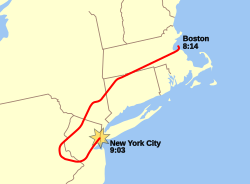
At 9:03 a.m., United Airlines Flight 175 struck floors 77 through 85 of the South Tower, broadcast live to millions worldwide, confirming that America was under coordinated terrorist attack.
Image source: United Airlines Flight 175
Sep 11, 2001
% complete
At 8:46 a.m., Flight 11 crashed into floors 93 through 99 of the North Tower, killing everyone aboard and hundreds inside the building, severing all stairways above the impact zone and trapping over a thousand people.
Image source: American Airlines Flight 11
Sep 11, 2001
% complete
Five al-Qaeda hijackers took control of American Airlines Flight 11 shortly after it departed Boston for Los Angeles, turning the aircraft toward New York City as part of a coordinated terrorist plot.
Sep 12, 2001 - May 30, 2002
% complete
Massive rescue and recovery operations commenced at the site known as Ground Zero, where thousands of workers spent months clearing 1.8 million tons of debris and searching for survivors and remains.
Image source: Rescue and recovery effort after the September 11 attacks on the World Trade Center
Mar 11, 2002
% complete
Two beams of light soaring skyward were first illuminated six months after the attacks, evoking the fallen towers. The temporary installation became an annual tradition displayed each September 11.
Image source: Tribute in Light
May 30, 2002
% complete
Eight months after the attacks, the cleanup of Ground Zero was formally concluded in a ceremony marked by the removal of the last steel column, allowing planning for reconstruction to move forward.
Image source: World Trade Center site
Feb 27, 2003
% complete
Architect Daniel Libeskind's design concept won the competition to rebuild the World Trade Center site, featuring a memorial preserving the tower footprints and a symbolic 1,776-foot spire echoing the year of American independence.
Sep 11, 2011
% complete
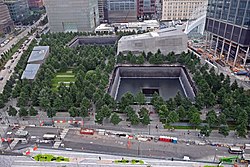
On the tenth anniversary of the attacks, the memorial opened featuring two reflecting pools set within the original tower footprints, surrounded by bronze parapets inscribed with the names of the 2,983 victims.
Image source: National September 11 Memorial & Museum
Nov 13, 2013
% complete
Four World Trade Center, designed by Fumihiko Maki, opened as the first completed tower of the rebuilt complex, housing the Port Authority's headquarters and anchoring the southeastern corner of the site.
Image source: 4 World Trade Center
May 21, 2014
% complete
The National September 11 Museum opened at the World Trade Center site, housing artifacts including recovered steel, personal effects of victims, and remnants such as the Last Column and Survivor Staircase.
Nov 3, 2014
% complete
One World Trade Center, the tallest building in the Western Hemisphere at 1,776 feet, opened for business, symbolizing New York's resilience and the rebirth of the Lower Manhattan skyline.
Image source: One World Trade Center
Mar 4, 2016
% complete
Santiago Calatrava's striking Oculus transit hub opened, connecting PATH trains and subway lines. Its white ribbed design resembles a dove in flight, serving over 250,000 daily commuters and visitors.
Image source: World Trade Center station (PATH)
Jun 11, 2018
% complete
Three World Trade Center, an 80-story tower designed by Richard Rogers, opened as the fifth-tallest building in New York City, further restoring the density and vitality of the redeveloped complex.
Image source: 3 World Trade Center
Dec 6, 2021
% complete
The St. Nicholas Greek Orthodox Church, which was destroyed on September 11, 2001, was reconsecrated after being rebuilt at the World Trade Center site in a new Byzantine-inspired design, restoring a house of worship lost in the attacks.
Image source: St. Nicholas Greek Orthodox Church (Manhattan)
Or browse the full history timeline directory, with more than 2,000 topics.
This World Trade Center timeline was generated with the help of AI, using information found on the internet.
We work hard to keep these timelines accurate, but mistakes do get through. If you spot one, email us at [email protected] and we'll fix it for future visitors.
Generate yours with AI or build it from scratch, for free.
Export your timeline, add your own events, edit or remove AI-generated events, and much more
No credit card required.
Cancel anytime.
Cancel anytime.
You can create an unlimited number of timelines with up to 10 events on each one, customize how they look, export them to PDF, PNG, PowerPoint, CSV, and Excel, and share them with a link. Paid plans raise the event limit and add features like spreadsheet imports and collaborators.
Yes. You can cancel your subscription from your account page at any time, and you will not be charged again. Your subscription stays active for the rest of the period you already paid for.
Yes. We will email you a reminder before the annual renewal, and we will also email you a receipt.
Yes. You can email us within 15 days of any payment, and we will issue you a full refund.
Check out our pricing docs or send us an email anytime: [email protected].