-
Use Cases
-
Resources
-
Pricing
2600 BCE - 1900 BCE
An extensive maritime trade network connected the Harappan and Mesopotamian civilizations during the middle Harappan phase. Merchants from Dilmun, in the Persian Gulf, acted as important intermediaries in this commerce.
300 BCE
Indo-Pacific beads discovered in Japan provide evidence of Indian Ocean-linked exchange reaching the Japanese archipelago during the Yayoi period.
Image source: Yayoi period
27 BCE - 180
Trade between the Roman Empire and India expanded after Augustus established a period of peace and prosperity. It reached its height during the first two centuries of the Common Era before being curtailed by the Antonine plague.
600 - 1300
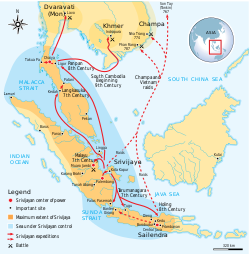
Between the seventh and thirteenth centuries, Srivijaya flourished as a thalassocratic empire in the Indonesian archipelago. It controlled maritime networks linking Maritime Southeast Asia with India and China.
Image source: Srivijaya
800
An eighth-century depiction at Borobudur shows a wooden double-outrigger sailing vessel. It is associated with ancient trading links between Indonesia, Madagascar, and East Africa, sometimes called the Cinnamon Route.
1818
Following Belzoni’s 1818 discovery, the site of Berenice was equated with ruins near Ras Banas in southern Egypt, helping identify an important Red Sea port associated with ancient Indian Ocean commerce.
1937
Roman pottery was found at Arikamedu in 1937. Later excavations demonstrated that the site was a trading station importing Roman-manufactured goods during the first half of the first century AD.
700
Muslim missionaries and merchants began spreading Islam along the western shores of the Indian Ocean from the eighth century, and possibly earlier, connecting religious expansion with commercial mobility.
Image source: Spread of Islam
700 - 1500
A stone mosque at Shanga, Kenya, dates from the eighth through fifteenth centuries. Its existence reflects the long-standing Islamic commercial and cultural connections of the Swahili coast.
1405 - 1433
Chinese fleets under Zheng He crisscrossed the Indian Ocean during the early fifteenth century, projecting Ming power and participating in diplomatic and commercial exchange across the region.
Image source: Ming treasure voyages
1600 - 1699
During the sixteenth and seventeenth centuries, Japanese ships entered Indian Ocean commerce through the Red Seal ship system, linking Japanese merchants with wider Asian maritime markets.
800 - 1700
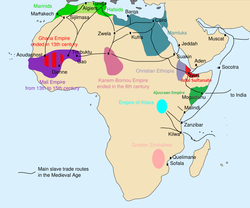
Muslim merchants traded an estimated 1,000 African slaves annually between 800 and 1700. The volume later increased to approximately 4,000 annually in the eighteenth century and 3,700 annually between 1800 and 1870.
Image source: Indian Ocean slave trade
1500 - 1850
European traders deported an estimated 567,900 to 733,200 enslaved people within the Indian Ocean between 1500 and 1850. Nearly the same number were deported from the Indian Ocean to the Americas during the period.
1500 - 1599
Slave trading also occurred in the eastern Indian Ocean before the Dutch settled there around 1600, although the volume of this earlier trade remains unknown.
1500
European slave trading in the Indian Ocean began when Portugal established Estado da Índia in the early sixteenth century, integrating coercive labor trafficking into its maritime empire.
Image source: Portuguese India
1580 - 1640
During the Iberian Union, similar annual numbers of enslaved people were estimated to have been brought from Asia to the Philippines. From the sixteenth century until the 1830s, approximately 200 enslaved people were exported annually from Mozambique.
Image source: Iberian Union
1600 - 1799
Indian and Chinese slave traders supplied Dutch Indonesia with an estimated 25,000 enslaved people during the seventeenth and eighteenth centuries.
1600 - 1799
Approximately 4,000 African slaves were used to construct the Colombo fortress in Dutch Ceylon, demonstrating how coerced labor supported colonial infrastructure.
Image source: Colombo
1600 - 1799
The Dutch East India Company’s rise brought a sharp increase in slave trafficking. As many as 500,000 enslaved people may have been present in Dutch colonies in the Indian Ocean during the seventeenth and eighteenth centuries.
1620 - 1830
Bali and neighboring islands supplied regional networks with approximately 100,000 to 150,000 enslaved people between 1620 and 1830.
1622
In 1622, an East India Company ship carried enslaved people from the Coromandel Coast to the Dutch East Indies, illustrating the companies’ involvement in Indian Ocean trafficking.
Image source: East India Company
1721 - 1735
France established colonies on Réunion and Mauritius in 1721. By 1735, approximately 7,200 enslaved people populated the Mascarene Islands.
Image source: Mascarene Islands
1807
The enslaved population of the Mascarene Islands reached approximately 133,000 by 1807, as plantation economies expanded in the French-controlled islands.
Image source: Culture of Mauritius
1810
Britain captured the Mascarene Islands in 1810. Although Britain had prohibited the slave trade in 1807, clandestine trafficking continued to supply enslaved people to French planters.
1848
Between 1670 and 1848, an estimated 336,000 to 388,000 enslaved people were deported to the Mascarene Islands. The process ended with abolition in the French colonies in 1848.
Image source: Timeline of abolition of slavery and serfdom
1497 - 1498
Under Vasco da Gama, Portugal discovered a naval route to the Indian Ocean around the southern tip of Africa in 1497–1498. The voyage opened a direct European sea link with India.
Image source: Vasco da Gama, Goa
1500 - 1599
During the sixteenth century, Portugal established bases in the Persian Gulf, extending its network of fortified ports and attempting to control key routes between the Indian Ocean and the Middle East.
1507
The Mamluks sent a fleet under Amir Husain Al-Kurdi in 1507. The fleet subsequently fought the Portuguese in the Battle of Chaul as regional powers challenged Portugal’s growing naval presence.
1581
The Ottomans attempted to challenge Portuguese hegemony in the Persian Gulf by sending an armada against the Portuguese under Ali Bey in 1581.
1600
The English East India Company was established at the beginning of the seventeenth century. Its maritime operations connected the Indian Ocean to European commercial networks.
1602
The establishment of the Dutch East India Company in the early seventeenth century rapidly increased the volume of commerce and slave trafficking within the Indian Ocean region.
Image source: Dutch East India Company
1602
In 1602, Iranian forces commanded by Imam-Quli Khan Undiladze expelled the Portuguese from Bahrain, weakening Portugal’s position in the Persian Gulf.
1622
With the assistance of four English ships, Shah Abbas retook Hormuz from Portugal in 1622. The victory ended Portuguese control of the strategically important island.
2026
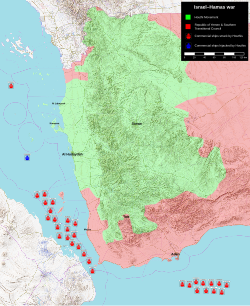
Disruption in the Middle East to routes between Europe and India has been associated with the establishment of colonialism and the World Wars period in Europe. In early 2026, the Middle East war also disrupted shipping in the Red Sea and Strait of Hormuz, while conflicts remained relatively rare elsewhere in the Indian Ocean.
Image source: Red Sea crisis
Or browse the full history timeline directory, with more than 2,500 topics.
This Indian Ocean Trade timeline was generated with the help of AI, using information found on the internet.
We work hard to keep these timelines accurate, but mistakes do get through. If you spot one, email us at [email protected] and we'll fix it for future visitors.
Generate yours with AI or build it from scratch, for free.
Export your timeline, add your own events, edit or remove AI-generated events, and much more
No credit card required.
Cancel anytime.
Cancel anytime.
You can create an unlimited number of timelines with up to 10 events on each one, customize how they look, export them to PDF, PNG, PowerPoint, CSV, and Excel, and share them with a link. Paid plans raise the event limit and add features like spreadsheet imports and collaborators.
Yes. You can cancel your subscription from your account page at any time, and you will not be charged again. Your subscription stays active for the rest of the period you already paid for.
Yes. We will email you a reminder before the annual renewal, and we will also email you a receipt.
Yes. You can email us within 15 days of any payment, and we will issue you a full refund.
Check out our pricing docs or send us an email anytime: [email protected].