-
Use Cases
-
Resources
-
Pricing
6000 BCE
During the Mesolithic period, early caves featured overhanging rock decorated with art, alongside the use of natural caves as settings for visual expression.
Image source: Rock art
3300 BCE - 1300 BCE
The earliest known sculpture in the Indian subcontinent came from the Indus Valley Civilisation. Important finds were excavated at Mohenjo-daro and Harappa, in areas now within Pakistan.
1500 BCE
A major early sculptural find from the subcontinent dates to about 1500 BCE and was discovered at Daimabad, extending the history of Indian metal and figurative art beyond the mature Indus tradition.
1450 BCE - 600 BCE
Abstract artistic expression appeared in pottery associated with the Black and Red Ware culture, dated approximately 1450–1200 BCE, and the Painted Grey Ware culture, dated approximately 1200–600 BCE. Finds occurred across a broad region, including Mathura.
Image source: Painted Grey Ware culture
1867
Archibald Carlleyle discovered some of the earliest rock carvings in India, twelve years before the discovery of the Cave of Altamira in Spain. His work became widely known only later through J. Cockburn's publication in 1899.
200 BCE
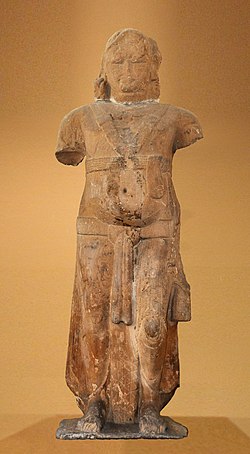
In the 2nd century BCE, Yakshas became subjects for colossal cult images, commonly around two metres or more in height. These works are regarded as probably the earliest Indian anthropomorphic productions in stone.
Image source: Yaksha
200 BCE - 100 CE
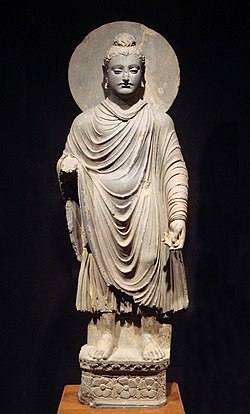
In far northern India and the Gandhara region of present-day Afghanistan and Pakistan, Buddhist sculpture became increasingly explicit during the 2nd to 1st centuries BCE. Artists represented episodes from the Buddha's life and teachings under strong Greco-Buddhist influence.
Image source: Greco-Buddhist art
100 BCE - 300 CE
Buddhist art first developed prominently through the Gandhara and Amaravati traditions around the 1st century BCE, creating influential sculptural and architectural forms for later Indian Buddhist art.
1 CE - 300 CE
Pink sandstone Hindu, Jain, and Buddhist sculptures from Mathura between the 1st and 3rd centuries CE combined indigenous Indian traditions with Western influences transmitted through Gandharan art. They established a basis for subsequent Indian religious sculpture.
Image source: Art of Mathura
1 CE - 300 CE
The Kushan Empire spread from Central Asia into northern India during the early centuries CE. Kushan rulers briefly commissioned large portrait statues representing members of the royal dynasty.
1 CE
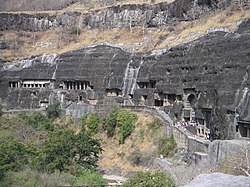
The oldest surviving frescoes of the historical period in India are preserved at the Ajanta Caves. Cave 10 contains paintings dating from the 1st century CE, preceding the larger and more famous later groups.
Image source: Ajanta Caves
400 CE
The building of free-standing structural temples began in the 5th century, while the excavation of rock-cut temples continued until the 12th century.
Image source: Indian rock-cut architecture
500 CE - 600 CE
Badami Chalukya architecture developed during the 5th and 6th centuries and became one of the important architectural traditions centred in the region of modern Karnataka.
500 CE - 1000 CE
The most significant ancient and early medieval fresco traditions are associated with the Ajanta, Bagh, Ellora, and Sittanavasal caves. Sittanavasal preserves Jain paintings from approximately the 7th to 10th centuries.
Image source: Indian painting
700 CE - 800 CE
The Shore Temple at Mahabalipuram was built in the 8th century as a free-standing structural temple. Its slender tower and finely carved granite blocks stand on the shore of the Bay of Bengal.
Image source: Shore Temple
848 CE - 1279 CE
During the Chola period in south India, many bronze sculptures were designed to be carried in religious processions. The iconic form of Shiva as Nataraja became a defining achievement, alongside monumental granite carvings inherited from the Pallava tradition.
1000 CE - 1200 CE
Western Chalukya architecture flourished from the 11th to the 12th centuries in the region centred on modern Karnataka, forming a major phase in the development of medieval Indian temple architecture.
1000 CE - 1400 CE
Hoysala architecture developed from the 11th through the 14th centuries in modern Karnataka. It is noted as one of the major regional architectural traditions of medieval India.
Image source: Hoysala architecture
1931
Chola fresco paintings were discovered in 1931 in the circumambulatory passage of the Brihadisvara Temple at Thanjavur, Tamil Nadu. They became the first known Chola fresco specimens.
Image source: Chola art and architecture
1480 CE
In south-central India, the Bahmani Sultanate disintegrated during the late 15th century into the Deccan sultanates centred at Bijapur, Golconda, Ahmadnagar, Bidar, and Berar.
Image source: Deccan sultanates
1504 CE - 1619 CE
Under the Baridi dynasty of Bidar, bidri ware developed as a metal inlay tradition. Zinc mixed with copper, tin, and lead was inlaid with silver or brass, then treated with a sal-ammoniac-containing mud paste that blackened the base metal.
1555 CE
Mughal miniature painting on paper developed rapidly in the late 16th century by combining existing Indian miniature traditions with the Persian miniature tradition brought to the Mughal court.
Image source: Mughal painting
1555 CE
When Emperor Humayun reestablished the Mughal Empire in 1555, he brought Mir Sayyid Ali and Abd al-Samad from the renowned atelier of Persian ruler Shah Tahmasp, decisively strengthening Mughal court painting.
1556 CE - 1605 CE
During Akbar's reign, the number of court painters grew from about 30 during the creation of the Hamzanama in the mid-1560s to approximately 130 by the mid-1590s.
1600 CE
Only after the Mughal conquest of Ahmadnagar in 1600 did Persian influence patronized by the Turco-Mongol Mughals begin to affect Deccan art substantially.
1605 CE - 1627 CE
After Akbar's death, his son Jahangir took the Mughal throne in 1605 and ruled until 1627, continuing the imperial patronage of painting and other fine arts.
Image source: Jahangir
1628 CE - 1658 CE
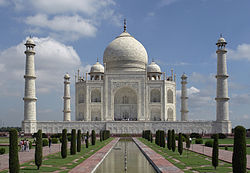
Shah Jahan ruled from 1628 to 1658. His most notable architectural contribution was the Taj Mahal, a landmark of Mughal architecture and one of the best-known works in the history of Indian art.
Image source: Taj Mahal
1658 CE - 1707 CE
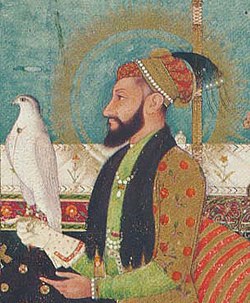
Aurangzeb forcibly took the throne from Shah Jahan and ruled from 1658 to 1707. His increasingly orthodox Sunni beliefs and the 1680 ban on music and painting contributed to the decline of Mughal patronage of the arts.
Image source: Aurangzeb
1800 CE - 1900 CE
Kalighat painting, or Kalighat Pat, originated in 19th-century Bengal near the Kalighat Kali Temple in Kolkata. Initially sold as souvenirs to temple visitors, it developed into a distinct school of Indian painting.
Image source: Kalighat painting
1850 CE
The Government College of Fine Arts in Chennai, the oldest institution of its kind in India, was established in 1850 and became part of the colonial-era expansion of formal art education.
1858 CE
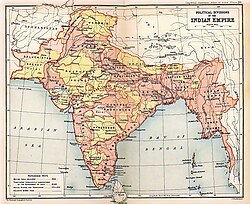
In 1858, the British government assumed direct administrative control of India under the British Raj. Colonial rule had a major impact on Indian art, especially from the mid-19th century onward.
Image source: British Raj
1900 CE - 1920 CE
The Bengal School of Art originated primarily in Kolkata and Shantiniketan and flourished across the subcontinent during the British Raj. It was associated with Indian nationalism and sought alternatives to dominant colonial styles.
Image source: Bengal School of Art
1905 CE
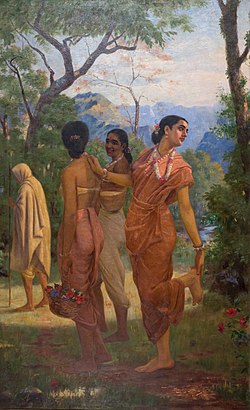
As the Swadeshi Movement gained momentum by 1905, Indian artists attempted to revive pre-colonial cultural identities. They rejected the Romanticized style of Company paintings and the mannered work associated with Raja Ravi Varma and his followers.
1905 CE
Abanindranath Tagore led the Bengal School through reworked Asian styles emphasizing Indian nationalism. He is widely described as the father of modern Indian art, while British administrators including E. B. Havell also promoted the movement.
1910 CE - 1941 CE
Artists including Rabindranath Tagore, Gaganendranath Tagore, and Amrita Sher-Gil helped introduce avant-garde Western styles into Indian art while engaging with the country's emerging modern cultural identity.
Image source: Modern Indian painting
1920 CE - 1925 CE
Between 1920 and 1925, Gaganendranath Tagore pioneered experiments in modernist painting. From 1925 onward, he developed a complex post-cubist style.
1944 CE
K. C. S. Paniker founded the Progressive Painters' Association in 1944, helping give rise to the Madras movement in Indian art.
1947 CE
India became independent of British rule in 1947. The political transition created a post-colonial context in which artists sought new ways to express Indian experience.
Image source: Indian independence movement
1952 CE
K. H. Ara, S. K. Bakre, H. A. Gade, M. F. Husain, S. H. Raza, and Francis Newton Souza founded the Bombay Progressive Artists' Group in 1952 to establish new modes of expression for post-colonial India.
Image source: Bombay Progressive Artists' Group
1954 CE
The National Gallery of Modern Art in New Delhi was established in 1954, providing a major national institution for collecting, exhibiting, and interpreting modern Indian art.
1956 CE
Although the Bombay Progressive Artists' Group dissolved in 1956, it profoundly influenced the idiom and direction of Indian art in the decades that followed.
1970 CE - 2020 CE
In the later 20th century and beyond, painting and sculpture remained important while artists such as Nalini Malani, Subodh Gupta, Narayanan Ramachandran, Vivan Sundaram, Jitish Kallat, G. R. Iranna, Bharati Kher, and Chittrovanu Muzumdar pursued radically new directions.
1996 CE
The National Gallery of Modern Art in Mumbai was established in 1996, expanding the national network of institutions devoted to modern and contemporary Indian art.
1997 CE
R. Siva Kumar's 1997 book Santiniketan: The Making of a Contextual Modernism introduced Contextual Modernism as a postcolonial critical tool for understanding alternative modernisms in former colonies, particularly the Santiniketan artists.
1997 CE
The Baroda Group was definitively historicized in 1997 through the publication of Contemporary Art in Baroda, an anthology edited by Ghulam Mohammed Sheikh. The volume documented a coalition that included Vivan Sundaram, Bhupen Khakhar, and Nalini Malani and whose history included the 1981 exhibition Place for People.
2009 CE
The National Gallery of Modern Art in Bangalore was inaugurated in 2009, further extending India's public infrastructure for modern and contemporary art.
2013 CE
The foundation of the Kolkata Museum of Modern Art was laid in 2013, marking an effort to create a major institution for modern and contemporary art in Kolkata.
Or browse the full history timeline directory, with more than 2,500 topics.
This History of Indian Art timeline was generated with the help of AI, using information found on the internet.
We work hard to keep these timelines accurate, but mistakes do get through. If you spot one, email us at [email protected] and we'll fix it for future visitors.
Generate yours with AI or build it from scratch, for free.
Export your timeline, add your own events, edit or remove AI-generated events, and much more
No credit card required.
Cancel anytime.
Cancel anytime.
You can create an unlimited number of timelines with up to 10 events on each one, customize how they look, export them to PDF, PNG, PowerPoint, CSV, and Excel, and share them with a link. Paid plans raise the event limit and add features like spreadsheet imports and collaborators.
Yes. You can cancel your subscription from your account page at any time, and you will not be charged again. Your subscription stays active for the rest of the period you already paid for.
Yes. We will email you a reminder before the annual renewal, and we will also email you a receipt.
Yes. You can email us within 15 days of any payment, and we will issue you a full refund.
Check out our pricing docs or send us an email anytime: [email protected].