-
Use Cases
-
Resources
-
Pricing
Atari is one of the most influential companies in video game history. Founded in 1972 by Nolan Bushnell and Ted Dabney, Atari popularized arcade gaming with Pong and revolutionized home entertainment with the Atari 2600. Despite financial struggles and the 1983 video game crash, the brand has endured through ownership changes and continues to exist today. More Less
1971
% complete
In 1971, Nolan Bushnell and Ted Dabney founded a small engineering company, Syzygy Engineering, that designed Computer Space, the world's first commercially available arcade video game, for Nutting Associates.
Image source: Atari, Inc.
Jun 27, 1972
% complete
On June 27, 1972, Nolan Bushnell and Ted Dabney incorporated Atari, Inc. in Sunnyvale, California. The company's products, such as Pong and the Atari 2600, would help define the electronic entertainment industry from the 1970s to the mid-1980s.
1973
% complete
In 1973, Atari secretly spawned a competitor called Kee Games, headed by Nolan's next-door neighbor Joe Keenan, to circumvent pinball distributors' insistence on exclusive distribution deals; both companies could market nearly the same game to different distributors.
1974
% complete
Joe Keenan's management of the Kee Games subsidiary led to his appointment as president of Atari when Kee was absorbed into the company in 1974.
1975
% complete
In 1975, Atari's Grass Valley, California subsidiary Cyan Engineering started development of a flexible console capable of playing the four existing Atari games. The result was the Atari Video Computer System (VCS), later renamed 2600.
Image source: Atari 2600
1976
% complete
Looking for outside investors, Bushnell sold Atari to Warner Communications in 1976 for $28 million.
1977
% complete
The development of a successor to the 2600 started as soon as it shipped. The original team estimated the 2600 had a lifespan of about three years and set forth to build the most powerful machine possible within that time frame.
Image source: Atari 5200
Dec 1978
% complete
Nolan Bushnell continued to have disagreements with Warner management over the direction of the company, the discontinuation of the pinball division, and the notion of discontinuing the 2600. In December 1978, he was fired as chairman and co-CEO following an argument with Manny Gerard.
Image source: Nolan Bushnell
1980
% complete
The new machines had some success when they finally became available in quantity in 1980.
Image source: Atari 8-bit computers
1982
% complete
From this platform Atari released its next-generation game console in 1982, the Atari 5200. It was unsuccessful due to incompatibility with the 2600 game library, a small quantity of dedicated games, and notoriously unreliable controllers.
1982
% complete
The ported version of Pac-Man for Atari 2600 omitted many of the visual features of the original to compensate for the lack of ROM space, and the hardware struggled when multiple ghosts appeared on screen, creating a flickering effect.
Image source: Pac-Man (Atari 2600 video game)
1983
% complete
These problems were followed by the video game crash of 1983, with losses that totaled more than $500 million.
Image source: Video game crash of 1983
1983
% complete
Faced with fierce competition and price wars in the game console and home computer markets, Atari was never able to duplicate the success of the 2600. In 1983, CEO Ray Kassar resigned.
Jul 1, 1984
% complete
After the video game crash of 1983, the assets of the home console and computer divisions of the original Atari Inc. were sold. Negotiating until close to midnight on July 1, 1984, Jack Tramiel completed the asset purchase for $240 million in promissory notes and stocks, renaming the company Atari Corporation.
Image source: Atari Corporation
Apr 1985
% complete
In April 1985, Atari Corporation released an update to the 8-bit computer line, the Atari 65XE, the first in the Atari XE series.
Jun 1985
% complete
June 1985 saw the release of the Atari 130XE; Atari User Groups received early sneak-preview samples of the new Atari 520ST's, and major retailer shipments hit store shelves in September 1985 of Atari's new 32-bit Atari ST computers ('ST' stands for 'sixteen/thirty-two').
Image source: Atari ST
1986
% complete
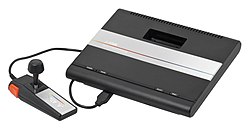
In 1986, Atari launched two consoles designed under Warner — the Atari 2600jr and the Atari 7800 console, which had seen limited release in 1984.
Image source: Atari 7800
1987
% complete
In 1987, Atari acquired the Federated Group for $67.3 million, securing shelf space in over 60 stores in California, Arizona, Texas and Kansas at a time when major American electronics outlets were reluctant to carry Atari-branded computers. The chain was sold to Silo in 1989.
1988
% complete
In 1988, the company unveiled the 1040STF and the Mega ST with a bit image manipulator chip, and launched its first parallel computer.
1989 - 1992
% complete
In 1989, Atari Corp. filed an antitrust lawsuit against Nintendo. Atari eventually lost the case when it was rejected by a US district court in 1992.
Image source: Atari Games Corp. v. Nintendo of America Inc.
1989
% complete
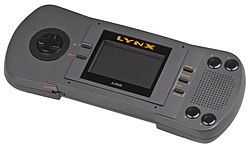
In 1989, Atari released the Atari Lynx, the first ever handheld console with a color display and a backlit screen, to much fanfare. A shortage of parts kept it from nationwide release for Christmas, and it lost market share to Nintendo's cheaper Game Boy.
Image source: Atari Lynx
1991
% complete
In 1991, Atari released its PCs ABC386SXII and ABC386DXII based on Intel's i386 chip.
1993
% complete
In 1993, Atari positioned its Jaguar as the only 64-bit interactive media entertainment system available, but it sold poorly. It would be the last home console produced by Atari and the last by an American manufacturer until Microsoft's Xbox in 2001.
Image source: Atari Jaguar
Jul 1996
% complete
By 1996, successful lawsuits had left Atari with millions in the bank, but the failure of the Lynx and Jaguar left it without a product to sell. In July 1996, Atari merged with JTS Inc., a short-lived maker of hard disk drives, to form JTS Corp., effectively perishing.
1985
% complete
In early 1985, Warner established a new corporation jointly with Namco subsequently named Atari Games Corporation, which took control of Atari's coin-operated games division. Warner also established AT Games, Inc., which was renamed Atari Holdings and continued as a nonoperating subsidiary until 1992.
Image source: Atari Games
1987
% complete
In 1987, Namco sold 33% of its shares in Atari Games to a group of employees led by then-president Hideyuki Nakajima, who had been president of Atari Games since 1985.
1988
% complete
Starting in 1988, Atari Games also sold cartridges for the Nintendo Entertainment System under the Tengen brand name, including a version of Tetris. The ensuing lawsuit with Nintendo reached a settlement in 1994, with Atari Games paying cash damages and licensing several patents.
Apr 1996
% complete
In April 1996, after an unsuccessful bid by Atari cofounder Nolan Bushnell, Atari Games was sold to WMS Industries, owners of the Williams, Bally, and Midway arcade brands, which restored the use of the Atari Games name.
Nov 19, 1999
% complete
On November 19, 1999, Atari Games Corporation was renamed Midway Games West Inc., resulting in the Atari Games name no longer being used, with San Francisco Rush 2049 being the final Atari-branded arcade release.
Image source: Midway Games
2009
% complete
Atari's post-1984 arcade titles became the property of Warner Bros. Games after receiving the assets following Midway's bankruptcy in 2009.
Image source: Warner Bros. Games
Mar 13, 1998
% complete
On March 13, 1998, JTS sold the Atari name and assets to Hasbro Interactive for $5 million, as part of a subsidiary renamed Atari Interactive.
Image source: Atari Interactive
Dec 2000
% complete
The brand name changed hands again in December 2000 when French software publisher Infogrames took over Hasbro Interactive, renaming it Infogrames Interactive, which intermittently published Atari-branded home titles.
Image source: Atari SA
Oct 2001
% complete
In October 2001, Infogrames Entertainment SA announced it was 'reinventing' the Atari brand with the launch of three new games featuring prominent Atari branding: Splashdown, MX Rider and TransWorld Surf.
Image source: Atari SA
May 8, 2003
% complete
On May 8, 2003, IESA renamed its majority-owned but discrete US subsidiary Infogrames, Inc., renaming the division Atari Interactive.
Mar 6, 2008 - Oct 8, 2008
% complete
On March 6, 2008, IESA made an offer to Atari, Inc.'s outstanding stock; on April 30, 2008, Atari accepted, and on October 8, 2008, IESA completed its acquisition, making Atari, Inc. a wholly owned subsidiary.
Dec 9, 2008
% complete
On December 9, 2008, Atari announced that it had acquired Cryptic Studios, an MMORPG developer.
May 2009
% complete
In May 2009, Infogrames Entertainment SA, the parent company of Atari and Atari Interactive, announced it would change its name to Atari SA, which remains the status quo. That same year, Namco Bandai purchased a 34% stake in Atari Europe on May 14, paving the way for its acquisition from IESA.
Apr 2010
% complete
In April 2010, Atari SA board member and former CEO David Gardner resigned. As of March 31, 2011, the board consisted of Frank Dangeard, Jim Wilson, Tom Virden, Gene Davis and Alexandra Fichelson.
Jan 21, 2013
% complete
After significant financial issues with losses in the tens of millions since 2005, the four related companies Atari, Atari Interactive, Humongous, and California US Holdings filed for Chapter 11 bankruptcy in the United States Bankruptcy Court for the Southern District of New York. Atari also sought bankruptcy protection under French law in 2013.
Jun 22, 2014
% complete
On June 22, 2014, Atari announced a new corporate strategy focusing on 'new audiences', specifically LGBT, social casinos, real-money gambling, and YouTube.
Jun 8, 2017 - Sep 26, 2017
% complete
On June 8, 2017, a teaser video promoted a new product, and CEO Chesnais confirmed development of a new PC-based game console. A mid-July press release confirmed the hardware referred to as the 'Ataribox', styled after the 2600 with a ribbed top surface. On September 26, 2017, Atari sent out a press release about the new 'Atari VCS', confirming more details.
Image source: Atari VCS (2021 console)
2020
% complete
In 2020, Atari launched its decentralized cryptocurrency Atari Token in equal partnership with the ICICB Group, which also received a non-exclusive license to run a cryptocurrency online casino on Atari's website based on the Atari Token.
Image source: Atari
Jan 27, 2020
% complete
On January 27, 2020, Atari announced a deal with GSD Group to build Atari Hotels, with the first breaking ground in Phoenix in mid-2020. In March 2021, Atari extended its partnership with ICICB Group for Atari-branded hotels outside the United States, including Dubai, Gibraltar and Spain.
Dec 16, 2020
% complete
On December 16, 2020, Atari shipped the first units of the Atari VCS, exclusive to backers of the system's crowdfunding campaign.
2021
% complete
In late 2021, Wade Rosen became the new CEO of Atari.
Apr 18, 2022
% complete
On April 18, 2022, Atari announced the termination of all license agreements with ICICB Group and its subsidiaries, including the Atari Chain Limited license and related hotel and casino licenses, effective immediately.
Mar 2024
% complete
In March 2024, Atari announced it will work with coin-op manufacturer Alan-1 to bring Atari Recharged titles to arcades, marking the return of the Atari brand in the arcade space after 25 years, since San Francisco Rush 2049 was released.
Image source: Atari Recharged
Or browse the full history timeline directory, with more than 2,000 topics.
This History of Atari timeline was generated with the help of AI, using information found on the internet.
We work hard to keep these timelines accurate, but mistakes do get through. If you spot one, email us at [email protected] and we'll fix it for future visitors.
Generate yours with AI or build it from scratch, for free.
Export your timeline, add your own events, edit or remove AI-generated events, and much more
No credit card required.
Cancel anytime.
Cancel anytime.
You can create an unlimited number of timelines with up to 10 events on each one, customize how they look, export them to PDF, PNG, PowerPoint, CSV, and Excel, and share them with a link. Paid plans raise the event limit and add features like spreadsheet imports and collaborators.
Yes. You can cancel your subscription from your account page at any time, and you will not be charged again. Your subscription stays active for the rest of the period you already paid for.
Yes. We will email you a reminder before the annual renewal, and we will also email you a receipt.
Yes. You can email us within 15 days of any payment, and we will issue you a full refund.
Check out our pricing docs or send us an email anytime: [email protected].