-
Use Cases
-
Resources
-
Pricing
Sega is a Japanese video game and entertainment company founded in 1960. It rose to prominence in arcades during the 1970s and 1980s with hits like Periscope, Out Run, and After Burner. In the console wars of the late 1980s and early 1990s, Sega competed fiercely against Nintendo with the Genesis/Mega Drive and its mascot Sonic the Hedgehog. After commercial failures like the Saturn and Dreamcast, Sega exited the hardware business in 2001 and became a third-party software publisher, later merging with Sammy in 2004. More Less
May 3, 1940
% complete
Service Games (SEGA) was founded by Martin Bromley, Irving Bromberg, and James Humpert to provide coin-operated amusement machines, including slot machines, to American military bases. The company would later merge with Rosen Enterprises in Japan to form Sega Enterprises.
1954
% complete
American David Rosen established Rosen Enterprises in Tokyo, operating photo booths and later importing coin-operated games to Japan. In 1965 it merged with Service Games of Japan to form Sega Enterprises, Ltd., with Rosen as CEO.
Jun 1, 1965
% complete
Rosen Enterprises merged with Service Games of Japan to create Sega Enterprises, Ltd. The combined company focused on importing and manufacturing coin-operated amusement machines for the Japanese market.
1969
% complete
American conglomerate Gulf+Western acquired Sega, providing capital for expansion while David Rosen continued to lead the company. Sega grew its arcade business significantly under this ownership.
1982
% complete
Gulf+Western sold Sega to Bally Manufacturing amid the North American video game crash. Bally soon resold Sega's North American operations, which were spun off as Sega Enterprises Inc. under Rosen's management.
1984
% complete
Hayao Nakayama, formerly head of Sega's arcade division, became president of Sega Enterprises. His aggressive leadership style would drive Sega's expansion into the console market throughout the late 1980s and 1990s.
1984
% complete
Japanese software company CSK Corporation, led by Isao Okawa, acquired a controlling interest in Sega, making it a Japanese-owned company and providing stability for future growth.
Image source: Sega
1966
% complete
Sega released Periscope, an electromechanical shooting game that became a major international success. It was one of the first arcade games exported widely from Japan and helped establish Sega's reputation in the amusement industry.
Image source: Periscope (arcade game)
1975
% complete
Sega entered the emerging video game industry, producing Pong clones and acquiring rights to Taito's Gun Fight for release in the United States, marking its shift from electromechanical to fully electronic arcade games.
Image source: Gun Fight
1979
% complete
Sega/Gremlin released Head On, a maze chase game that was a major hit in arcades and inspired later games like Pac-Man. It became one of Sega's most successful early video games.
Image source: Head On (video game)
1981
% complete
Sega released Turbo, a pioneering sprite-scaling racing game, demonstrating the company's strength in driving games and sprite scaling technology that would define many future hits.
Image source: Turbo (video game)
1982
% complete
Zaxxon introduced isometric perspective to arcade shooters and became a worldwide hit, ported to numerous home systems and cementing Sega's arcade reputation.
Image source: Zaxxon
1985
% complete
Yu Suzuki's Hang-On featured a full-size motorcycle cabinet and Super Scaler graphics, becoming a massive hit. Space Harrier followed the same year, showcasing Sega's cutting-edge arcade technology.
Image source: Hang-On
1986
% complete
Yu Suzuki's Out Run became one of the best-selling arcade games of all time, renowned for its Ferrari-inspired driving, branching paths, and iconic soundtrack. It spawned numerous sequels and ports.
Image source: Out Run
Jul 15, 1983
% complete
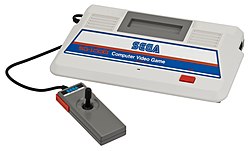
Sega launched its first home console, the SG-1000, on the same day Nintendo released the Famicom in Japan. Though modestly successful, it marked Sega's entry into the home console market.
Image source: SG-1000
Oct 20, 1985
% complete
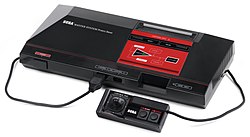
The Sega Mark III, marketed internationally as the Master System, competed against the NES. While it struggled in Japan and North America, it achieved great success in Europe and Brazil, where it remained popular for decades.
Image source: Master System
Oct 29, 1988
% complete
Sega released the Mega Drive in Japan in October 1988. Despite strong hardware, it initially struggled against the Famicom in its home market before finding greater success abroad.
Aug 14, 1989
% complete
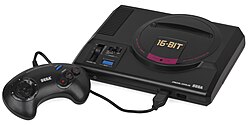
Sega launched the 16-bit Genesis (Mega Drive) in New York City ahead of the holiday season. Its aggressive marketing targeting older gamers helped it challenge Nintendo's dominance in the console market.
Image source: Sega Genesis
Jun 23, 1991
% complete
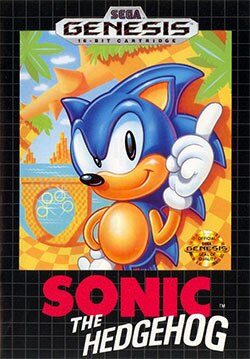
Sonic the Hedgehog launched as Sega's answer to Mario, becoming an instant phenomenon. The speedy blue mascot defined Sega's identity and drove Genesis sales throughout the 1990s.
Image source: Sonic the Hedgehog (1991 video game)
Dec 12, 1991
% complete
The Sega CD (Mega-CD), a CD-ROM peripheral for the Genesis, launched in Japan and later in North America. Despite innovative FMV games, high prices and limited software kept sales disappointing.
Image source: Sega CD
Nov 22, 1994
% complete
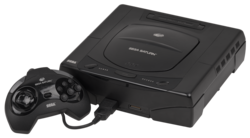
Sega launched the Saturn in Japan ahead of schedule to counter the Sony PlayStation. Strong initial sales in Japan were undermined by complex dual-CPU architecture and poor third-party support.
May 11, 1995
% complete
At E3 1995, Sega announced the Saturn's immediate availability at select retailers, four months ahead of schedule. The move angered retailers and developers and failed to stop the PlayStation's momentum.
Image source: Sega Saturn
1996
% complete
Bernie Stolar became president of Sega of America, shifting focus away from the struggling Saturn toward a next-generation strategy, including the 'four times the power' marketing campaign for Dreamcast.
Mar 31, 1998
% complete
Sega quietly discontinued the Saturn in North America, leaving the console without a successor announcement and damaging retailer trust. The Saturn had sold around 9.5 million units worldwide.
Nov 27, 1998
% complete
Sega launched the Dreamcast, the first console with a built-in modem for online play. It broke sales records in Japan and America and was critically acclaimed, but could not overcome Sony's PlayStation 2 hype.
Image source: Dreamcast
Sep 9, 1999
% complete
The Dreamcast's '9/9/99' North American launch set a then-record $97 million in first-day sales. Hits like Sonic Adventure, Soulcalibur, and NFL 2K showcased the console's power and online capabilities via SegaNet.
2000
% complete
CSK founder Isao Okawa took direct control of Sega and injected roughly $700 million of his own money to keep the company afloat during the Dreamcast's costly battle against the PlayStation 2.
Jan 31, 2001
% complete
After Dreamcast losses mounted, Sega announced it would discontinue the Dreamcast and transform into a third-party software publisher for rival platforms including PlayStation 2, GameCube, and Xbox.
Oct 1, 2004
% complete
Pachinko maker Sammy merged with Sega to form Sega Sammy Holdings, ending Sega's independence. The merger provided financial stability and integrated Sega's entertainment business with Sammy's pachislot empire.
Image source: Sega Sammy Holdings
2013
% complete
Sega acquired Index Holdings, parent of acclaimed RPG developer Atlus, bringing franchises like Shin Megami Tensei and Persona under the Sega umbrella and strengthening its game portfolio.
Aug 15, 2017
% complete
Developed by fans-turned-professionals Christian Whitehead and PagodaWest Games, Sonic Mania received critical acclaim as a return to form for the franchise, celebrating the series' 2D roots.
Image source: Sonic Mania
Feb 14, 2020
% complete
Paramount's live-action/CGI Sonic film became the highest-grossing video game film adaptation at the time in North America, launching a successful multimedia franchise for the character.
Image source: Sonic the Hedgehog (film)
Or browse the full history timeline directory, with more than 2,000 topics.
This History of Sega timeline was generated with the help of AI, using information found on the internet.
We work hard to keep these timelines accurate, but mistakes do get through. If you spot one, email us at [email protected] and we'll fix it for future visitors.
Generate yours with AI or build it from scratch, for free.
Export your timeline, add your own events, edit or remove AI-generated events, and much more
No credit card required.
Cancel anytime.
Cancel anytime.
You can create an unlimited number of timelines with up to 10 events on each one, customize how they look, export them to PDF, PNG, PowerPoint, CSV, and Excel, and share them with a link. Paid plans raise the event limit and add features like spreadsheet imports and collaborators.
Yes. You can cancel your subscription from your account page at any time, and you will not be charged again. Your subscription stays active for the rest of the period you already paid for.
Yes. We will email you a reminder before the annual renewal, and we will also email you a receipt.
Yes. You can email us within 15 days of any payment, and we will issue you a full refund.
Check out our pricing docs or send us an email anytime: [email protected].