-
Use Cases
-
Resources
-
Pricing
Atlanta, the capital of Georgia, began in 1837 as a railroad terminus called Terminus. It grew into a major commercial hub of the Southeast, was nearly destroyed during the Civil War in Sherman's March to the Sea, and was rebuilt to become known as the 'Phoenix City.' Atlanta played a central role in the Civil Rights Movement as the home of Martin Luther King Jr., hosted the 1996 Summer Olympics, and today stands as one of America's most important economic and cultural centers. More Less
1820
% complete
Following Indian Removal pressures, white settlers began moving into north Georgia, gradually displacing Creek and Cherokee communities and establishing homesteads near the future site of Atlanta.
Image source: History of Atlanta
Dec 29, 1835
% complete
The Treaty of New Echota transferred Cherokee lands east of the Mississippi to the United States, opening up territory including the Atlanta area to rapid white settlement and leading to the Trail of Tears.
Image source: Treaty of New Echota
1837
% complete
Atlanta originated as a railroad settlement at the southern end of the Western & Atlantic Railroad. The zero-mile marker drove into the ground in 1837 is traditionally considered the founding point of the city.
Dec 23, 1843
% complete
The growing railroad settlement was incorporated as Marthasville, named after Governor Wilson Lumpkin's daughter Martha, before being renamed just two years later.
Image source: History of Atlanta
Sep 1845
% complete
The completion of the Georgia Railroad line from Augusta cemented Atlanta's role as a major southeastern rail hub, spurring rapid population growth and commercial development.
Image source: Georgia Railroad and Banking Company
Dec 29, 1845
% complete
The town was renamed Atlanta, reportedly a feminized version of 'Atlantica-Pacifica,' reflecting aspirations as a rail link between the Atlantic and the West, and was officially incorporated as a city in 1847.
1881
% complete
The International Cotton Exposition showcased the New South's industrial potential, drawing national attention to Atlanta as an emerging center of manufacturing and commerce.
Image source: Cotton States and International Exposition
May 8, 1886
% complete
Pharmacist John S. Pemberton created Coca-Cola at Jacobs' Pharmacy in downtown Atlanta, launching what would become the world's most famous soft drink brand and a cornerstone of the city's corporate identity.
Image source: Coca-Cola
1895
% complete
The Cotton States and International Exposition at Piedmont Park promoted the economic recovery of the South and attracted nearly a million visitors to Atlanta, further burnishing the city's national reputation.
Image source: Cotton States and International Exposition
Sep 22, 1906
% complete
White mobs attacked Black neighborhoods across Atlanta over several days, killing dozens and injuring many more. The riot exposed deep racial tensions and spurred the growth of Black self-help organizations.
Image source: 1906 Atlanta race massacre
Aug 17, 1915
% complete
Jewish factory manager Leo Frank was abducted from prison and lynched by a mob after his conviction for murder, an event that energized both the revived Ku Klux Klan and the Anti-Defamation League.
Image source: Leo Frank
Dec 15, 1939
% complete
The film adaptation of Margaret Mitchell's Pulitzer-winning novel premiered at Loew's Grand Theatre amid massive celebrations, drawing worldwide attention to Atlanta and boosting civic pride during the Depression era.
Image source: Gone with the Wind (film)
Jul 20, 1864
% complete
Confederate forces under General John Bell Hood attacked Union troops under George Thomas north of Atlanta but were repulsed, marking one of the key engagements of the Atlanta Campaign.
Image source: Battle of Peachtree Creek
Jul 22, 1864
% complete
A fierce day-long battle southeast of the city saw Union forces under William T. Sherman defeat Confederate attacks by Hood's army, bringing Sherman's forces closer to capturing the vital rail center.
Image source: Battle of Atlanta
Sep 2, 1864
% complete
Union General William Tecumseh Sherman captured Atlanta after a months-long campaign. The fall of this crucial Confederate supply hub boosted Northern morale and helped secure Abraham Lincoln's reelection.
Image source: Atlanta in the American Civil War
Nov 15, 1864
% complete
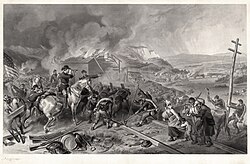
Sherman ordered the burning of Atlanta's military and industrial assets before marching his army toward Savannah, leaving much of the devastated city in ruins and becoming a defining moment in its history.
Image source: Sherman's March to the Sea
1865 - 1877
% complete
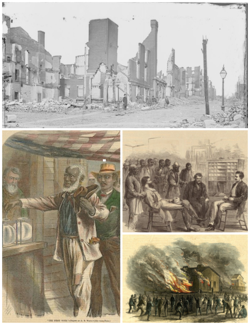
Atlanta rebuilt rapidly after the war, with freed African Americans establishing churches, schools, and businesses, while federal policies and new industries transformed the city's economy and politics.
Image source: Reconstruction era
1868
% complete
After Reconstruction-era political maneuvering, Atlanta replaced Milledgeville as Georgia's capital city, a status it has retained ever since and which fueled its continued growth.
Image source: Atlanta
Feb 12, 1909
% complete
The National Association for the Advancement of Colored People was founded in New York, with Atlanta's 1906 race riot among the events galvanizing activists to organize nationally against racial violence and discrimination.
Image source: NAACP
Jan 15, 1929
% complete
Martin Luther King Jr. was born in the Sweet Auburn neighborhood of Atlanta, where he was shaped by Ebenezer Baptist Church and the city's thriving Black middle class before becoming the nation's foremost civil rights leader.
Image source: Martin Luther King Jr.
Mar 15, 1960 - 1961
% complete
Students from Atlanta University Center colleges launched sit-ins against segregated facilities as part of the Atlanta Student Movement, contributing to the gradual desegregation of public accommodations in the city.
Aug 28, 1963
% complete
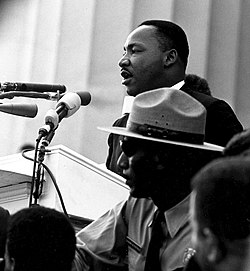
Atlanta native Martin Luther King Jr. delivered his iconic 'I Have a Dream' speech at the March on Washington, cementing his leadership of the civil rights movement and bringing global attention to the struggle for equality.
Image source: I Have a Dream
Apr 4, 1968
% complete
The assassination of Atlanta's most famous son shocked the nation and sparked grief and unrest nationwide. His body returned to Atlanta, and his funeral drew leaders from around the world to the city.
Image source: Assassination of Martin Luther King Jr.
Oct 1973 - 1982
% complete
Maynard Jackson became the first African American mayor of any major Southern city, expanding minority business participation in city contracts and overseeing the expansion of Hartsfield Airport.
Image source: Maynard Jackson
1926
% complete
Candler Field, later Hartsfield–Jackson Atlanta International Airport, began operations in 1926 and grew into the world's busiest airport, transforming Atlanta into the commercial capital of the Southeast.
Image source: Hartsfield–Jackson Atlanta International Airport
Jan 1937 - 1962
% complete
William Berry Hartsfield served six terms as Atlanta's mayor, championing aviation, expanding the airport that now bears his name, and guiding the city toward more moderate racial politics than other Southern cities.
Image source: William B. Hartsfield
Oct 1981 - 1990
% complete
Former UN Ambassador and civil rights leader Andrew Young succeeded Maynard Jackson as mayor, promoting international investment and helping position Atlanta as a global city capable of hosting the Olympics.
Image source: Andrew Young
Sep 18, 1990
% complete
The International Olympic Committee awarded Atlanta the Centennial Olympic Games, beating Athens and triggering billions of dollars in infrastructure investment and urban revitalization.
Image source: 1996 Summer Olympics
Jul 19, 1996 - Aug 4, 1996
% complete
Atlanta hosted the centennial celebration of the modern Olympics, welcoming athletes from around the world. The games transformed the cityscape with venues like Centennial Olympic Park despite challenges including the Centennial Park bombing.
Jul 27, 1996
% complete
A pipe bomb exploded in Centennial Olympic Park during the Games, killing two people and injuring over a hundred. The incident briefly disrupted the Olympics and led to a years-long investigation of Eric Rudolph.
Image source: Centennial Olympic Park bombing
Jan 2002
% complete
Shirley Franklin became the first woman elected mayor of Atlanta, focusing on fiscal reform, sewer infrastructure overhaul, and quality-of-life improvements during her two terms.
Image source: Shirley Franklin
2006
% complete
Construction began on the Atlanta BeltLine, an ambitious plan converting old railway corridors into trails, transit, and parks encircling the city, spurring redevelopment and becoming a model of urban transformation.
Image source: Atlanta Beltline
Or browse the full history timeline directory, with more than 2,000 topics.
This History of Atlanta timeline was generated with the help of AI, using information found on the internet.
We work hard to keep these timelines accurate, but mistakes do get through. If you spot one, email us at [email protected] and we'll fix it for future visitors.
Generate yours with AI or build it from scratch, for free.
Export your timeline, add your own events, edit or remove AI-generated events, and much more
No credit card required.
Cancel anytime.
Cancel anytime.
You can create an unlimited number of timelines with up to 10 events on each one, customize how they look, export them to PDF, PNG, PowerPoint, CSV, and Excel, and share them with a link. Paid plans raise the event limit and add features like spreadsheet imports and collaborators.
Yes. You can cancel your subscription from your account page at any time, and you will not be charged again. Your subscription stays active for the rest of the period you already paid for.
Yes. We will email you a reminder before the annual renewal, and we will also email you a receipt.
Yes. You can email us within 15 days of any payment, and we will issue you a full refund.
Check out our pricing docs or send us an email anytime: [email protected].