-
Use Cases
-
Resources
-
Pricing
This timeline traces the history of Baltimore, Maryland, one of America's most historically significant port cities. Founded in 1729 and named after Lord Baltimore, the city grew into a major shipping and industrial hub. It played a pivotal role in the War of 1812, inspiring 'The Star-Spangled Banner,' became home to the nation's first railroad, experienced significant immigration waves, faced civil unrest in 1968 and 2015, and has undergone ongoing efforts at economic and urban revitalization. More Less
Jul 30, 1729
% complete
Baltimore was established by the Maryland colonial legislature as a port town on the Patapsco River, named after Lord Baltimore, the proprietor of the Maryland colony. Its deep harbor made it well suited for shipping tobacco and grain to Europe and the Caribbean.
Image source: History of Baltimore
Dec 31, 1796
% complete
Baltimore was officially incorporated as a city, allowing it to establish its own municipal government. Rapid growth followed as the port flourished with trade in flour, grain, and other commodities.
Jul 7, 1806
% complete
The Baltimore Basilica, designed by Benjamin Henry Latrobe, began construction and became the first Roman Catholic cathedral built in the United States. It symbolized Baltimore's importance as the center of American Catholicism under Archbishop John Carroll.
Image source: Basilica of the National Shrine of the Assumption of the Blessed Virgin Mary
Sep 12, 1814 - Sep 14, 1814
% complete
British forces attacked Baltimore during the War of 1812. The successful American defense of Fort McHenry, witnessed by Francis Scott Key, inspired him to write 'The Star-Spangled Banner,' which later became the national anthem of the United States.
Image source: Battle of Baltimore
Feb 28, 1827
% complete
Merchants in Baltimore chartered the Baltimore and Ohio Railroad, the first common carrier railroad in the United States, intended to compete with New York's Erie Canal for western trade. It became a model for American railroading.
Image source: Baltimore and Ohio Railroad
1829
% complete
The B&O Railroad established its shops at Mount Clare, making Baltimore a hub of early American railroading and manufacturing. The site is now home to the B&O Railroad Museum.
Image source: Mount Clare (Maryland)
1876
% complete
Johns Hopkins University was founded with a bequest from financier Johns Hopkins, becoming the first research university in the United States. Johns Hopkins Hospital opened in 1889, establishing Baltimore as a center of medical innovation.
Image source: Johns Hopkins University
1905 - 1920
% complete
Following the Great Fire, Baltimore embraced the City Beautiful movement, commissioning the Olmsted Brothers to develop park systems and improving civic infrastructure, including new monuments, schools, and widened streets.
Nov 23, 1914
% complete
The Baltimore Museum of Art opened near Johns Hopkins University, eventually becoming renowned for its collections of modern art, including the Cone Collection with works by Matisse and Picasso.
Image source: Baltimore Museum of Art
Feb 11, 1916
% complete
The Baltimore Symphony Orchestra was established as one of the earliest municipally funded orchestras in the nation, growing into a major cultural institution performing at the Lyric Theatre and later Joseph Meyerhoff Symphony Hall.
Image source: Baltimore Symphony Orchestra
Apr 19, 1861
% complete
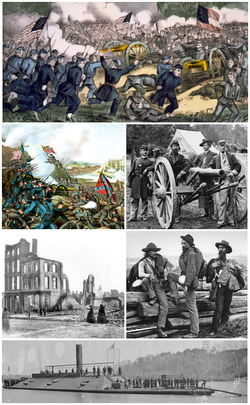
As Massachusetts troops passed through Baltimore en route to Washington, D.C., clashes with Confederate sympathizers left multiple dead, marking the first deaths by hostile action of the Civil War. The incident highlighted the divided loyalties within Maryland.
Image source: Baltimore riot of 1861
May 13, 1861
% complete
Federal troops occupied Baltimore to secure its strategic position and prevent Maryland from seceding. Martial law was imposed, and pro-Confederate officials were arrested, keeping the city under Union control throughout the war.
Image source: American Civil War
1910
% complete
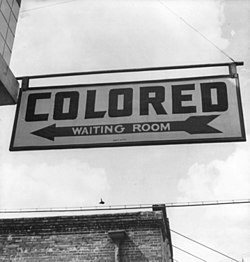
Baltimore became one of the first U.S. cities to pass residential segregation ordinances, dividing neighborhoods by race. Though later struck down legally, such practices shaped patterns of housing inequality that persisted through redlining.
Image source: Racial segregation in the United States
1916 - 1930
% complete
Thousands of African Americans moved from the rural South to Baltimore seeking industrial jobs and better opportunities, transforming the city's demographics and culture while also facing segregation and housing discrimination.
Image source: Great Migration (African American)
May 17, 1954
% complete
The Supreme Court's landmark desegregation ruling prompted Baltimore, which had already begun integrating some institutions, to move toward school desegregation, though full integration proceeded slowly amid resistance.
Apr 6, 1968 - Apr 14, 1968
% complete
Following the assassination of Martin Luther King Jr., civil unrest broke out in Baltimore, with looting and fires along Gay Street and Pennsylvania Avenue. The National Guard and federal troops were deployed, leaving lasting physical and social scars.
Nov 3, 1987
% complete
Kurt Schmoke won election as Baltimore's first African American mayor, serving three terms and championing education reform and drug policy innovation, including famously advocating treating addiction as a public health issue.
Image source: Kurt Schmoke
Jun 2, 2002
% complete
David Simon's acclaimed HBO series 'The Wire' premiered, using Baltimore as a lens to examine urban issues including drugs, policing, politics, education, and media, earning worldwide recognition and sparking conversations about American cities.
Image source: The Wire
Feb 4, 2010
% complete
Sheila Dixon resigned amid a corruption scandal, and City Council President Stephanie Rawlings-Blake succeeded her, becoming the second consecutive African American woman to lead the city.
Image source: Stephanie Rawlings-Blake
Apr 27, 2015 - May 3, 2015
% complete
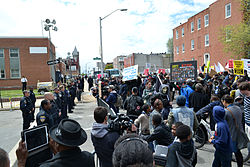
Freddie Gray died after suffering injuries in police custody, triggering widespread protests over policing and inequality. Unrest led to a state of emergency and National Guard deployment, prompting reforms in policing and renewed focus on disinvestment in Black neighborhoods.
Image source: 2015 Baltimore protests
May 2, 2019
% complete
Mayor Catherine Pugh resigned following a scandal involving self-enrichment through sales of her children's book series 'Healthy Holly.' Bernard 'Jack' Young succeeded her as mayor.
Image source: Catherine Pugh
Nov 3, 2020
% complete
Brandon Scott, then the youngest mayor in decades, was elected on a platform of reducing gun violence, reforming public safety, and investing in Baltimore neighborhoods, taking office that December.
Image source: Brandon Scott
Feb 7, 1904 - Feb 8, 1904
% complete
A massive fire swept through Baltimore's business district, destroying over 1,500 buildings across more than 70 city blocks. The disaster led to improved building codes, standardized fire hydrants and hoses nationwide, and an ambitious rebuilding effort.
Image source: Great Baltimore Fire
1959
% complete
The Bethlehem Steel mill at Sparrows Point employed tens of thousands of workers, becoming one of the world's largest steel plants. Generations of Baltimoreans depended on steelmaking jobs that defined the region's working-class economy.
Image source: Sparrows Point, Maryland
1964
% complete
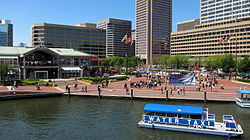
Baltimore launched an ambitious urban renewal plan to transform its decaying Inner Harbor from industrial waterfront into a commercial and cultural destination, a redevelopment project that became nationally famous.
Image source: Inner Harbor
Jul 2, 1980
% complete
Developer James Rouse opened Harborplace, a festival marketplace that anchored the Inner Harbor renaissance and inspired similar waterfront developments in cities across America.
Image source: Harborplace
Aug 8, 1981
% complete
The National Aquarium opened as a centerpiece of the revitalized Inner Harbor, drawing millions of visitors annually and helping cement Baltimore's reputation as a major tourist destination.
Image source: National Aquarium (Baltimore)
Apr 6, 1992
% complete
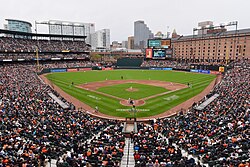
Oriole Park at Camden Yards opened as the home of the Baltimore Orioles, pioneering the retro ballpark movement that influenced stadium design nationwide by blending classic architecture with modern amenities.
Image source: Oriole Park at Camden Yards
Nov 24, 1995
% complete
The American Visionary Art Museum opened at Federal Hill, celebrating self-taught artists and adding to Baltimore's growing array of distinctive cultural attractions around the harbor.
Image source: American Visionary Art Museum
Or browse the full history timeline directory, with more than 2,000 topics.
This History of Baltimore timeline was generated with the help of AI, using information found on the internet.
We work hard to keep these timelines accurate, but mistakes do get through. If you spot one, email us at [email protected] and we'll fix it for future visitors.
Generate yours with AI or build it from scratch, for free.
Export your timeline, add your own events, edit or remove AI-generated events, and much more
No credit card required.
Cancel anytime.
Cancel anytime.
You can create an unlimited number of timelines with up to 10 events on each one, customize how they look, export them to PDF, PNG, PowerPoint, CSV, and Excel, and share them with a link. Paid plans raise the event limit and add features like spreadsheet imports and collaborators.
Yes. You can cancel your subscription from your account page at any time, and you will not be charged again. Your subscription stays active for the rest of the period you already paid for.
Yes. We will email you a reminder before the annual renewal, and we will also email you a receipt.
Yes. You can email us within 15 days of any payment, and we will issue you a full refund.
Check out our pricing docs or send us an email anytime: [email protected].