-
Use Cases
-
Resources
-
Pricing
1450 - 1600
% complete
Ballet is a formalized Italian dance form with its origins in the Italian Renaissance courts of the 15th and 16th centuries, where lavish entertainments combined music, dance, and spectacle to display the wealth and power of noble courts.
1470
% complete
Around 1470, one of the first dancing masters was active, helping formalize the dance practices that would evolve into ballet in the Italian courts.
1489
% complete
In 1489, Galeazzo, Duke of Milan, married Isabella of Aragon in Tortona. The wedding celebrations featured elaborate dance entertainments that exemplified the court spectacles from which ballet developed.
Image source: Ballet
1573
% complete
The first formal 'court ballet' ever recognized was staged in 1573: 'Ballet des Polonais', performed on the occasion of the visit of the Polish Ambassador to the French court.
Image source: History of ballet
1581
% complete
In 1581, Catherine de' Medici commissioned another court ballet, the Ballet Comique de la Reine. Choreographed and directed by Balthasar de Beaujoyeulx, it was commissioned by Louise of Lorraine, queen consort of King Henry III, to celebrate the marriage of Henry's favorite the Duke de Joyeuse to Marguerite de Lorraine, sister of Queen Louise.
Image source: Ballet Comique de la Reine
1600
% complete
The word ballet comes from French and was borrowed into English around the 17th century, reflecting the growing influence of French dance culture across Europe.
1633 - 1648
% complete
In Poland, King Władysław IV Vasa (1633–1648) hosted Italian opera productions, which included ballet performers in some scenes, spreading Italian theatrical dance traditions into Eastern Europe.
Image source: Władysław IV Vasa
1652
% complete
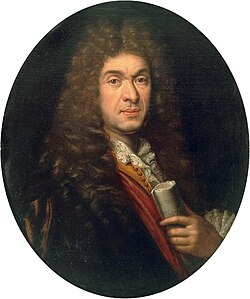
Jean-Baptiste Lully, an Italian violinist, dancer, choreographer, and composer, joined the court of Louis XIV in 1652 and played a significant role in establishing the general direction ballet would follow for the next century.
Image source: Jean-Baptiste Lully
1653
% complete
The title of Sun King for the French monarch originated in Louis XIV's role in Lully's Ballet de la Nuit (1653), in which the young king appeared as the rising sun.
Image source: Ballet Royal de la Nuit
1661
% complete
In 1661 Louis XIV, determined to further his ambition in controlling the nobles and reverse a decline in dance standards that began in the 17th century, established the Académie Royale de Danse, a school that professionalized the training of dancers.
Image source: Académie Royale de Danse

1669
% complete
In 1669 Louis XIV founded the Académie d'Opéra with Pierre Perrin as director, laying the institutional foundation for French opera and ballet.
Image source: Paris Opera
1669
% complete
In the late 17th century Louis XIV founded the Académie Royale de Musique (the Paris Opera), within which emerged the first professional theatrical ballet company, the Paris Opera Ballet.
Image source: Paris Opera Ballet
1670
% complete
Louis XIV retired as a dancer in 1670, largely because of excessive weight gain, ending his personal performing career though not his patronage of ballet.
Image source: Louis XIV
1670
% complete
Among the greatest productions of the era, with Pierre Beauchamp as the choreographer, was Le Bourgeois Gentilhomme (1670), a collaboration showcasing the fusion of comedy, music, and dance at the French court.
Image source: Le Bourgeois gentilhomme
1680 - 1687
% complete
Beauchamp was appointed Intendant des ballets du roi and in 1680 became the director of the dance academy, a position he held until 1687, shaping the technical standards of French ballet.
Image source: Pierre Beauchamp
1700
% complete
Raoul Auger Feuillet, a Parisian ballet master, adopted Beauchamp's system of dance notation and had his work published in 1700, preserving and disseminating the choreographic conventions of French baroque dance.
Image source: Raoul Auger Feuillet
1700 - 1800
% complete
The 18th century was a period of advancement in the technical standards of ballet and the period when ballet became a serious dramatic art form on par with the opera.
1700 - 1800
% complete
Ballet performances spread to Eastern Europe during the 18th century, into areas such as Hungary, where they were held in private theatres at aristocratic castles.
1750 - 1900
% complete
Italian ballet techniques remained the dominant influence in much of southern and eastern Europe until Russian techniques supplanted them in the early 20th century.
Image source: Ballet technique
1760
% complete
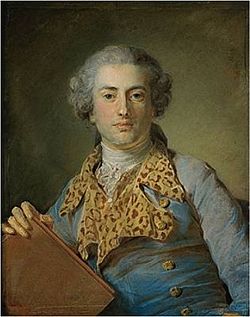
Central to the advance of ballet as dramatic art was the seminal work of Jean-Georges Noverre, Lettres sur la danse et les ballets (1760), which focused on developing the ballet d'action, in which the movements of the dancers are designed to express character and assist in the narrative.
Image source: Jean-Georges Noverre
1800 - 1850
% complete
The ballerina became the most popular dance performer in Europe in the first half of the 19th century, gradually turning the spotlight away from the male dancer.
Image source: From the World of John Wick: Ballerina
1830 - 1850
% complete
The 19th century was a period of great social change, reflected in ballet by a shift away from the aristocratic sensibilities that had dominated earlier periods through romantic ballet.
Image source: Romantic ballet
1834
% complete
In 1834, Fanny Elssler arrived at the Paris Opera and became known as the 'Pagan Dancer', because of the fiery qualities of the Cachucha dance that made her famous.
Image source: Fanny Elssler
1740 - 1749
% complete
The Royal Danish Ballet and the Imperial Ballet of the Russian Empire were founded in the 1740s and began to flourish, especially after about 1850, becoming major centers of classical ballet.
Image source: Royal Danish Ballet
1850 - 1899
% complete
Many leading European professional ballet companies that survive today were established at new theatres in Europe's capital cities during the mid- to late-19th century, including the Kyiv Ballet, the Hungarian National Ballet, the National Theatre Ballet (Prague) and the Vienna State Ballet.
1862
% complete
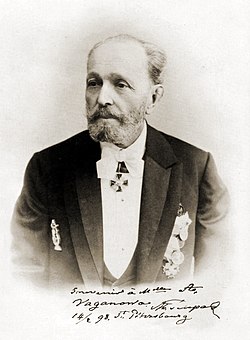
After 1850, ballet began to wane in Paris but flourished in Denmark and Russia thanks to masters such as August Bournonville, Jules Perrot, Arthur Saint-Léon, Enrico Cecchetti and Marius Petipa. Petipa appealed to popular taste with The Pharaoh's Daughter (1862).
Image source: Marius Petipa
1867
% complete
The National Opera of Ukraine, a performing arts theatre with a resident opera company, was established in Kyiv in 1867. By 1893, this grew to a troupe large enough to stage large ballets.
Image source: Kyiv Opera House
1870 - 1900
% complete
In the late nineteenth century, orientalism was in vogue, influencing ballet themes and staging. Petipa appealed to popular taste with The Talisman (1889) and La Bayadère (1877).
Image source: Orientalism
1890 - 1895
% complete
Petipa used Tchaikovsky's music for his choreography of The Nutcracker (1892, though this is open to some debate among historians), The Sleeping Beauty (1890), and the definitive revival of Swan Lake (1895, with Lev Ivanov).
1840 - 1899
% complete
Ballet companies from Europe began lucrative tours of theatres in North, Central and South America during the mid-19th century, carrying ballet to new audiences across the Atlantic.
1867
% complete
The prestigious Colon Theater in Buenos Aires, Argentina had hosted foreign ballet artists on its stage, with touring companies from Europe presenting full ballets as early as 1867.
Image source: Teatro Colón
1907
% complete
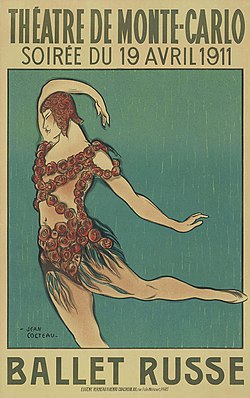
In 1907 the Russian ballet moved back to France, where the Ballets Russes of Sergei Diaghilev and its successors were particularly influential, transforming Western perceptions of ballet.
Image source: Ballets Russes
1928
% complete
Tim Scholl, author of From Petipa to Balanchine, considers Balanchine's Apollo (1928) to be the first neoclassical ballet, marking a turning point toward stripped-down, plotless choreography.
Image source: Apollo (ballet)
1931 - 2002
% complete
Soon ballet spread around the world with the formation of new companies, including London's The Royal Ballet (1931), the San Francisco Ballet (1933), American Ballet Theatre (1937), the Royal Winnipeg Ballet (1939), The Australian Ballet (1940 as the predecessor Borovansky Ballet), the New York City Ballet (1948), the Cuban National Ballet (1948), the National Ballet of Canada (1951), and the National Ballet Academy and Trust of India (2002).
1952 - 1958
% complete
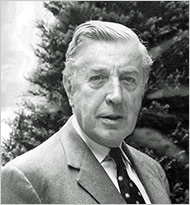
Three of Frederick Ashton's works have become standard pieces in the international repertoire: Sylvia (1952), Romeo and Juliet (1956), and Ondine (1958), the last created as a vehicle to showcase Margot Fonteyn.
Image source: Frederick Ashton
1957
% complete
Twyla Tharp also worked with the Joffrey Ballet company, founded in 1957 by Robert Joffrey, an American ensemble known for blending classical and modern influences.
Image source: Joffrey Ballet
Sep 13, 1960 - Oct 23, 1960
% complete
The American Ballet Theatre went on a tour of the Soviet Union between 13 September and 23 October 1960, an early example of Cold War cultural exchange between American and Soviet ballet worlds.
Image source: American Ballet Theatre
Sep 1962
% complete
The Bolshoi Ballet company went on a tour of America in September 1962, dazzling American audiences and cementing the reputation of Russian ballet in the West.
Image source: Bolshoi Ballet
1963
% complete
In 1963, Lincoln Kirstein's American Ballet, which was the first ballet made in America, achieved significant success thanks to the support of the Ford Foundation, which established George Balanchine's neoclassical style as a prominent national institution.
Image source: George Balanchine
1967
% complete
In 1967, Balanchine's Jewels broke with the narrative tradition and dramatized a theme rather than a plot, becoming a landmark of abstract, plotless ballet.
Image source: Jewels (ballet)
1973
% complete
Twyla Tharp choreographed Deuce Coupe for the Joffrey Ballet in 1973, using pop music and a blend of modern and ballet techniques, exemplifying the crossover between ballet and popular culture.
1976
% complete
Twila Tharp choreographed Push Comes To Shove for American Ballet Theatre and Mikhail Baryshnikov in 1976, fusing ballet with modern dance; in 1986 she created In The Upper Room for her own company.
1980
% complete
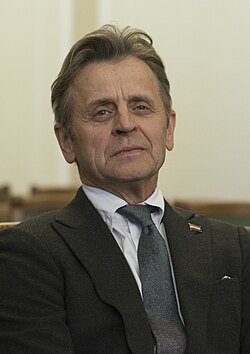
Following Baryshnikov's appointment as artistic director of American Ballet Theatre in 1980, he worked with various modern choreographers, most notably Twyla Tharp, bridging classical ballet and modern dance.
Image source: Mikhail Baryshnikov
1999
% complete
The 1999 North American premiere of The Fountain of Bakhchisarai by the Kirov Ballet in New York was an outstanding success, demonstrating the enduring appeal of Russian classical ballet abroad.
Image source: The Fountain of Bakhchisarai (ballet)
Or browse the full history timeline directory, with more than 2,000 topics.
This History of Ballet timeline was generated with the help of AI, using information found on the internet.
We work hard to keep these timelines accurate, but mistakes do get through. If you spot one, email us at [email protected] and we'll fix it for future visitors.
Generate yours with AI or build it from scratch, for free.
Export your timeline, add your own events, edit or remove AI-generated events, and much more
No credit card required.
Cancel anytime.
Cancel anytime.
You can create an unlimited number of timelines with up to 10 events on each one, customize how they look, export them to PDF, PNG, PowerPoint, CSV, and Excel, and share them with a link. Paid plans raise the event limit and add features like spreadsheet imports and collaborators.
Yes. You can cancel your subscription from your account page at any time, and you will not be charged again. Your subscription stays active for the rest of the period you already paid for.
Yes. We will email you a reminder before the annual renewal, and we will also email you a receipt.
Yes. You can email us within 15 days of any payment, and we will issue you a full refund.
Check out our pricing docs or send us an email anytime: [email protected].