-
Use Cases
-
Resources
-
Pricing
Broadway refers to the theatrical performances presented in the 41 professional theaters located in the Theater District of Manhattan, New York City. Its history spans over two centuries, evolving from modest beginnings in the 1700s to becoming the pinnacle of American commercial theater, renowned worldwide for its musicals, plays, and cultural influence. More Less
1750
% complete
New York City's first significant theatre was established around 1750, when actor-managers Walter Murray and Thomas Kean established a resident theatre company at the Theatre on Nassau Street in Lower Manhattan, which held about 280 people.
Image source: Theater in the United States
1752
% complete
In 1752, William Hallam sent a company of twelve actors from Britain to the colonies with his brother Lewis as their manager.
1753
% complete
The company moved to New York in 1753, performing ballad operas and ballad-farces like Damon and Phillida.
1798
% complete
After the war's end, theatre resumed in 1798 when the 2,000-seat Park Theatre was built on Chatham Street on present-day Park Row.
Image source: Park Theatre (Manhattan)
1826
% complete
A second major theatre, the Bowery Theatre, opened in 1826, followed by others.
Image source: Bowery Theatre
1829
% complete
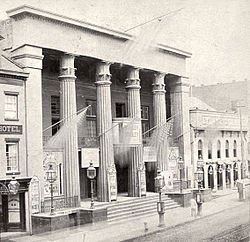
In 1829, at Broadway and Prince Street, Niblo's Garden opened and soon became one of New York's premier nightspots.
Image source: Niblo's Garden
1836
% complete
In 1836, Mayor Cornelius Lawrence opened 42nd Street and invited Manhattanites to 'enjoy the pure clean air.' Close to 60 years later, theatrical entrepreneur Oscar Hammerstein I built the iconic Victoria Theater on West 42nd Street.
Image source: 42nd Street (Manhattan)
1844
% complete
Palmo's Opera House opened in 1844 and presented opera for only four seasons before bankruptcy led to its rebranding as a venue for plays under the name Burton's Theatre.
Image source: Philip Burton (theatre director)
1847
% complete
The Astor Opera House opened in 1847 as another major venue in Manhattan.
Image source: Astor Opera House
1850
% complete
Theatre in New York moved from Downtown gradually to Midtown Manhattan, beginning around 1850, seeking less expensive real estate. At the beginning of the nineteenth century, the area that now comprises the Theater District was owned by a handful of families and comprised a few farms.
Image source: Broadway theatre
1870
% complete
In 1870, the heart of Broadway was in Union Square, and by the end of the century, many theatres were near Madison Square.
1857
% complete
Broadway's first 'long-run' musical was a 50-performance hit called The Elves in 1857.
1860
% complete
New York runs continued to lag far behind those in London, but Laura Keene's 'musical burletta' The Seven Sisters shattered previous New York records with a run of 253 performances.
Image source: Laura Keene
1865
% complete
Booth played Hamlet for a famous 100 consecutive performances at the Winter Garden Theatre in 1865, with the run ending just a few months before his brother John Wilkes Booth assassinated Abraham Lincoln. He would later revive the role at his own Booth's Theatre.
Image source: Edwin Booth
Sep 12, 1866
% complete
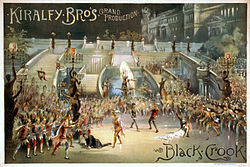
The first theatre piece that conforms to the modern conception of a musical, adding dance and original music that helped to tell the story, is considered to be The Black Crook, which premiered in New York on September 12, 1866.
Image source: The Black Crook
1878 - 1890
% complete
Comedians Edward Harrigan and Tony Hart produced and starred in musicals on Broadway between 1878 (The Mulligan Guard Picnic) and 1890, with book and lyrics by Harrigan and music by his father-in-law David Braham.
Image source: Edward Harrigan
1878
% complete
Gilbert and Sullivan's comic operas, beginning with H.M.S. Pinafore in 1878, were imported to New York by the authors and also in numerous unlicensed productions.
Image source: H.M.S. Pinafore
1881
% complete
Tony Pastor opened the first vaudeville theatre one block east of Union Square in 1881, where Lillian Russell performed.
Image source: Tony Pastor
1891 - 1896
% complete
British comic operas were imitated in New York by American productions such as Reginald Dekoven's Robin Hood (1891) and John Philip Sousa's El Capitan (1896), along with operas, ballets, and other British and European hits.
Image source: El Capitan (operetta)
1891
% complete
Hoyt's show A Trip to Chinatown became Broadway's long-run champion when it surpassed Adonis and its 603 total performances in 1893, holding the stage for 657 performances.
Image source: A Trip to Chinatown
1896
% complete
In 1896, theatre owners Marc Klaw and A. L. Erlanger formed a powerful syndicate that controlled bookings for theatres across America.
1898
% complete
A Trip to Coontown was the first musical comedy entirely produced and performed by African Americans in a Broadway theatre, inspired largely by the routines of the minstrel shows, followed by Clorindy: The Origin of the Cakewalk (1898) and In Dahomey (1902).
1898 - 1910
% complete
Victor Herbert produced intimate musical plays with modern settings as well as his string of famous operettas including The Fortune Teller (1898), Babes in Toyland (1903), Mlle. Modiste (1905), The Red Mill (1906), and Naughty Marietta (1910).
Image source: Victor Herbert
1900 - 1901
% complete
A few very successful British musicals continued to achieve great success in New York, including Florodora in 1900–01.
Image source: Florodora
1904 - 1906
% complete
George M. Cohan scored major Broadway hits with Little Johnny Jones (1904), 45 Minutes From Broadway (1906), and George Washington Jr., helping define the American musical.
Image source: George M. Cohan
Aug 1919
% complete
In August 1919, the Actors' Equity Association demanded a standard contract for all professional productions, leading to a landmark strike that transformed actors' working conditions.
Image source: Actors' Equity Association
Mar 1920
% complete
Chinatown was surpassed by the musical Irene (1919) in 1921 as the longest-running Broadway musical, and even earlier, in March 1920, by Lightnin' (1918) as the longest-running Broadway show.
Image source: Lightnin' (play)
1925
% complete
Lightnin' was the longest-running Broadway show until being overtaken in performance totals by Abie's Irish Rose in 1925.
Image source: Abie's Irish Rose
Dec 27, 1927
% complete
Leaving comparatively frivolous entertainments behind and taking drama a step forward, Show Boat premiered on December 27, 1927, at the Ziegfeld Theatre, integrating story, music, and dance in a groundbreaking way.
Image source: Show Boat
1930
% complete
In 1930, Theatre Guild's production of Roar, China! was Broadway's first play with a majority Asian cast.
Apr 1941
% complete
The most successful play of its era was Lillian Hellman's Watch on the Rhine, which opened in April 1941.
Image source: Watch on the Rhine
1943
% complete
After the lean years of the Great Depression, Broadway theatre entered a golden age with the blockbuster hit Oklahoma!, which ran for 2,212 performances.
Image source: Oklahoma
1947
% complete
Broadway productions and artists are honored by the annual Antoinette Perry Awards, commonly called the Tony Awards, given by the American Theatre Wing and The Broadway League, first presented in 1947.
Image source: Tony Awards
1950
% complete
Other awards given to Broadway productions include the Outer Critics Circle Award, initially presented in 1950, honoring outstanding achievements in Broadway and Off-Broadway theatre.
1955
% complete
The Drama Desk Award has been presented since 1955, recognizing excellence in New York theatre across Broadway, Off-Broadway, and Off-Off-Broadway productions.
Image source: Drama Desk Awards
1967
% complete
The importance of the Tony Awards increased since 1967 when the awards presentation show began to be broadcast on national television.
1969
% complete
The 1960s and 1970s saw a worsening of the Times Square area and a drop in legitimate shows: 94 productions opened in the 1950–51 season versus 59 in 1969–70. In the 1920s there were 70–80 theaters; by 1969 only 36 remained.
1982
% complete
In early 1982, Joe Papp, who established The Public Theater, led the 'Save the Theatres' campaign to preserve the historic Broadway/Times Square theatre district.
Image source: Joseph Papp
Jul 1982
% complete
At Papp's behest, in July 1982, a bill was introduced in the 97th Congress entitled 'H.R.6885, A bill to designate the Broadway/Times Square Theatre District in the City of New York as a national historic site.'
Dec 1983
% complete
In December 1983, Save the Theatres prepared 'The Broadway Theater District, a Preservation Development and Management Plan,' demanding landmark designation for each theater in the district.
2005
% complete
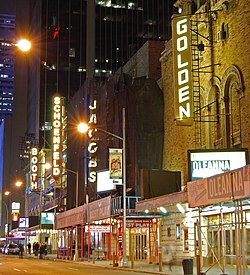
The August Wilson Theatre, owned by Jujamcyn, had been renamed after Black playwright August Wilson in 2005, honoring his legacy on Broadway.
Image source: August Wilson Theatre
Jan 9, 2006
% complete
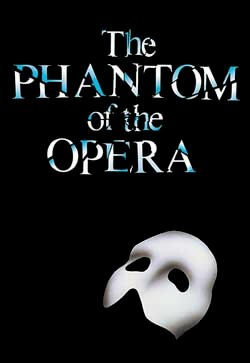
On January 9, 2006, The Phantom of the Opera at the Majestic Theatre became the longest-running Broadway musical, with 7,486 performances, overtaking Cats.
Image source: The Phantom of the Opera (1986 musical)
Mar 12, 2020
% complete
Due to the COVID-19 pandemic in New York City, Broadway theaters closed on March 12, 2020, shuttering 16 shows that were playing or were in the process of opening. The shutdown was extended multiple times into 2021.
Image source: Impact of the COVID-19 pandemic on the performing arts
Oct 15, 2020 - Sep 26, 2021
% complete
The 74th Tony Awards were postponed due to the pandemic; nominations were announced on October 15, 2020, and the ceremony took place on September 26, 2021.
Image source: 74th Tony Awards
May 2021
% complete
Governor Andrew Cuomo announced that most sectors of New York would have restrictions lifted on May 19, 2021, but Broadway could not immediately resume. He set a target that Broadway theaters should reopen on September 14.
Jun 26, 2021
% complete
Springsteen on Broadway became the first full-length show to resume performances, opening on June 26, 2021, to 1,721 vaccinated patrons at the St. James Theatre.
Image source: Springsteen on Broadway
Jul 30, 2021
% complete
On July 30, 2021, it was announced that all Broadway theaters required attendees aged 12+ to provide proof of full COVID-19 vaccination. Effective December 14, guests ages 5–11 needed at least one shot until January 29, 2022, when they had to be fully vaccinated.
Aug 22, 2021
% complete
Pass Over had its first preview on August 4 and opened on August 22, 2021, becoming the first new play to open on Broadway since the pandemic shutdown.
Sep 2, 2021
% complete
Hadestown and Waitress were the first musicals to resume performances on September 2, 2021, marking the return of full-scale musical productions to Broadway.
Image source: Hadestown
2022 - 2024
% complete
In 2022–2023, the first full season since the pandemic, Broadway sold 12.3 million tickets, 35% to local residents and 17% to international visitors. Shows sold about US$1.54 billion in tickets in both the 2022–2023 and 2023–2024 seasons.
Mar 2022
% complete
The Shuberts announced in March 2022 that the Cort Theatre, which was under renovation at the time, would be renamed after actor James Earl Jones; it was rededicated in September 2022.
Image source: James Earl Jones Theatre
Jun 2022
% complete
In June 2022, the Nederlanders announced that the Brooks Atkinson Theatre would be renamed after Lena Horne; the Lena Horne Theatre was rededicated that November.
Image source: Lena Horne Theatre
Apr 16, 2023
% complete
The Phantom of the Opera closed on Broadway on April 16, 2023, soon after celebrating its 35th anniversary, after a total of 13,981 performances.
Jan 2026
% complete
While existing musicals and revivals continued with acceptable returns post-2021, most newly-created musicals have struggled. As of January 2026, just four post-2021 musicals reported profits: MJ, & Juliet, Six, and The Outsiders.
Jun 7, 2026
% complete
The most recent Tony Awards ceremony was held on June 7, 2026, continuing the tradition of honoring excellence on Broadway.
Or browse the full history timeline directory, with more than 2,000 topics.
This History of Broadway timeline was generated with the help of AI, using information found on the internet.
We work hard to keep these timelines accurate, but mistakes do get through. If you spot one, email us at [email protected] and we'll fix it for future visitors.
Generate yours with AI or build it from scratch, for free.
Export your timeline, add your own events, edit or remove AI-generated events, and much more
No credit card required.
Cancel anytime.
Cancel anytime.
You can create an unlimited number of timelines with up to 10 events on each one, customize how they look, export them to PDF, PNG, PowerPoint, CSV, and Excel, and share them with a link. Paid plans raise the event limit and add features like spreadsheet imports and collaborators.
Yes. You can cancel your subscription from your account page at any time, and you will not be charged again. Your subscription stays active for the rest of the period you already paid for.
Yes. We will email you a reminder before the annual renewal, and we will also email you a receipt.
Yes. You can email us within 15 days of any payment, and we will issue you a full refund.
Check out our pricing docs or send us an email anytime: [email protected].