-
Use Cases
-
Resources
-
Pricing
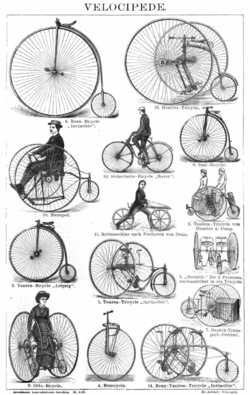
The history of bicycles traces the evolution of human-powered two-wheeled transportation from Karl von Drais's 1817 running machine through the pedal-driven velocipedes of the 1860s, the high-wheel penny-farthings, and the safety bicycle of the 1880s, to today's lightweight, multi-speed, and electric bicycles that remain vital for transport, sport, and recreation worldwide. More Less
1655
% complete
A three-wheeled wheelchair powered by hand cranks was built in either 1655 or 1680 by a disabled German man, Stephan Farffler, who wanted to be able to maintain his mobility.
Image source: History of the bicycle
1732
% complete
In Japan, a pedal-powered tricycle called Rikushu-honsha was described by Hiraishi Kuheiji Tokimitsu (1696-1771) in 1732, with the record currently owned by the Hikone Public Library, Hikone.
1792
% complete
An unverified contention holds that a certain 'Comte de Sivrac' developed a célérifère in 1792, demonstrating it at the Palais-Royal in France. It is now thought that the two-wheeled célérifère never existed and was instead a misinterpretation by French journalist Louis Baudry de Saunier in 1891.
Image source: History of the bicycle
1817
% complete
Karl von Drais invented his Laufmaschine ('running machine') in 1817, called the Draisine or draisienne by the press. His interest was likely spurred by the starvation and death of horses caused by crop failure in 1816, the Year Without a Summer following the eruption of Tambora in 1815.
Image source: Draisine
1817 - 1818
% complete
Von Drais introduced his invention to the public in Mannheim in 1817 and in Paris in 1818, attracting widespread attention across Europe.
Jun 12, 1817
% complete
On his first reported ride from Mannheim on June 12, 1817, Karl von Drais covered 13 km (eight miles) in less than an hour, demonstrating the potential of his running machine.
1818
% complete
The concept was picked up by a number of British cartwrights; the most notable was Denis Johnson of London, who announced in late 1818 that he would sell an improved model of the draisine.
Image source: Hobby horse (toy)
1818
% complete
Drais patented his design in 1818, creating the first commercially successful two-wheeled, steerable, human-propelled machine, commonly called a velocipede and nicknamed hobby-horse or dandy horse.
1829
% complete
An 1829 article in The Kaleidoscope described an improved version as a cheap and useful machine that could help a rider cover long distances with less fatigue than walking.
1839
% complete
The first mechanically propelled, two-wheeled vehicle may have been built by Kirkpatrick MacMillan, a Scottish blacksmith, in 1839, although this claim is often disputed.
Image source: Kirkpatrick Macmillan
1842
% complete
MacMillan is also associated with the first recorded instance of a cycling traffic offense: a Glasgow newspaper in 1842 reported an accident in which an anonymous 'gentleman from Dumfries-shire... of ingenious design' knocked over a little girl in Glasgow and was fined five shillings.
1845
% complete
A bicycle is said to have been produced by Gavin Dalzell of Lesmahagow around 1845, one of several early claims about two-wheeled machines in Scotland.
1853
% complete
Philipp Moritz Fischer, who used the draisine to get to school from the age of 9, invented the pedal crank in 1853. He built the very first bicycle with pedals but did not make the invention public; the Tretkurbelfahrrad from 1853 survives on display in the municipality museum in Schweinfurt.
1863
% complete
Herlihy documents that Pierre Lallement claimed to have created the pedal bicycle in Paris in 1863. He had seen someone riding a draisine in 1862 and came up with the idea to add pedals to it. The earliest year bicycle historians agree on for attaching pedals to the front wheel is 1864.
Image source: Pierre Lallement
1865
% complete
In 1865, Michaux associates travelled from Paris to Avignon on a velocipede in only eight days, demonstrating the machine's practicality for long-distance travel.
Image source: Velocipede
1866
% complete
In 1866 Paris, a Chinese visitor named Bin Chun could still observe foot-pushed velocipedes, showing that pedal-powered designs had not yet fully displaced the earlier draisine-style machines.
1866
% complete
Lallement filed the earliest and only patent for a pedal-driven bicycle in the US in 1866. He had left Paris in July 1865, crossed the Atlantic, settled in Connecticut, and patented the velocipede, after which associated inventions and patents soared in America.
1868
% complete
In 1868, Rowley Turner, a sales agent of the Coventry Sewing Machine Company (which soon became the Coventry Machinists Company), brought a Michaux cycle to Coventry, England, launching the British bicycle industry.
1868 - 1870
% complete
Initially developed around 1863, the pedal velocipede sparked a fashionable craze briefly during 1868–70. The popularity of the machine grew on both sides of the Atlantic, and by 1868–69 the craze was strong even in rural areas.
1868
% complete
Together with their friend Georges de la Bouglise, the Olivier brothers formed a partnership with Pierre Michaux, Michaux et Cie, in 1868, avoiding use of the Olivier family name lest the venture prove a failure. The company dominated the industry in its first years.
1869
% complete
Several inventions followed using rear-wheel drive, the best known being the rod-driven velocipede by Scotsman Thomas McCall in 1869. McCall of Kilmarnock was also the first documented producer of rod-driven treadle bicycles.
1869
% complete
In 1869, William Van Anden of Poughkeepsie, New York, USA, invented the freewheel for the bicycle, allowing riders to coast without pedaling.
Image source: Freewheel
1869
% complete
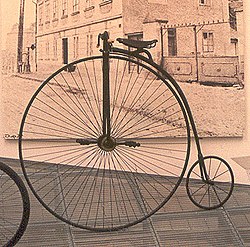
Meyer invented the wire-spoke tension wheel in 1869 and produced a classic high bicycle design until the 1880s, contributing key technology to the high-wheel era.
Image source: Penny-farthing
1875
% complete
By 1875, high-wheel bicycles were becoming popular in France, though ridership expanded slowly among the general public.
Image source: Penny-farthing
1877
% complete
In 1877, Joseph Henry Hughes' provisional patent application was allowed, titled 'Improvements in the bearings of bicycles and velocipedes or carriages', advancing bearing technology.
1878
% complete
Among the earliest cycling clubs was The Bicycle Touring Club, which has operated since 1878, helping popularize recreational cycling.
Image source: Cycling UK
1878
% complete
Bostonians such as Frank Weston started importing bicycles in 1877 and 1878, and Albert Augustus Pope started production of his 'Columbia' high-wheelers in 1878, gaining control of nearly all applicable patents, starting with Lallement's 1866 patent.
Image source: Pope Manufacturing Company
1879
% complete
Harry John Lawson invented a rear-chain-drive bicycle in 1879 with his 'bicyclette', though it still had a huge front wheel and a small rear wheel, limiting its success.
Image source: Harry John Lawson
1885
% complete
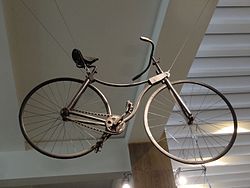
John Kemp Starley produced the first successful 'safety bicycle', the 'Rover', in 1885, which he never patented. Starley's 1885 Rover, manufactured in Coventry, is usually described as the first recognizably modern bicycle.
Image source: Rover Company
1885 - 1890
% complete
Widely imitated, the safety bicycle completely replaced the high-wheeler in North America and Western Europe by 1890, establishing the modern bicycle form.
Image source: Safety bicycle
1888
% complete
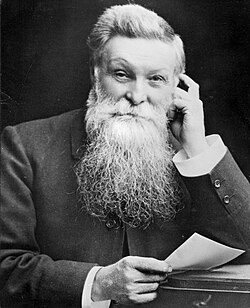
In 1888, Scotsman John Boyd Dunlop introduced the first practical pneumatic tire, which soon became universal and made for a much smoother ride on paved streets.
Image source: John Boyd Dunlop
1888
% complete
The Raleigh Bicycle Company was founded in Nottingham, England in 1888, becoming one of the world's most influential bicycle manufacturers.
Image source: Raleigh Bicycle Company
1889
% complete
Willie Hume demonstrated the supremacy of Dunlop's tyres in 1889, winning the tyre's first-ever races in Ireland and then England.
1892
% complete
The Svea Velocipede with vertical pedal arrangement and locking hubs was introduced in 1892 by the Swedish engineers Fredrik Ljungström and Birger Ljungström.
Image source: Svea Velocipede
1893
% complete
The recumbent bicycle was invented in 1893, offering an alternative riding position that would later prove aerodynamically superior.
Image source: Recumbent bicycle
1895
% complete
In 1895, 85 percent of all bikes bought in the Netherlands were from Britain; the vestiges of that influence can still be seen in the solid shape of a traditional Dutch bike today.
Image source: Roadster (bicycle)
1897
% complete
Most likely the first electric bicycle was built in 1897 by Hosea W., an early experiment in motor-assisted cycling.
Image source: Electric bicycle
Oct 10, 1899
% complete
On 10 October 1899, Isaac R Johnson, an African-American inventor, lodged his patent for a folding bicycle – the first with a recognisably modern diamond frame, the pattern still used in 21st-century bicycles.
1900 - 1910
% complete
The derailleur developed in France between 1900 and 1910 among cyclotourists, and was improved over time, eventually transforming bicycle gearing.
Image source: Derailleur
1900
% complete
By the turn of the century, cycling clubs flourished on both sides of the Atlantic, and touring and racing became widely popular pastimes.
1934
% complete
In 1934, the Union Cycliste Internationale banned recumbent bicycles from all officially sanctioned racing, at the behest of the conventional bicycle industry, after Francis Faure beat world champion Henri Lemoine and broke Oscar Egg's hour record while riding Mochet's Velocar.
Sep 1939
% complete
By September 1939, there were 41 bicycle companies mobilized, reflecting the industry's scale as World War II began.
1960 - 1975
% complete
Sales of adult bicycles doubled between 1960 and 1970, and doubled again between 1971 and 1975, the peak years of the adult cycling boom in the United States, eventually reaching nearly 17 million units.
1971
% complete
The 1971 motorcycle racing documentary On Any Sunday is generally credited with inspiring the off-road cycling movement nationally in the US.
Image source: On Any Sunday
1980
% complete
The Fatbike was invented for off-road usage in 1980, featuring oversized tires for riding on soft terrain like snow and sand.
Image source: Fatbike
1980
% complete
By 1980, racing and sport/touring derailleur bikes dominated the market in North America, reflecting decades of gearing innovation.
1981
% complete
In 1981, the first mass-produced mountain bike appeared, intended for use off-pavement over a variety of surfaces, launching a global phenomenon.
Image source: Mountain bike
1990
% complete
By 1990, the roadster was almost dead; while annual UK bicycle sales reached an all-time record of 2.8 million, almost all of them were mountain and road/sport models.
2000
% complete
More than 1 billion bicycles had been manufactured worldwide by the early 21st century, making the bicycle one of the most successful human inventions ever. The 21st century has seen continued application of technology to bicycles in designing, building, and using them.
2009
% complete
Sam Whittingham set a human powered speed record of 132 km/h (82 mph) on level ground in a faired recumbent streamliner in 2009 at Battle Mountain.
Or browse the full history timeline directory, with more than 2,000 topics.
This History of Bicycles timeline was generated with the help of AI, using information found on the internet.
We work hard to keep these timelines accurate, but mistakes do get through. If you spot one, email us at [email protected] and we'll fix it for future visitors.
Generate yours with AI or build it from scratch, for free.
Export your timeline, add your own events, edit or remove AI-generated events, and much more
No credit card required.
Cancel anytime.
Cancel anytime.
You can create an unlimited number of timelines with up to 10 events on each one, customize how they look, export them to PDF, PNG, PowerPoint, CSV, and Excel, and share them with a link. Paid plans raise the event limit and add features like spreadsheet imports and collaborators.
Yes. You can cancel your subscription from your account page at any time, and you will not be charged again. Your subscription stays active for the rest of the period you already paid for.
Yes. We will email you a reminder before the annual renewal, and we will also email you a receipt.
Yes. You can email us within 15 days of any payment, and we will issue you a full refund.
Check out our pricing docs or send us an email anytime: [email protected].