-
Use Cases
-
Resources
-
Pricing
Board games have been played for thousands of years, evolving from ancient Egyptian and Chinese strategy games into the diverse global hobby we know today. This timeline traces key milestones, including the rise of chess, the commercialization of games like Monopoly, and the modern board game renaissance. More Less
7000 BC - 6000 BC
% complete
Archaeological finds of game boards exist that date from as early as the Neolithic period. As of 2024, a total of 14 sites have reported 51 game boards, ranging from the early 7000s BC to the mid-6000s BC, making these among the earliest evidence of board gaming in human history.
Image source: History of games
5870 BC
% complete
Game boards dated across many periods include one based on divots carved out of limestone in a Neolithic dwelling dated to c. 5870 BC ± 240 BC at a site in Jordan, although this dating has been disputed by some scholars.
3100 BC
% complete
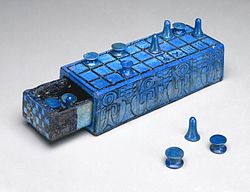
Senet has been argued to be the oldest known board game in the world, with possible game board fragments (c. 3100 BC) and undisputed pictorial representations (c. 2686 BC – c. 2613 BC) found in ancient Egyptian Predynastic and First Dynasty burials dating as far back as 3500 BC.
Image source: Senet
3000 BC
% complete
Some of the oldest discovered gaming pieces were found in southwest Turkey, including a set of elaborate sculptured stones in sets of four, speculated to be designed for a chess-like game, which were created during the Bronze Age around 3000 BC.
3000 BC - 2300 BC
% complete
Mehen, also from ancient Egypt, is one of the oldest games dated with reasonable confidence, at c. 3000 BC – c. 2300 BC, with some estimating it dates back to c. 3500 BC. The coiled-snake board game is named after the Egyptian serpent deity.
Image source: Mehen
2600 BC - 2400 BC
% complete
Another game similar to the Royal Game of Ur was discovered in 1977 by the Italian Archaeological Mission in grave no. 731, a pseudo-catacomb grave at Shahr-i Sokhta, a UNESCO World Heritage archaeological site in Iran. The set comprises 27 pieces and 4 different dice.
Image source: Shahr-e Sukhteh
2500 BC - 1500 BC
% complete
Among the many archaeological finds of game boards are examples from Egypt dated to c. 2500 BC – c. 1500 BC, demonstrating how deeply embedded board gaming was in Egyptian culture over millennia.
2500 BC
% complete
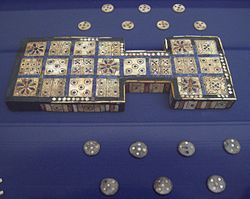
The Royal Game of Ur is estimated to have originated around 2500 BC in ancient Mesopotamia, with specimens found in royal tombs. It became one of the most iconic ancient race games known to archaeology.
Image source: Royal Game of Ur
800 BC - 200 BC
% complete
Discovered game boards are dated across many different periods at different sites, including examples from Roman Settlements dated to c. 800 BC – c. 200 BC, showing the continued spread of board gaming across the classical world.
800 BC - 701 BC
% complete
The oldest records of board gaming in Europe date back to Homer's Iliad (written in the 8th century BC), in which he mentions the Ancient Greek game of petteia, an early form of board game played in the Greek world.
Image source: Polis (board game)
1896
% complete
Ludo (c. 1896) is a classic dice game in which players roll dice to move their tokens around the board. Variants such as giving each player the choice of rolling the dice or using the previous player's roll can add strategic decision-making to the game.
Image source: Ludo
1934
% complete
Sorry! (1934) uses a deck of special cards that, when shuffled, create randomness, determining how players move their pieces around the board in this classic race-style family game.
Image source: Sorry! (game)
1935
% complete
Monopoly (1935) became the most popular board game sold during its period, with 500 million games played as of 1999. Players roll dice to determine how many steps they move their token, buying properties and driving opponents into bankruptcy.
Image source: Monopoly (game)
1946
% complete
Stratego (1946) is a war-themed board game in which some information is hidden from players, as each side cannot see the ranks of their opponent's pieces, creating hidden-information gameplay unlike perfect information games such as chess.
Image source: Stratego
1948
% complete
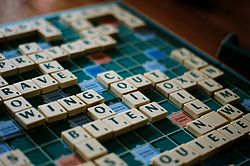
Scrabble (1948) creates randomness using randomly picked letters, challenging players to form words on a grid and score points based on letter values and premium squares.
Image source: Scrabble
1949
% complete
Candy Land (1949), like snakes and ladders, requires no decisions by the players and is decided purely by luck, making it a classic example of a children's game with no strategic element.
Image source: Candy Land
1954
% complete
Advanced diplomacy, exemplified by the aptly named game Diplomacy from 1954, consists of making elaborate plans together with other players, with the ever-present possibility of betrayal shaping negotiations and alliances.
Image source: Diplomacy (game)
1957
% complete
In Risk, dice rolls decide how players' forces fare in battle as they compete for global domination, exemplifying how chance mechanics can resolve combat outcomes in strategy board games.
Image source: Risk (game)
1960
% complete
Game of Life (1960) became one of the well-established standby Golden Era board games that dominated the 20th-century board game market, simulating a player's journey through life from college to retirement.
Image source: The Game of Life
1952
% complete
Harold Murray's A History of Board Games Other Than Chess (1952) has been called the first attempt to develop a scheme for the classification of board games, separating them into five categories: race, war, hunt, alignment/configuration, and mancala games.
Image source: Glossary of board games
1960
% complete
Robert Bell's Board and Table Games from Many Civilizations (1960) similarly espoused a classification of board games, this time divided into four categories: race, war, positional, and mancala games, building on Murray's earlier work.
1991
% complete
A 1991 estimate placed the global board game market at over $1.2 billion, reflecting the substantial commercial scale of the industry even before the modern board game renaissance.
Image source: Board game
1999
% complete
In David Parlett's The Oxford History of Board Games (1999), based on the work of Murray and Bell, he described a classical categorization of board games consisting of four primary categories: race, space, chase, and displace games.
Image source: David Parlett
2001
% complete
A 2001 estimate for the United States 'board games and puzzle' market gave a value of under $400 million, while the United Kingdom market was valued at about £50 million.
2009
% complete
In 2009, Germany was considered to be the best market per capita, with the highest number of games sold per individual, cementing its status as the heartland of the Eurogame tradition.
2009
% complete
A 2009 estimate for the Korean market was put at 800 million won, and another estimate for the American board game market for the same year was at about $800 million, showing strong growth across major markets.
2011
% complete
A 2011 estimate for the Chinese board game market placed its value at over 10 billion yuan, highlighting the rapid expansion of board gaming in Asia during the early 21st century.
2013
% complete
A 2013 estimate put the size of the German toy market at 2.7 billion euros, out of which the board games and puzzle market was worth about 375 million euros, with Polish markets estimated at 2 billion and 280 million zlotys respectively.
2015
% complete
A 2015 estimate suggested a hobby game market value of almost $900 million, underscoring the expanding economic footprint of the hobbyist board game segment.
1995
% complete
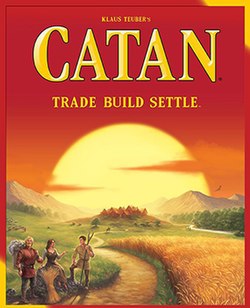
The Settlers of Catan (1995) is often credited with popularising German-style board games outside of Europe and growing the hobbyist game market to a wider audience. In Catan, dice rolls determine which resources a player gains.
Image source: Catan
1997
% complete
Tigris and Euphrates (1997), designed by Reiner Knizia, is a game in which some information is hidden from players, contrasting with perfect information games like chess where each player has complete knowledge of the game state.
Image source: Tigris–Euphrates river system
2000
% complete
Carcassonne (2000) was a major part of the period of board games industry development that saw a shift away from 20th-century domination by well-established standby Golden Era board games like Monopoly and Game of Life.
Image source: Carcassonne (board game)
2004
% complete
Ticket to Ride (2004) was another major title in the shift away from Golden Era standbys, helping define the new wave of accessible yet strategic German-style board games for a global hobbyist audience.
Image source: Ticket to Ride (board game)
2012
% complete
A 2012 article in The Guardian described board games as 'making a comeback', capturing mainstream media recognition of the growing popularity of tabletop gaming in the digital age.
2014
% complete
A 2014 article gave an estimate that put the growth of the board game market at 'between 25% and 40% annually' since 2010, and described the current time as the 'golden era for board games'.
2020
% complete
Crowd-sourcing for board games is a large facet of the market, with $233 million raised on Kickstarter in 2020 alone, demonstrating how crowdfunding has become central to bringing new board games to market.
Or browse the full history timeline directory, with more than 2,000 topics.
This History of Board Games timeline was generated with the help of AI, using information found on the internet.
We work hard to keep these timelines accurate, but mistakes do get through. If you spot one, email us at [email protected] and we'll fix it for future visitors.
Generate yours with AI or build it from scratch, for free.
Export your timeline, add your own events, edit or remove AI-generated events, and much more
No credit card required.
Cancel anytime.
Cancel anytime.
You can create an unlimited number of timelines with up to 10 events on each one, customize how they look, export them to PDF, PNG, PowerPoint, CSV, and Excel, and share them with a link. Paid plans raise the event limit and add features like spreadsheet imports and collaborators.
Yes. You can cancel your subscription from your account page at any time, and you will not be charged again. Your subscription stays active for the rest of the period you already paid for.
Yes. We will email you a reminder before the annual renewal, and we will also email you a receipt.
Yes. You can email us within 15 days of any payment, and we will issue you a full refund.
Check out our pricing docs or send us an email anytime: [email protected].