-
Use Cases
-
Resources
-
Pricing
The Ancient Olympic Games were a series of athletic competitions held every four years in Olympia, Greece, in honor of the god Zeus. Beginning in 776 BCE, they became the most prestigious sporting event of the ancient world, featuring events like running, wrestling, boxing, and chariot racing. The games continued for over a millennium until they were abolished in 393 CE by Emperor Theodosius I as part of his campaign against pagan practices. More Less
800 BC - 701 BC
% completado
Although the traditional founding date of 776 BC cannot be verified, historians generally accept that the ancient Olympic games began at some point during the eighth century BC, marking the start of one of antiquity's most enduring traditions.
Image source: Ancient Olympic Games
776 BC
% completado
To this day, 776 BC is the conventional given date for the inception of the ancient Olympics. While this specific date of origin cannot be verified, it is generally accepted that the games date from some time in the eighth century BC.
600 BC - 501 BC
% completado
Christesen's important work on the Olympic victor lists shows that victors' names and details were unreliable until the sixth century, meaning records of early Olympic champions before this period cannot be trusted.
400 BC - 301 BC
% completado
The historian Ephorus, who lived in the fourth century BC, is one potential candidate for establishing the use of Olympiads to count years, providing a chronological framework for Greek history.
400 BC - 301 BC
% completado
Credit for codifying the use of Olympiads to count years usually falls to Hippias of Elis, although Eratosthenes and Timaeus are also named as possible originators of this epoch system.
400 BC - 301 BC
% completado
The use of Olympiads to count years was established by historians such as Ephorus, Hippias of Elis, Eratosthenes, or Timaeus, making the four-year Olympic cycle the backbone of ancient Greek chronology.
Image source: Olympiad
350 BC
% completado
Ephorus is one potential candidate for establishing the use of Olympiads to count years, though credit for codifying this particular epoch usually falls to others such as Hippias of Elis or Eratosthenes.
300 BC - 201 BC
% completado
Eratosthenes is among those to whom credit for codifying the Olympiad dating system usually falls; Timaeus may have been imitated by him in establishing this method of counting years.
Image source: Eratosthenes
300 BC - 201 BC
% completado
Timaeus is another figure sometimes credited with codifying the use of Olympiads to count years, and Eratosthenes may have imitated his approach when developing his own chronological works.
Image source: Timaeus (historian)
800 BC - 701 BC
% completado
In the 8th century BC, power in ancient Greece became centered on the city-state (polis). This political transformation provided the civic framework within which panhellenic competitions like the Olympic Games could flourish.
Image source: Polis
800 BC - 701 BC
% completado
From the 8th century BC onwards, the Greek city-states expanded with the establishment of colonies in the Mediterranean and the Black Sea, spreading Greek culture far beyond the mainland.
Image source: Colonies in antiquity
599 BC - 401 BC
% completado
The spread of Greek colonies in the 6th and 5th centuries BC is repeatedly linked to successful Olympic athletes, as victorious competitors often became founders or benefactors of new settlements across the Mediterranean world.
Image source: Greek colonisation
599 BC - 401 BC
% completado
During the 6th and 5th centuries BC, Greek colonies spread widely, and this expansion is repeatedly linked to successful Olympic athletes who carried prestige between mother cities and settlements abroad.
530 BC - 500 BC
% completado
Archaeological evidence from the late sixth century BC reveals athletes sporting a garment during competitions, offering insight into athletic dress practices of the era.
499 BC - 400 BC
% completado
The 5th-century BC historian Thucydides credits the Spartans with introducing the custom of publicly stripping and anointing themselves with oil in their gymnastic exercises, a practice that became characteristic of Greek athletics.
499 BC - 400 BC
% completado
Following the Spartan custom noted by Thucydides, publicly stripping and anointing the body with oil became standard practice in Greek gymnastic exercises and athletic competition.
450 BC - 400 BC
% completado
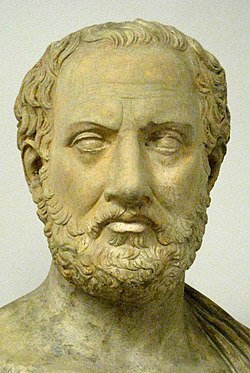
The historian Thucydides, writing in the fifth century BC, recorded that the Spartans were credited with introducing the custom of publicly stripping and anointing themselves with oil in their gymnastic exercises.
Image source: Thucydides
776 BC - 385 AD
% completado
From its conventional inception in 776 BC to its last attested celebration in 385, the ancient Olympic Games endured for over a thousand years, outlasting empires and wars alike.
201 AD - 300 AD
% completado
The 3rd century saw a decline in the popularity of the games, as political instability and economic troubles across the Roman Empire diminished interest in the ancient festival.
385 AD
% completado
A bronze plaque found in 1994 was inscribed with victors of the combative events hailing from the mainland and Asia Minor, proving that an international Olympic Games continued until at least 385, the 291st Olympiad.
385 AD
% completado
The victors listed on the bronze plaque hailed from both the mainland and Asia Minor, demonstrating that the Olympics remained an international competition as late as the 291st Olympiad in 385.
385 AD
% completado
Evidence from an inscribed bronze plaque confirms that the Olympic Games were still being held at the 291st Olympiad in 385, centuries after their legendary founding.
1896
% completado
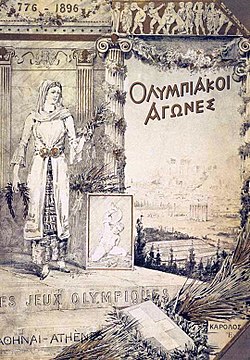
A long-held desire to revive the Olympic tradition came to fruition at the Olympics held in Athens in 1896, reconnecting the modern world with the ancient games' legacy.
Image source: 1896 Summer Olympics
1994
% completado
In 1994, archaeologists discovered a bronze plaque inscribed with the victors of the combative events hailing from the Greek mainland and Asia Minor, providing evidence of the games' late survival.
200 BC - 101 BC
% completado
Despite Greece coming under Roman control in the 2nd century BC, the Olympic Games continued to be celebrated, demonstrating their enduring cultural importance even under foreign domination.
200 BC - 101 BC
% completado
Greece came under Roman rule in the 2nd century BC, beginning a new chapter in the history of the Greek world and its panhellenic institutions, including the Olympic Games.
Image source: Greece in the Roman era
101 AD - 200 AD
% completado
The renaissance of the Olympic games endured for most of the second century, a period of renewed vitality and imperial patronage under Rome's Philhellenic emperors.
117 AD - 138 AD
% completado
In the first half of the second century, the Philhellenic emperor Hadrian oversaw a new and successful phase in the history of the games, showing strong support for Greek culture and athletics.
Image source: Hadrian
138 AD - 161 AD
% completado
Alongside Hadrian, the Philhellenic emperor Antoninus Pius oversaw a new and successful phase in the history of the Olympic games during the first half of the second century AD.
Image source: Antoninus Pius
150 AD
% completado
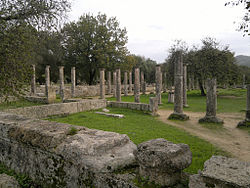
By the mid-second century AD, the site's water supply and sanitation were finally improved after nearly a thousand years, greatly enhancing conditions at the sanctuary of Olympia.
Image source: Olympia, Greece
Or browse the full history timeline directory, with more than 2,000 topics.
This Ancient Olympic Games timeline was generated with the help of AI, using information found on the internet.
We work hard to keep these timelines accurate, but mistakes do get through. If you spot one, email us at [email protected] and we'll fix it for future visitors.
Generate yours with AI or build it from scratch, for free.
Export your timeline, add your own events, edit or remove AI-generated events, and much more
No credit card required.
Cancel anytime.
Cancel anytime.
You can create an unlimited number of timelines with up to 10 events on each one, customize how they look, export them to PDF, PNG, PowerPoint, CSV, and Excel, and share them with a link. Paid plans raise the event limit and add features like spreadsheet imports and collaborators.
Yes. You can cancel your subscription from your account page at any time, and you will not be charged again. Your subscription stays active for the rest of the period you already paid for.
Yes. We will email you a reminder before the annual renewal, and we will also email you a receipt.
Yes. You can email us within 15 days of any payment, and we will issue you a full refund.
Check out our pricing docs or send us an email anytime: [email protected].