-
Use Cases
-
Resources
-
Pricing
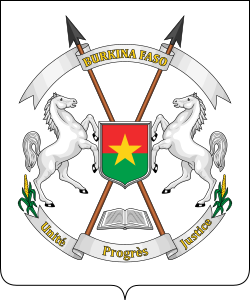
Burkina Faso, a landlocked West African nation, has a rich history spanning ancient Mossi kingdoms that emerged around the 11th century, French colonial rule as Upper Volta from 1919, independence in 1960 under Maurice Yaméogo, and transformative events including Thomas Sankara's revolutionary government (1983-1987), after which the country was renamed Burkina Faso in 1984. The nation has experienced repeated coups, democratic transitions, and ongoing struggles with jihadist insurgency since 2015. More Less
300 CE - 1300 CE
% complete
Recent archaeological discoveries at Bura in southwest Niger and in adjacent southwest Burkina Faso have documented the existence of the iron-age Bura culture from the 3rd century to the 13th century, known especially for its distinctive terracotta artifacts.
Image source: Bura culture
1100 CE
% complete
From medieval times until the end of the 19th century, the central region of present-day Burkina Faso was ruled by the Mossi people, descendants of warriors of the Dagomba people of present-day Ghana, who mixed with Mandé and other local peoples in the 11th century.
Image source: Mossi people
1400 CE - 1700 CE
% complete
Loropéni is an ancient stone ruin which was linked to the gold trade between the 14th and 17th centuries, serving as a fortified settlement connected to trans-Saharan commerce routes.
Image source: Ruins of Loropéni
1896
% complete
The French arrived and claimed the area in 1896, beginning the colonization of the territory. Mossi resistance to French rule persisted for several years after this initial claim.
Image source: French Upper Volta
1901
% complete
Mossi resistance to French colonization ended only with the capture of their capital, Ouagadougou, in 1901, consolidating French control over the region.
Image source: Ouagadougou
1919
% complete
In 1919, certain provinces from Ivory Coast were united into the colony of French Upper Volta within the French West Africa federation.
1932
% complete
In 1932, the new colony was split up for economic reasons, its territories being divided among neighboring French colonies such as Ivory Coast and Sudan.
Image source: Republic of Upper Volta
1937
% complete
The former colony was reconstituted in 1937 as an administrative division called the Upper Coast (Haute Côte), a precursor to the later restoration of Upper Volta.
Sep 4, 1947
% complete
After World War II, the Mossi actively pressured the French for separate territorial status, and on September 4, 1947, Upper Volta became a French West African territory again in its own right.
Jul 23, 1956
% complete
A revision in the organization of French Overseas Territories began with the passage of the Basic Law (Loi Cadre) of July 23, 1956, which laid groundwork for greater territorial autonomy.
Image source: Gaston Defferre
1957
% complete
This act was followed by reorganizational measures approved by the French parliament early in 1957 that ensured a large degree of self-government for individual territories.
Dec 11, 1958
% complete
Upper Volta became an autonomous republic in the French community on December 11, 1958, a major step toward full independence.
Jul 11, 1960
% complete
On July 11, 1960, France agreed to Upper Volta becoming fully independent, clearing the way for the declaration of independence weeks later.
Image source: History of Burkina Faso
Aug 5, 1960
% complete
The Republic of Upper Volta declared independence on August 5, 1960. The 1960 constitution provided for election by universal suffrage of a president and a national assembly for 5-year terms.
Jan 3, 1966
% complete
The government lasted until 1966 when—after much unrest including mass demonstrations and strikes by students, labor unions, and civil servants—the military intervened and deposed President Maurice Yaméogo in the 1966 Upper Voltan coup d'état.
Jun 14, 1970
% complete
After the army had remained in power for four years, on June 14, 1970, Voltans ratified a new constitution that established a 4-year transition period toward complete civilian rule.
1973
% complete
President Lamizana faced a major crisis in the form of the Sahel drought and was sent in 1973 to the UN and the US in order to secure aid for the stricken country.
Image source: Sangoulé Lamizana
1977 - 1978
% complete
After conflict over the 1970 constitution, a new constitution was written and approved in 1977, and Lamizana was reelected by open elections in 1978.
1980
% complete
Colonel Zerbo established the Military Committee of Recovery for National Progress as the supreme governmental authority, thus eradicating the 1977 constitution.
Nov 25, 1980
% complete
Lamizana's government faced problems with the country's traditionally powerful trade unions, and on November 25, 1980, Colonel Saye Zerbo overthrew President Lamizana in a bloodless coup.
Nov 7, 1982
% complete
Colonel Zerbo also encountered resistance from trade unions and was overthrown two years later, on November 7, 1982, by Major Dr. Jean-Baptiste Ouédraogo.
Jan 1983
% complete
The leader of the leftists, Captain Thomas Sankara, was appointed prime minister in January 1983, but was subsequently arrested amid political tensions within the government.
Image source: Thomas Sankara
Aug 4, 1983
% complete
Efforts to free Sankara, directed by Captain Blaise Compaoré, resulted in a military coup d'état on August 4, 1983, bringing Sankara to power as president.
Aug 2, 1984
% complete
On August 2, 1984, on President Sankara's initiative, the country's name was changed from Upper Volta to Burkina Faso, meaning 'land of the upright/honest people'.
Image source: Burkina Faso
Dec 25, 1985 - Dec 30, 1985
% complete
On Christmas Day 1985, tensions with Mali over the mineral-rich Agacher Strip erupted in a war that lasted five days and killed about 100 people.
Image source: Agacher Strip War
Oct 15, 1987
% complete
On October 15, 1987, Thomas Sankara was assassinated in a coup which brought his former ally, Captain Blaise Compaoré, to power.
Image source: 1987 Burkina Faso coup d'état
Jun 1989
% complete
As part of a much-discussed political 'opening' process, several political organizations, three of them non-Marxist, were accepted under an umbrella political organization created in June 1989 by the Popular Front.
Image source: Blaise Compaoré
Sep 18, 1989
% complete
On September 18, 1989, while Compaoré was returning from a two-week trip to Asia, Lengani and Zongo were accused of plotting to overthrow the Popular Front.
Image source: Popular Front (Burkina Faso)
Dec 23, 1989
% complete
On December 23, 1989, a presidential security detail arrested about 30 civilians and military personnel accused of plotting a coup in collaboration with the Burkinabé external opposition.
Jun 2, 1991
% complete
Burkina Faso adopted a new constitution on June 2, 1991, establishing the framework for multi-party democracy under Compaoré's leadership.
2005
% complete
In 2005, Compaoré was elected to his third term as president, extending his long hold on power begun after the 1987 coup.
Image source: 2005 Burkinabé presidential election
Nov 2010
% complete
In November 2010, President Compaoré was re-elected for a fourth straight term, despite growing opposition to his prolonged rule.
Feb 2011 - Apr 2011
% complete
In February 2011, the death of a schoolboy provoked an uprising in the entire country, lasting through April 2011, which was coupled with a military mutiny and a strike of the magistrates.
Jun 2014
% complete
In June 2014, Compaoré's ruling party, the CDP, called on him to organise a referendum that would allow him to alter the constitution in order to seek re-election in 2015; otherwise he would be forced to step down due to term limits.
Image source: 2014 Burkina Faso uprising
Oct 30, 2014
% complete
On October 30, 2014, the National Assembly was scheduled to debate an amendment to the constitution which would have enabled Compaoré to stand for re-election in 2015, triggering mass protests that forced him to resign.
Nov 17, 2014
% complete
On November 17, 2014, a civilian, Michel Kafando, was chosen to replace Zida as transitional head of state, and he was sworn in on November 18.
Image source: Michel Kafando
Nov 19, 2014
% complete
Kafando appointed Lieutenant-Colonel Isaac Zida as Prime Minister of Burkina Faso on November 19, 2014, completing the transitional government.
Image source: Yacouba Isaac Zida
Jul 19, 2015
% complete
On July 19, 2015, amidst tensions between the military and Prime Minister Zida, Kafando stripped Zida of the defense portfolio and took over the portfolio himself.
Sep 16, 2015
% complete
Two days after a recommendation from the National Reconciliation and Reforms Commission to disband the Regiment of Presidential Security (RSP), members of the RSP detained President Kafando and Prime Minister Zida, installing the National Council for Democracy with Gilbert Diendéré as its chairman.
Oct 13, 2015
% complete
On October 13, 2015, it was announced that general elections would be held on November 29, 2015, restoring the path toward civilian democratic rule.
Image source: 2015 Burkinabè general election
Dec 29, 2015
% complete
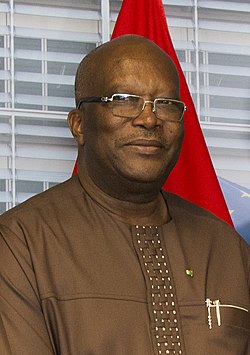
Roch Marc Christian Kaboré was sworn in as president on December 29, 2015, following the successful general elections, ending the turbulent transition period.
Image source: Roch Marc Christian Kaboré
2016 - 2018
% complete
The country experienced terrorist attacks in its capital in 2016, 2017, and 2018, prompting several governments to warn citizens not to travel into the northern part of the country and into several provinces in the East Region as Burkina Faso mobilized resources to counter terrorist threats.
Image source: Terrorism in Burkina Faso
Jan 7, 2016
% complete
On January 7, 2016, President Kaboré appointed Paul Kaba Thieba as Prime Minister of Burkina Faso.
Image source: Paul Kaba Thieba
2020
% complete
In the 2020 general election, President Roch Marc Christian Kaboré was re-elected, though insecurity continued to worsen across much of the country.
Image source: 2020 Burkinabè general election
Jan 24, 2022
% complete
On January 24, 2022, President Roch Kaboré was ousted in a military coup led by Lieutenant-Colonel Paul-Henri Sandaogo Damiba, driven largely by frustration over the government's failure to contain jihadist violence.
Image source: January 2022 Burkina Faso coup d'état
Sep 30, 2022
% complete
On September 30, 2022, the second military coup of the year took place and Damiba was ousted over his inability to deal with an Islamist insurgency.
Image source: September 2022 Burkina Faso coup d'état
Oct 6, 2022
% complete
On October 6, 2022, Captain Ibrahim Traore was officially appointed as president of Burkina Faso, becoming one of the world's youngest heads of state.
Image source: Ibrahim Traoré
Or browse the full history timeline directory, with more than 2,000 topics.
This History of Burkina Faso timeline was generated with the help of AI, using information found on the internet.
We work hard to keep these timelines accurate, but mistakes do get through. If you spot one, email us at [email protected] and we'll fix it for future visitors.
Generate yours with AI or build it from scratch, for free.
Export your timeline, add your own events, edit or remove AI-generated events, and much more
No credit card required.
Cancel anytime.
Cancel anytime.
You can create an unlimited number of timelines with up to 10 events on each one, customize how they look, export them to PDF, PNG, PowerPoint, CSV, and Excel, and share them with a link. Paid plans raise the event limit and add features like spreadsheet imports and collaborators.
Yes. You can cancel your subscription from your account page at any time, and you will not be charged again. Your subscription stays active for the rest of the period you already paid for.
Yes. We will email you a reminder before the annual renewal, and we will also email you a receipt.
Yes. You can email us within 15 days of any payment, and we will issue you a full refund.
Check out our pricing docs or send us an email anytime: [email protected].