-
Use Cases
-
Resources
-
Pricing
Cryptography is the practice of securing communication through codes and ciphers so that only intended recipients can read a message. Its history spans thousands of years, beginning with simple substitution ciphers used by ancient civilizations such as Egypt, Greece, and Rome. Over time, cryptography evolved from manual techniques like the Caesar cipher and polyalphabetic Vigenère cipher to mechanical devices such as the Enigma machine during World War II. The 20th century brought revolutionary advances with computer-based encryption, the invention of public-key cryptography (RSA), and standards like AES. Today, cryptography underpins digital security worldwide, protecting everything from online banking to private messaging, while researchers look ahead to quantum-resistant algorithms. More Less
800 AD - 1100 AD
% complete
In early medieval England between the years 800–1100, substitution ciphers were frequently used by scribes as a playful and clever way to encipher notes, solutions to riddles, and colophons.
1000 AD - 1300 AD
% complete
Later commentaries on the Kama Sutra offer detailed instructions for substitution ciphers, but these were composed between the tenth and thirteenth centuries AD.
1187 AD - 1268 AD
% complete
An important contribution of Ibn Adlan (1187–1268) was on sample size for use of frequency analysis, advancing the science of cryptanalysis in the medieval Islamic world.
1312 AD - 1361 AD
% complete
Information about cryptology was attributed to Ibn al-Durayhim who lived from AD 1312 to 1361, but whose writings on cryptography have been lost.
1355 AD - 1418 AD
% complete
Ahmad al-Qalqashandi (AD 1355–1418) wrote the Subh al-a 'sha, a 14-volume encyclopedia which included a section on cryptology, preserving important cryptographic knowledge.
Image source: Al-Qalqashandi
1467 AD
% complete
The polyalphabetic cipher was most clearly explained by Leon Battista Alberti around AD 1467, for which he was called the 'father of Western cryptology'.
Image source: Leon Battista Alberti
1510 AD
% complete
Cryptography in Japan seems not to have been used until about 1510, and advanced techniques were not known until after the opening of the country to the West beginning in the 1860s.
1553 AD
% complete
Giovan Battista Bellaso in 1553 first described the cipher that would become known in the 19th century as the Vigenère cipher, misattributed to Blaise de Vigenère.
Image source: Giovan Battista Bellaso
1600 AD
% complete
The chief cryptographer of King Louis XIV of France was Antoine Rossignol; he and his family created what is known as the Great Cipher because it remained unsolved from its initial use until 1890.
Image source: Rossignols
1880 AD - 1900 AD
% complete
Understanding of cryptography at this time typically consisted of hard-won rules of thumb; see, for example, Auguste Kerckhoffs' cryptographic writings in the latter 19th century.
Image source: Kerckhoffs's principle
1890 AD
% complete
The Great Cipher remained unsolved from its initial use until 1890, when French military cryptanalyst Étienne Bazeries finally solved it.
Image source: Étienne Bazeries
1900 AD
% complete
An encrypted message from the time of the Man in the Iron Mask (decrypted just prior to 1900 by Étienne Bazeries) has shed some, regrettably non-definitive, light on the identity of that real, if legendary and unfortunate, prisoner.
Image source: Man in the Iron Mask
1917 AD
% complete
In 1917, Gilbert Vernam proposed a teleprinter cipher in which a previously prepared key, kept on paper tape, is combined character by character with the plaintext message to produce the cyphertext.
Image source: Gilbert Vernam
1949 AD
% complete
This article was written in 1945 and was eventually published in the Bell System Technical Journal in 1949, laying theoretical foundations for modern cryptography.
Image source: Claude Shannon
1960 AD - 1974 AD
% complete
Various classified papers were written at GCHQ during the 1960s and 1970s which eventually led to schemes essentially identical to RSA encryption and to Diffie–Hellman key exchange in 1973 and 1974.
Image source: GCHQ
1976 AD
% complete
Regardless of DES' inherent quality, the DES key size (56-bits) was thought to be too small by some even in 1976, perhaps most publicly by Whitfield Diffie.
Image source: Data Encryption Standard
1976 AD
% complete
The second development, in 1976, was perhaps even more important, for it fundamentally changed the way cryptosystems might work. Asymmetric key cryptography and Diffie–Hellman key exchange were publicly announced by Diffie and Hellman in 1976.
Image source: Diffie–Hellman key exchange
1977 AD
% complete
The best known of the public key / private key algorithms, usually called the RSA algorithm, was invented by Ron Rivest, Adi Shamir and Len Adelman in 1977; all seem to have been independently developed at a UK intelligence agency before the public announcement.
Image source: RSA (cryptosystem)
Jan 1977
% complete
After advice and modification by the NSA, acting behind the scenes, DES was adopted and published as a Federal Information Processing Standard Publication in 1977 (currently at FIPS 46-3). It had earlier appeared in the Federal Register on 17 March 1975.
1990 AD
% complete
Beginning around 1990, the use of the Internet for commercial purposes and the introduction of commercial transactions over the Internet called for a widespread standard for encryption.
1991 AD
% complete
He wrote and then in 1991 released PGP (Pretty Good Privacy), a very high quality crypto system that brought strong encryption to the general public.
1996 AD
% complete
Until 1996 export from the U.S. of strong encryption technology was heavily restricted, shaping the global availability of cryptographic tools.
Image source: Export of cryptography from the United States
1997 AD
% complete
DES' 56-bit key-size has been shown insufficient against brute force attacks; one such attack, undertaken by the cyber civil-rights group Electronic Frontier Foundation in 1997, succeeded in 56 hours, rendering straight DES insecure for new designs.
1998 AD
% complete
PGP even eventually became an open Internet standard (RFC 2440 or OpenPGP), cementing its role in widespread encrypted communications.
2001 AD
% complete
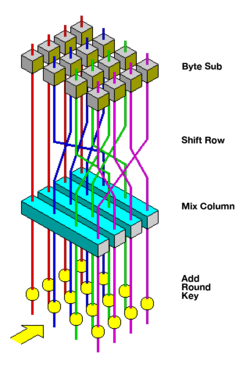
The aging DES was officially replaced by the Advanced Encryption Standard (AES) in 2001 when NIST announced FIPS 197.
Image source: Advanced Encryption Standard
2004 AD
% complete
As recently as 2004, former FBI Director Louis Freeh, testifying before the 9/11 Commission, called for new laws against public use of encryption.
Image source: Louis Freeh
1917 AD
% complete
Cryptography, and its misuse, were involved in the execution of Mata Hari and in Dreyfus' conviction and imprisonment, both in the early 20th century.
Image source: Mata Hari
1919 AD
% complete
The German Foreign Office began to use the one-time pad in 1919; some of this traffic was read in World War II partly as the result of recovery of key material in South America discarded without sufficient care by a German courier.
Image source: One-time pad
Dec 1932
% complete
Mathematician Marian Rejewski, at Poland's Cipher Bureau, in December 1932 deduced the detailed structure of the German Army Enigma, using mathematics and limited documentation supplied by Captain Gustave Bertrand of French military intelligence acquired from a German clerk.
Image source: Marian Rejewski
Jul 25, 1939
% complete
As the Poles' resources became strained by German changes and war loomed, the Cipher Bureau, on the Polish General Staff's instructions, on 25 July 1939 at Warsaw initiated French and British intelligence representatives into the secrets of Enigma decryption.
Sep 17, 1939
% complete
Soon after the invasion of Poland by Germany on 1 September 1939, key Cipher Bureau personnel were evacuated southeastward; on 17 September, as the Soviet Union attacked Poland from the East, they crossed into Romania.
Image source: Invasion of Poland
1940 AD
% complete
A US Army group, the SIS, managed to break the highest security Japanese diplomatic cipher system (an electromechanical stepping switch machine called Purple by the Americans) in 1940, before the attack on Pearl Harbor.
Image source: Type B Cipher Machine
Jun 1943
% complete
It was only Ultra intelligence that finally persuaded the admiralty to change their codes in June 1943.
Image source: Ultra (cryptography)
Apr 19, 1945
% complete
At the end of the War, on 19 April 1945, Britain's highest level civilian and military officials were told that they could never reveal that the German Enigma cipher had been broken because it would give the defeated enemy the chance to say they 'were not well and fairly beaten'.
Image source: Cryptanalysis of the Enigma
1957 AD
% complete
The VIC cipher (used at least until 1957 in connection with Rudolf Abel's NY spy ring) was a very complex hand cipher, claimed to be the most complicated known to have been used by the Soviets, according to David Kahn.
Image source: VIC cipher
Or browse the full history timeline directory, with more than 2,000 topics.
This History of Cryptography timeline was generated with the help of AI, using information found on the internet.
We work hard to keep these timelines accurate, but mistakes do get through. If you spot one, email us at [email protected] and we'll fix it for future visitors.
Generate yours with AI or build it from scratch, for free.
Export your timeline, add your own events, edit or remove AI-generated events, and much more
No credit card required.
Cancel anytime.
Cancel anytime.
You can create an unlimited number of timelines with up to 10 events on each one, customize how they look, export them to PDF, PNG, PowerPoint, CSV, and Excel, and share them with a link. Paid plans raise the event limit and add features like spreadsheet imports and collaborators.
Yes. You can cancel your subscription from your account page at any time, and you will not be charged again. Your subscription stays active for the rest of the period you already paid for.
Yes. We will email you a reminder before the annual renewal, and we will also email you a receipt.
Yes. You can email us within 15 days of any payment, and we will issue you a full refund.
Check out our pricing docs or send us an email anytime: [email protected].