-
Use Cases
-
Resources
-
Pricing
The history of cybersecurity traces the evolution of efforts to protect computer systems and data from unauthorized access, beginning with early academic research in the 1970s, through the rise of viruses, worms, and hacking in the 1980s and 1990s, to today's landscape of sophisticated cybercrime, state-sponsored attacks, ransomware, and advanced defenses like encryption, zero-trust architecture, and artificial intelligence. More Less
1939 - 1945
% complete
Germany used the Enigma cipher machine to encrypt military communications during World War II. Allied codebreakers at Bletchley Park, led by Alan Turing, successfully decrypted Enigma messages, laying early foundations for modern cryptography and computing-based security.
Image source: Cryptanalysis of the Enigma
Jul 1948
% complete
Claude Shannon published his landmark paper establishing information theory, providing mathematical tools for understanding data, entropy, and secure communication that would underpin later cryptographic research.
Image source: A Mathematical Theory of Communication
1961
% complete
Students at MIT's Tech Model Railroad Club popularized the term 'hacking' to describe clever technical problem-solving. This exploratory culture later evolved into both ethical security research and malicious intrusion activity.
Image source: Hacker culture
Oct 29, 1969
% complete
The first message was sent over ARPANET, a precursor to the internet. As computer networks grew, so did concerns about protecting connected systems from unauthorized access, sparking the field of network security.
Image source: ARPANET
1970
% complete
Computer scientist Willis Ware authored a RAND Corporation report warning about vulnerabilities in multi-user computer systems and the emerging threats of unauthorized access, one of the first formal analyses of computer security risks.
Image source: Willis Ware
Nov 1976
% complete
Whitfield Diffie and Martin Hellman introduced public-key cryptography concepts, revolutionizing the field by enabling secure communication between parties who had never shared a secret key beforehand.
Image source: Diffie–Hellman key exchange
Nov 16, 1976
% complete
The US National Bureau of Standards adopted DES as the federal encryption standard. Developed with IBM and based on the Lucifer cipher, DES standardized symmetric encryption for commercial and government use for decades.
Image source: Data Encryption Standard
1977
% complete
Ron Rivest, Adi Shamir, and Leonard Adleman developed the RSA algorithm, the first practical public-key cryptosystem widely used for secure data transmission and digital signatures.
Image source: RSA (cryptosystem)
1971
% complete
Bob Thomas created Creeper, an experimental self-replicating program that moved between DEC PDP-10 computers on ARPANET displaying the message 'I'M THE CREEPER: CATCH ME IF YOU CAN.' The Reaper program was written to delete it, becoming the first antivirus software.
Image source: Creeper and Reaper
1982
% complete
Fifteen-year-old Richard Skrenta wrote Elk Cloner, which infected Apple II floppy disks and displayed a poem after every 50th boot. It spread among friends and is considered one of the first viruses to propagate outside its home environment.
Image source: Elk Cloner
Jan 1986
% complete
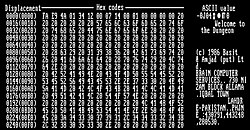
Two Pakistani brothers created Brain, a boot sector virus targeting IBM PCs, allegedly to track pirated copies of their software. It spread globally via floppy disks and became the first virus affecting MS-DOS computers.
Image source: Brain (computer virus)
Nov 2, 1988
% complete
Robert Tappan Morris released a worm from MIT intended to gauge the size of the internet, but a coding error caused it to replicate uncontrollably, infecting roughly 10% of internet-connected machines. It led to the first conviction under the Computer Fraud and Abuse Act.
Image source: Morris worm
Feb 1991
% complete
The Michelangelo boot sector virus, designed to activate on March 6, triggered widespread media panic and massive antivirus software purchases. Actual infections proved far lower than predicted, but the event raised public awareness of malware.
Mar 26, 1999
% complete
The Melissa virus propagated through Microsoft Word documents attached to emails, automatically mailing itself to contacts in victims' address books. It overwhelmed email servers worldwide and marked the rise of email-borne malware.
May 4, 2000
% complete
Originating in the Philippines, the ILOVEYOU worm arrived as an email attachment disguised as a love letter. It infected tens of millions of machines within days, causing billions of dollars in damage and highlighting social engineering's power.
Image source: ILOVEYOU
Nov 1988
% complete
In response to the Morris worm, DARPA established the Computer Emergency Response Team Coordination Center at Carnegie Mellon University to coordinate responses to cybersecurity incidents, institutionalizing incident response.
Image source: CERT Coordination Center
Feb 12, 2014
% complete
NIST released its voluntary Cybersecurity Framework to help organizations identify, protect, detect, respond to, and recover from cyber threats. It became a de facto standard adopted across industries worldwide.
Image source: NIST Cybersecurity Framework
May 25, 2018
% complete
The EU's GDPR imposed strict requirements on how organizations collect, store, and protect personal data, with fines up to 4% of global revenue. It transformed privacy and security practices globally and inspired similar laws elsewhere.
Image source: General Data Protection Regulation
Dec 13, 2020
% complete
Attackers inserted a backdoor into SolarWinds' Orion software updates, compromising thousands of organizations including multiple US federal agencies. The sophisticated espionage campaign highlighted the dangers of software supply chain vulnerabilities.
Image source: 2020 United States federal government data breach
May 7, 2021
% complete
The DarkSide ransomware group attacked Colonial Pipeline, forcing a shutdown of the largest fuel pipeline in the US and triggering fuel shortages along the East Coast. The incident prompted executive action on critical infrastructure cybersecurity.
Image source: Colonial Pipeline ransomware attack
1994
% complete
Russian hacker Vladimir Levin transferred approximately $10 million from Citibank accounts using stolen credentials, one of the first high-profile cases of online financial theft that exposed banking vulnerabilities.
Feb 15, 1995
% complete
The FBI arrested Kevin Mitnick, one of the most wanted computer criminals in US history, for breaking into dozens of corporate networks. His case popularized concerns about social engineering and inspired reforms in security awareness training.
Image source: Kevin Mitnick
Feb 2000
% complete
Canadian teenager Michael Calce, known as Mafiaboy, launched distributed denial-of-service attacks that took down Yahoo!, Amazon, CNN, eBay, and other major sites, demonstrating the vulnerability of even the largest web platforms.
Jul 2001
% complete
The Code Red worm exploited a buffer overflow flaw in Microsoft Internet Information Services, infecting hundreds of thousands of servers and defacing websites, including an attempted attack on the White House website.
Image source: Code Red (computer worm)
Jan 25, 2003
% complete
SQL Slammer infected most vulnerable SQL Server machines within minutes, doubling in size every few seconds. It disrupted airline flights, ATM networks, and emergency services, underscoring the need for rapid patching.
Image source: SQL Slammer
2010
% complete
Stuxnet, a sophisticated worm believed to be a joint US-Israeli operation, targeted Siemens control systems at Iran's Natanz uranium enrichment facility, physically destroying centrifuges and marking the dawn of cyber warfare against industrial infrastructure.
Image source: Stuxnet
Nov 24, 2014
% complete
Attackers breached Sony Pictures Entertainment, leaking unreleased films, emails, and employee data ahead of the release of 'The Interview.' The US government attributed the attack to North Korea, escalating state-sponsored cyber tensions.
Image source: 2014 Sony Pictures hack
Sep 22, 2016
% complete
Yahoo revealed that all 3 billion user accounts were compromised in breaches dating back to 2013–2014, the largest known data breach in history, which reduced the company's sale price to Verizon and reshaped breach disclosure practices.
Image source: Yahoo data breaches
May 2017 - Jul 2017
% complete
Attackers exploited an unpatched Apache Struts vulnerability to steal Social Security numbers, birth dates, and other sensitive data from credit bureau Equifax. The breach prompted congressional hearings and a settlement exceeding $650 million.
May 12, 2017
% complete
WannaCry exploited an EternalBlue Windows vulnerability to encrypt files on over 200,000 computers across 150 countries, crippling hospitals, railways, and businesses. The UK's National Health Service was among the hardest hit.
Image source: WannaCry ransomware attack
Or browse the full history timeline directory, with more than 2,000 topics.
This History of Cybersecurity timeline was generated with the help of AI, using information found on the internet.
We work hard to keep these timelines accurate, but mistakes do get through. If you spot one, email us at [email protected] and we'll fix it for future visitors.
Generate yours with AI or build it from scratch, for free.
Export your timeline, add your own events, edit or remove AI-generated events, and much more
No credit card required.
Cancel anytime.
Cancel anytime.
You can create an unlimited number of timelines with up to 10 events on each one, customize how they look, export them to PDF, PNG, PowerPoint, CSV, and Excel, and share them with a link. Paid plans raise the event limit and add features like spreadsheet imports and collaborators.
Yes. You can cancel your subscription from your account page at any time, and you will not be charged again. Your subscription stays active for the rest of the period you already paid for.
Yes. We will email you a reminder before the annual renewal, and we will also email you a receipt.
Yes. You can email us within 15 days of any payment, and we will issue you a full refund.
Check out our pricing docs or send us an email anytime: [email protected].