-
Use Cases
-
Resources
-
Pricing
1869
% complete
The first fictional depiction of a satellite being launched into orbit was a short story by Edward Everett Hale titled "The Brick Moon", imagining a human-made satellite placed into orbit around the Earth.
Image source: The Brick Moon
1879
% complete
The idea of an artificial satellite surfaced again in Jules Verne's novel "The Begum's Fortune", continuing the literary tradition of imagining objects orbiting the Earth decades before technology made it possible.
Image source: The Begum's Fortune
1903
% complete
In 1903, Konstantin Tsiolkovsky (1857–1935) published "Exploring Space Using Jet Propulsion Devices", which was the first academic treatise on the use of rocketry to launch spacecraft, laying theoretical groundwork for spaceflight.
Image source: Konstantin Tsiolkovsky

1928
% complete
Herman Potočnik explored the idea of using orbiting spacecraft for detailed peaceful and military observation of the ground in his 1928 book, "The Problem of Space Travel".
Image source: Herman Potočnik
1945
% complete
In a 1945 Wireless World article, English science fiction writer Arthur C. Clarke described the concept of using artificial satellites for global communications, anticipating the geostationary communication satellites of later decades.
Image source: Arthur C. Clarke
1946
% complete
In 1946, American theoretical astrophysicist Lyman Spitzer proposed an orbiting space telescope, an idea that would eventually lead to observatories such as the Hubble Space Telescope.
Image source: Lyman Spitzer
May 1946
% complete
In May 1946, the United States Air Force's Project RAND released the Preliminary Design of an Experimental World-Circling Spaceship, stating that a satellite vehicle with appropriate instrumentation could be one of the most potent scientific tools of the Twentieth Century. The United States had been considering launching orbital satellites since 1945 under the Bureau of Aeronautics of the United States Navy.
Image source: RAND Corporation
Feb 1954
% complete
In February 1954, Project RAND released "Scientific Uses for a Satellite Vehicle", which expanded on potential scientific uses for satellite vehicles and helped build momentum for an American satellite program.
Jan 1955
% complete
In early 1955, after being pressured by the American Rocket Society, the National Science Foundation, and the International Geophysical Year, the Army and Navy worked on Project Orbiter with two competing programs to develop an American satellite.
Image source: Project Orbiter
Jun 1955
% complete
Following the February 1954 report on scientific uses for satellite vehicles, Project RAND released "The Scientific Use of an Artificial Satellite" in June 1955, further detailing how satellites could serve science.
Jul 29, 1955
% complete
In the context of activities planned for the International Geophysical Year (1957–1958), the White House announced on July 29, 1955 that the United States intended to launch satellites by the spring of 1958.
Image source: International Geophysical Year
Jul 31, 1955
% complete
On July 31, 1955, just two days after the American announcement, the Soviet Union declared its intention to launch a satellite by the fall of 1957, setting up the orbital race between the two superpowers.
Image source: List of spacecraft called Sputnik
Oct 4, 1957
% complete
The first artificial satellite was Sputnik 1, launched by the Soviet Union on October 4, 1957 under the Sputnik program, with Sergei Korolev as chief designer. It shocked the world and inaugurated the space age.
Image source: Sputnik 1
Nov 3, 1957
% complete
Sputnik 2 was launched on November 3, 1957 and carried the first living passenger into orbit, a dog named Laika, demonstrating that living beings could survive launch and orbital flight.
Image source: Sputnik 2
Jan 31, 1958
% complete
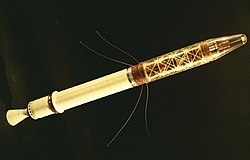
Explorer 1 became the United States' first artificial satellite on January 31, 1958, answering Sputnik and leading to the discovery of the Van Allen radiation belts.
Image source: Explorer 1
Apr 1, 1960
% complete
The TIROS-1 spacecraft, launched on April 1, 1960 as part of NASA's Television Infrared Observation Satellite program, sent back the first television footage of weather patterns to be taken from space, founding weather satellite observation.
Image source: TIROS-1
Jun 1961
% complete
In June 1961, three and a half years after the launch of Sputnik 1, the United States Space Surveillance Network cataloged 115 Earth-orbiting satellites, showing how quickly orbital activity had grown.
Image source: United States Space Surveillance Network
Dec 15, 1964
% complete
The first Italian satellite, San Marco 1, was launched on December 15, 1964 on a U.S. rocket, making Italy one of the earliest nations to place its own satellite into orbit.
Image source: San Marco 1
Nov 26, 1965
% complete
On November 26, 1965, the Astérix or A-1 satellite (initially conceptualized as FR.2) was put into orbit by a Diamant A rocket launched from the CIEES site at Hammaguir, Algeria, making France the third country to launch its own satellite with its own rocket.
Image source: Astérix (satellite)
1972
% complete
The first standardized satellite bus design was the HS-333 geosynchronous (GEO) communication satellite launched in 1972, pioneering reusable satellite platforms that reduced cost and development time.
Image source: HS-333
Jan 24, 1978
% complete
Some notable satellite failures have polluted and dispersed radioactive materials, including Kosmos 954, Kosmos 1402, and Transit 5-BN-3. Kosmos 954, a Soviet radar ocean reconnaissance satellite powered by a nuclear reactor, crashed over northern Canada in January 1978, spreading radioactive debris.
Image source: Kosmos 954
1997
% complete
Beginning in 1997, FreeFlyer became available as a commercial off-the-shelf software application for satellite mission analysis, design, and operations, supporting the growing satellite industry.
Jan 11, 2007
% complete
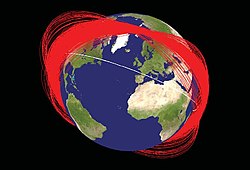
In 2007, the Chinese military shot down an aging weather satellite with a missile, demonstrating anti-satellite capability and creating a large cloud of orbital debris.
Image source: 2007 Chinese anti-satellite missile test
Feb 21, 2008
% complete
Following the Chinese test, the U.S. Navy shot down a defunct spy satellite in February 2008, intercepting the failing spacecraft before it reentered the atmosphere.
Image source: USA-193
Nov 18, 2015
% complete
On November 18, 2015, after two failed attempts, Russia successfully carried out a flight test of an anti-satellite missile known as Nudol, adding to the growing list of nations with anti-satellite capabilities.
Image source: A-235 anti-ballistic missile system
Mar 27, 2019
% complete
On March 27, 2019, India shot down a live test satellite at 300 km altitude in 3 minutes, becoming the fourth country to demonstrate the capability to destroy live satellites.
Image source: Mission Shakti
2018
% complete
As of 2018, about 90% of the satellites orbiting the Earth are in low Earth orbit or geostationary orbit; geostationary means the satellites stay still in the sky relative to a fixed point on the ground.
2020
% complete
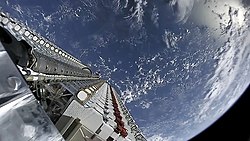
SpaceX Starlink satellites formed the first large satellite internet constellation to exceed 1000 active satellites on orbit in 2020. They are designed to be 100% demisable and burn up completely on atmospheric reentry at the end of their life or in the event of an early failure.
Image source: Starlink
Aug 2020
% complete
A report from the SATCON1 workshop in 2020 concluded that the effects of large satellite constellations can severely affect some astronomical research efforts, and it listed six ways to mitigate harm to astronomy.
Image source: Satellite constellation
2021
% complete
As of 2021, there are over 950 Earth observation satellites in orbit, with the largest number operated by Planet Labs, reflecting the rapid commercialization of remote sensing from space.
Image source: Earth observation satellite
2021
% complete
Japan's space agency (JAXA) and NASA have been working on a wooden satellite prototype called LingoSat for several years, and they sent the first wood samples to space in 2021 to test the material's resilience to space conditions.
Jun 2024 - Sep 2024
% complete
Japan's space agency (JAXA) and NASA plan to send a wooden satellite prototype called LingoSat into orbit in the summer of 2024, exploring sustainable materials for future spacecraft.
Jun 28, 2025
% complete
As of June 28, 2025, there are 12,952 satellites in the Earth's orbit, of which 8,530 belong to the United States, 1,559 to Russia, and 908 to China, illustrating the dramatic growth of orbital activity.
Image source: Satellite
Or browse the full history timeline directory, with more than 2,000 topics.
This History of Satellites timeline was generated with the help of AI, using information found on the internet.
We work hard to keep these timelines accurate, but mistakes do get through. If you spot one, email us at [email protected] and we'll fix it for future visitors.
Generate yours with AI or build it from scratch, for free.
Export your timeline, add your own events, edit or remove AI-generated events, and much more
No credit card required.
Cancel anytime.
Cancel anytime.
You can create an unlimited number of timelines with up to 10 events on each one, customize how they look, export them to PDF, PNG, PowerPoint, CSV, and Excel, and share them with a link. Paid plans raise the event limit and add features like spreadsheet imports and collaborators.
Yes. You can cancel your subscription from your account page at any time, and you will not be charged again. Your subscription stays active for the rest of the period you already paid for.
Yes. We will email you a reminder before the annual renewal, and we will also email you a receipt.
Yes. You can email us within 15 days of any payment, and we will issue you a full refund.
Check out our pricing docs or send us an email anytime: [email protected].